
Bodybalm – Alchemical Healing Powder for Long-Term Care
Bodybalm – Alchemical Healing Powder for Long-Term Care
Bodybalm is what healers boil when prayer is unavailable, magic is too costly, and the patient has not yet died.
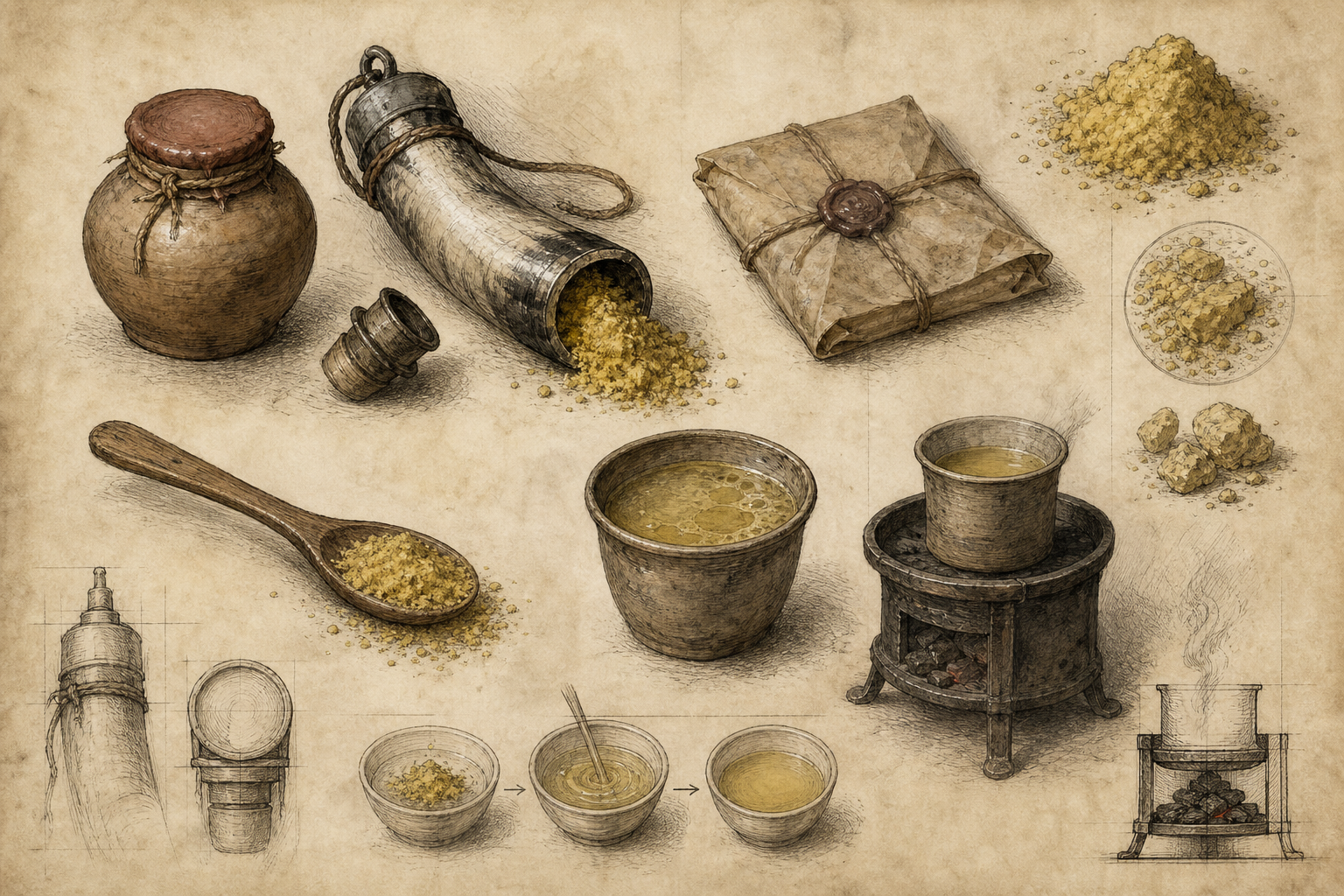
Bodybalm is a bitter yellow alchemical powder boiled into a medicinal drink. It does not heal damage or cure poison or disease by itself. Instead, it helps a trained healer provide long-term care, treat poison, or treat disease.
Carry Bodybalm when travelling far from temples, towns, or magical healing. It is most useful after the fight, when someone is poisoned, feverish, infected, or too weak to recover safely without care.
Overview
It is is a pungent yellow alchemical powder boiled into a bitter medicinal draught. It is used by apothecaries, battlefield surgeons, caravan healers, plague-house attendants, temple infirmaries, and anyone else forced to treat poison, fever, infection, and long recovery without the certainty of magic.
It is not a cure. Bodybalm does not seal wounds, purge venom, or drive disease from the blood by itself. It gives the attending healer a better chance to keep the patient alive through the slow hours when ordinary care still matters: boiling water, changing dressings, watching breath, forcing down fluids, cooling fevered skin, and deciding whether the patient can survive another night.
It belongs in the hard space between heroic adventure and human consequence. The fight is over. The wound was bound. The poison did not kill at once. Now someone has to work.
Physical Description
It is usually sold as a dry yellow powder in a sealed clay pot, horn tube, waxed packet, or small glass vial. Good Bodybalm has a sharp, sour, medicinal smell even before it touches water. Bad Bodybalm smells stale, dusty, or faintly sweet, which experienced healers distrust.
To prepare it, the powder is boiled in clean water, cooled, and given to the patient as a cloudy yellow draught. A thin oily skin forms on the surface. The taste is bitter, fatty, and difficult to forget.
Soldiers call it corpse-tea. Caravan guards call it yellow mercy. Apothecaries call it expensive.
Why Bodybalm Matters
Bodybalm matters because it gives nonmagical healing real weight. It lets a healer do something useful without pretending that medicine is the same as spellcasting.
In this world, healing magic exists, but it does not make suffering vanish from ordinary life. It is rare, costly, guarded by temples, bound to oaths, limited by distance, or already spent when the worst injuries arrive. Bodybalm is the thing used when no priest is coming, when the cleric has no power left, when the nearest shrine is three days downriver, or when the patient is too poor to be saved by anyone important.
It also makes triage playable. One dose can turn a scene into a decision: the poisoned scout, the feverish child, the wounded prisoner, the noble witness, the plague-house attendant who has already treated everyone else. Bodybalm is not dramatic because it glows. It is dramatic because it is not enough for everyone.
Edition Tabs
Bodybalm 5.5e / 2024
Bodybalm Pathfinder 1e / 3.5e
Bodybalm 5.5e / 2024
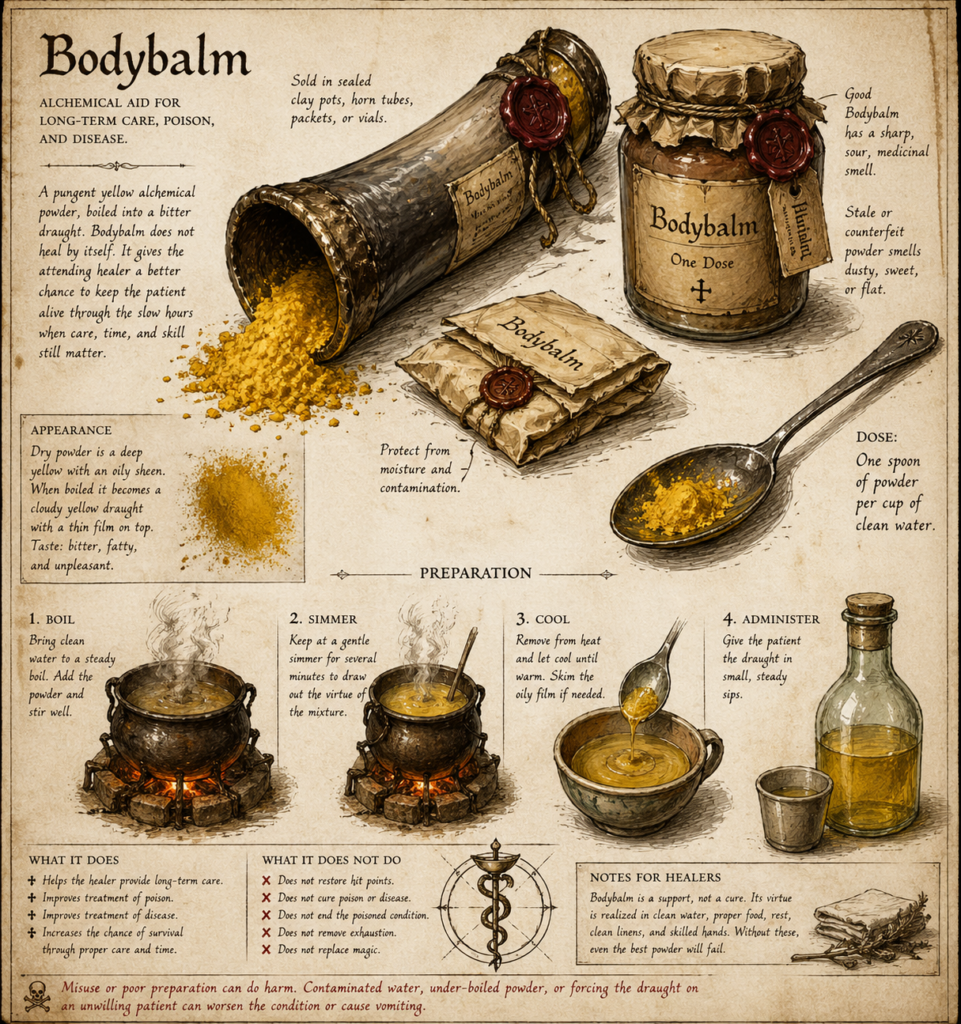
Adventuring Gear, Alchemical
Cost: 25 gp
Weight: Negligible
Use: 1 dose
Preparation: 10 minutes of boiling and cooling
Application: A creature must drink the prepared draught
When a dose of Bodybalm is boiled in water and given to a creature to drink, the attending healer gains advantage on Wisdom (Medicine) checks made for that creature for the next 24 hours, but only for the following tasks:
- providing long-term or extended care;
- treating poison;
- treating disease.
Bodybalm does not restore hit points, cure disease, neutralise poison, end the poisoned condition, remove exhaustion, or replace a spell or class feature.
A creature can benefit from only one dose of Bodybalm at a time. For most games, one dose per creature per 24 hours is the cleanest limit.
5.5e Adjudication Notes
Use Bodybalm when a Medicine check would already matter. It should improve care, not create a cure.
Good uses include helping a poisoned scout survive the night, supporting a feverish patient during travel, improving treatment in a field hospital, or giving a healer a better chance to manage disease during a dangerous rest.
Do not let Bodybalm become cheap lesser restoration. It should not automatically end poison, remove disease, erase exhaustion, or undo a monster’s venom. It helps the healer work. It does not make the patient safe.
Bodybalm Pathfinder 1e / 3.5e
Alchemical Tool
Price: 25 gp
Weight: —
Craft: Craft (alchemy) DC 25
When this pungent yellow powder is boiled in water and given to a creature to drink, it provides the attending healer a +5 alchemical bonus on Heal checks made for that creature when providing long-term care, treating poison, or treating disease.
The bonus applies to the healer, not the patient. Bodybalm does not cure poison or disease by itself, restore hit points directly, or replace magical healing.
A creature should not benefit from more than one dose at a time.
Orginal Source Adventurer’s Armory
How Bodybalm Is Used
Bodybalm belongs in scenes where the danger has slowed down but has not passed.
A scout bitten in a sewer is held beside a shuttered lamp while the party healer boils a dose in a dented cup. A poisoned courtier is kept awake through the night while an apothecary measures the draught by spoonfuls. A caravan surgeon saves the last packet for the traveller whose fever breaks badly on the third day from clean water.
The item works best when recovery is part of the adventure. The party may need clean water, fuel, shelter, privacy, time, a steady hand, or protection from enemies before the healer can even use it properly.
Bodybalm is not an exciting object in a pack. It becomes exciting when someone asks, “Who gets the dose?”
Failure, Risk, and Misuse
Bodybalm is unpleasant, and that should matter. A conscious patient may resist drinking it, especially if feverish, poisoned, delirious, frightened, or already nauseated.
Common problems include spilled doses, contaminated water, under-boiled powder, counterfeit yellow dust, vomiting, ruined supplies, and healers who mistake Bodybalm for a cure rather than a support.
A failed Heal or Medicine check should not always mean nothing happens. Better consequences include delayed recovery, another day of required rest, a worsening fever, the poison leaving temporary weakness, the disease spreading before it is contained, or the healer realising that ordinary care is no longer enough.
Value in the World
At 25 gp, Bodybalm is expensive for ordinary people and cheap for adventurers. That tension is useful.
A noble household may keep several doses in a locked medicine chest. A military surgeon may count remaining packets before deciding who receives proper care. A poor village may own one dose, bought years ago after a bad winter, and argue over whether this is finally the emergency it was saved for.
Bodybalm is commonest in cities, forts, mining camps, ports, plague districts, caravanserais, gladiatorial schools, and long-distance trade routes. It follows places where poison, infection, bad water, untreated wounds, and exhausted bodies are part of life.
The item also creates believable corruption. A quartermaster can reserve it for officers. A temple can charge too much for it. A false apothecary can sell yellow chalk to desperate families. A ruler can stockpile it while the poor die untreated outside the walls.
Trade, Craft, and Common Variants
Most variants differ by packaging and trustworthiness, not by stronger rules.
- Standard Bodybalm: The normal 25 gp dose, sold in a sealed pot, vial, tube, or waxed packet.
- Field-Packed Bodybalm: The same dose packed more securely for travel, rain, saddle bags, and military use. It may cost slightly more if stored in a waterproof tube or reinforced case, but it uses the same rules.
- Infirmary Jar: A larger sealed jar containing multiple standard doses, used by temples, military surgeons, plague houses, and apothecaries. This is bulk supply, not a stronger form.
- Counterfeit Bodybalm: Yellow flour, chalk, bitter herb dust, spoiled powder, or weak imitation alchemy. It provides no bonus and may make the patient vomit.
That is the full useful range. Bodybalm does not need luxury grades, superior versions, rare colours, or a ladder of mechanical upgrades. Its power is practical, narrow, and ugly.
Using Bodybalm in Your Game
Use Bodybalm to make aftermath matter.
It gives the party a reason to stop after a fight, find clean water, protect a healer, enter an infirmary, question an apothecary, search a battlefield surgeon’s kit, or spend money before an illness becomes fatal.
It also gives ordinary healers credibility. A village healer with Bodybalm is not a cleric, but she is not helpless. A plague-house attendant with three doses and twenty patients is not background colour; she is a moral problem. A battlefield surgeon with a locked chest of yellow powder may decide which soldiers are worth saving.
The best Bodybalm scenes are not about the item itself. They are about limited care under pressure.
Adventure and Worldbuilding Hooks
- The Last Dose: A remote village has one dose of Bodybalm left and three patients who need it: a poisoned hunter, a feverish child, and the only witness to a murder.
- The Yellow Counterfeit: Soldiers are dying after treatment with false Bodybalm. The fraud points to a corrupt quartermaster, a desperate apothecary, or someone deliberately weakening the army before a siege.
- The Locked Infirmary: A plague-house has Bodybalm but no safe way to distribute it. The healers are trapped inside, the crowd outside is turning violent, and the city guard wants the doors sealed.
- The Officer’s Chest: After a brutal battle, the army’s remaining Bodybalm is locked in the command tent for noble officers. The wounded common soldiers know it, and the camp is close to mutiny.
Historical Context
Bodybalm is a fantasy alchemical item, but it fits the medieval world of prepared remedies, apothecary practice, boiled medicinal drinks, poison treatments, and long bedside care. Its closest historical value is not that a single real powder worked exactly like Bodybalm, but that medieval treatment often relied on prepared mixtures administered under the care of someone who knew how and when to use them.
In this world, Bodybalm is an alchemical refinement of that tradition: a bitter medicinal draught that supports the healer’s craft rather than replacing it with magic.
For useful background, see the National Library of Medicine’s open-access edition of Further Notes on the Recipes from Medieval Welsh Medical Texts, which discusses medieval medical recipes, including drinkable preparations associated with poison and venom.
Keep this reference growing
If this page helped with your reading or game, you can support its upkeep or explore the curated books.
Explore the Bookshop — epics, classics and stories behind imagined worlds.