
Earth Age 04 · Eon XXXIII
The Age of Giants
Jurassic · c. 201.4–143.1 million years ago
Dinosaurs inherit a world emptied of many rivals. Sauropods turn landscapes into feeding grounds measured in miles, great theropods hunt beneath conifer canopies, pterosaurs cross widening seas, and marine reptiles make the oceans as monstrous as the land. Beneath that visible age, older powers endure—and new visitors arrive from the stars.
01 · When giants inherit the Earth
The world after the Triassic extinction
The Jurassic does not begin with the first giant animal, nor even with the first giant dinosaur. It begins with something more decisive: a reshaped world in which dinosaurian gigantism becomes widespread, diverse and ecologically dominant.
The extinction at the end of the Triassic removes many competitors. Dinosaurs survive and expand into the emptied territories. Long-necked herbivores grow larger and more numerous. Predatory theropods diversify alongside them. Armoured dinosaurs defend the forest floor. Pterosaurs remain the great visible vertebrates of the air, while ichthyosaurs, plesiosaurs, pliosaurs and marine crocodyliforms turn Jurassic seas into monster realms of their own.
Pangaea is also coming apart. Rift systems widen. The Atlantic begins to open. Laurasia and Gondwana become more distinct, coastlines multiply and shallow seas invade continental margins. The physical world creates new barriers, islands, wetlands, shorelines and inland basins; living things answer by becoming increasingly regional.
Sauropods, theropod hunters, armoured herbivores and small fleet-footed dinosaurs dominate an increasingly varied terrestrial world.
Ichthyosaurs, plesiosaurs, pliosaurs, marine crocodyliforms, ammonites and fish fill warm continental seas and open waters.
Pterosaurs cross cliffs, islands, lagoons and forests while feathered dinosaur lineages quietly approach avian form.
Conifers, cycads, ginkgos, ferns and horsetails shape the green world. Flowering plants do not yet dominate these landscapes.
Early Jurassic · c. 201.4–174.7 Ma
Rise of the Giants
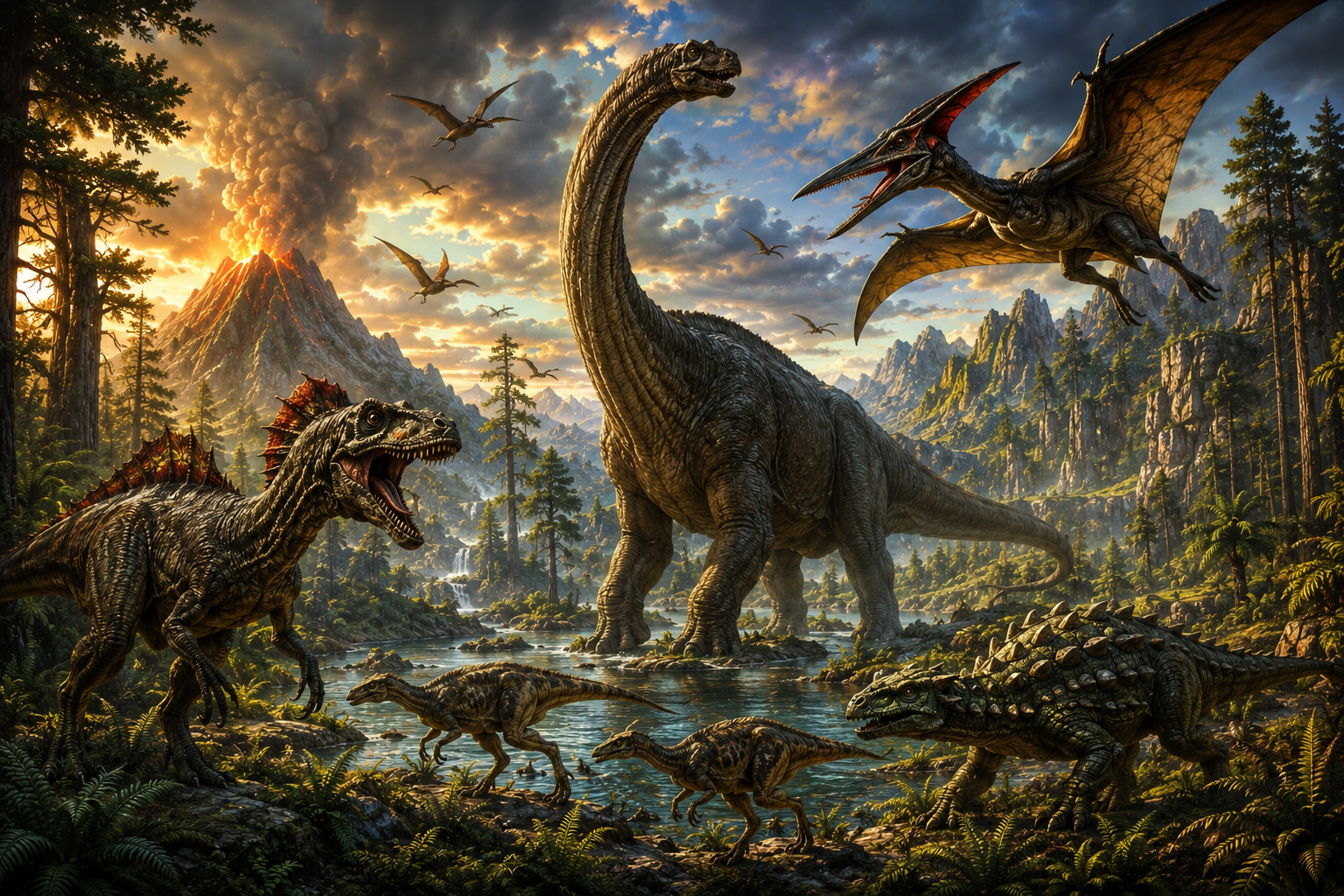
The opening Jurassic is a survivor’s world becoming an empire. After the Triassic–Jurassic extinction, many large reptilian competitors are gone. Dinosaurs move into ecological spaces that had been contested only a few million years earlier, and their diversity increases across the recovering supercontinent.
Predators beneath the new forests
Dilophosaurus is among the most imposing Early Jurassic hunters represented in the SpiralWorlds Bestiary. Crested, powerfully built and already far larger than the earliest dinosaurs, it patrols river margins and open woodland where smaller animals must cross exposed ground.
The herbivore world is changing just as dramatically. Long-necked sauropodomorphs and early sauropods move through broad feeding territories. Scelidosaurus carries heavy rows of bony armour, while smaller ornithischians occupy the undergrowth and margins. The dinosaur world is no longer defined by one body plan. It is becoming a system of giants, armour, speed and predation.
Monsters in the water
Offshore, the same transformation is visible at a different scale. Temnodontosaurus, a huge ichthyosaur with enormous eyes and a long tooth-lined snout, hunts fish, cephalopods and ammonites. Plesiosaurus and related long-necked marine reptiles work coastlines and shallow waters.
Above the cliffs and forest margins, Dimorphodon and other early pterosaurs occupy the air. They are not enormous late-Cretaceous sky giants. They are smaller, stranger and already well established—cliff nesters, fish takers and opportunistic hunters moving through a world with no birds in the modern sense.
c. 183 Ma · The Toarcian crisis
The recovering world overheats
The Early Jurassic is not one uninterrupted green ascent. Around 183 million years ago, a major carbon-cycle disruption and volcanic greenhouse episode drives rapid warming. Oceans become oxygen-poor across large regions, marine ecosystems suffer severe disruption and extinction, and weathering and sea-level change reshape environments on a global scale.
The giants survive the crisis, but the lesson of deep time repeats: dominance never means safety.
The Earth begins to open
Pangaea still spans an immense portion of the globe, but rifting accelerates. Volcanic provinces, subsiding basins and new coastlines mark the beginnings of the Atlantic. Every widening channel creates ecological opportunity: islands, estuaries, marine corridors and isolated inland worlds where populations can diverge.
Below all of this, older histories remain. The collapse of elder surface kingdoms in the preceding age did not erase them. Sealed chambers, subterranean sanctuaries and survivor populations persist while dinosaurs inherit the sunlight.
Creatures of the Early Jurassic
Middle Jurassic · c. 174.7–161.5 Ma
The Reptilian Renaissance
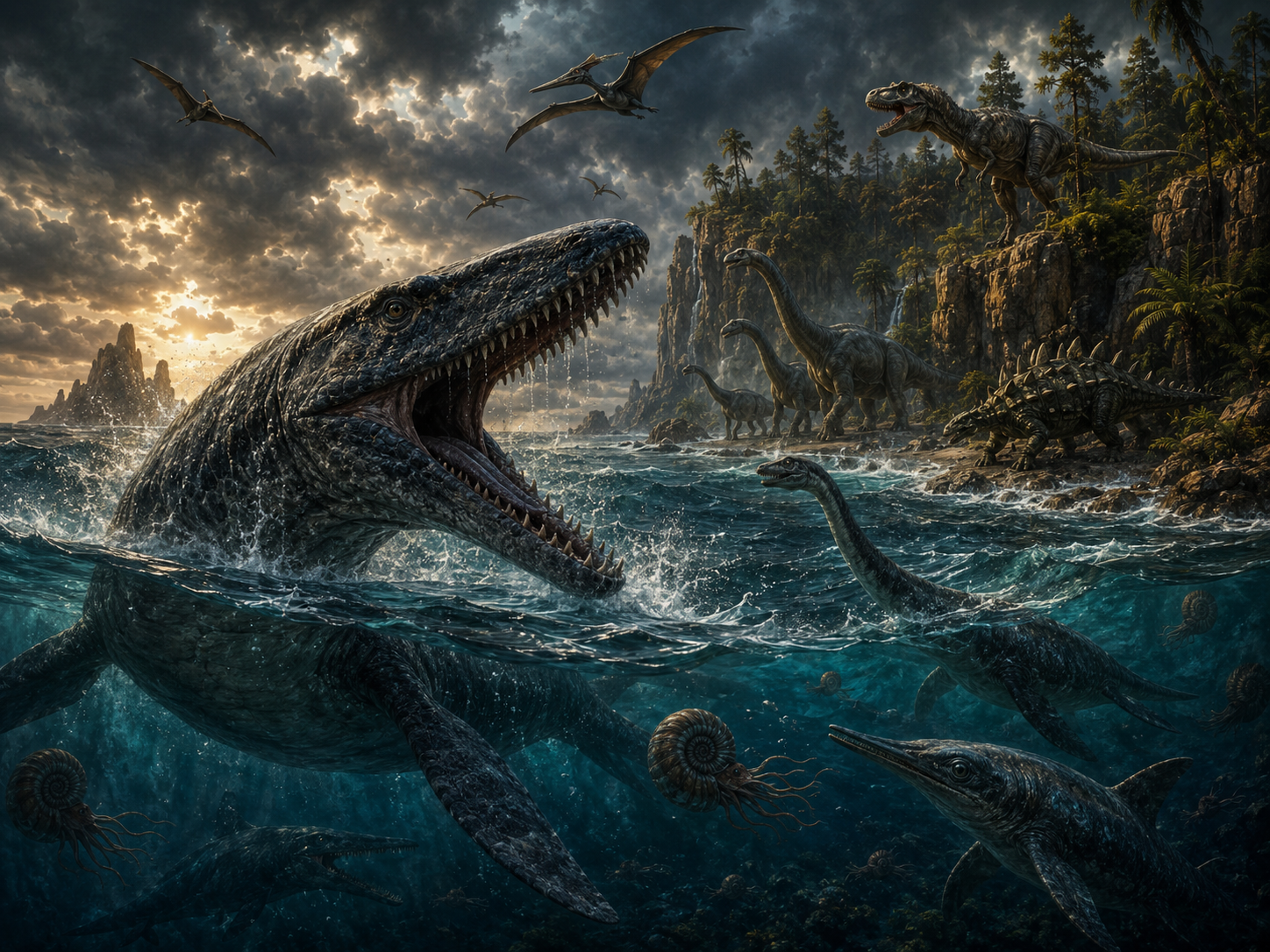
By the Middle Jurassic, recovery is no longer the defining story. Great herbivores move through mature ecosystems, predators occupy increasingly specialised niches and the breakup of Pangaea produces a world of spreading seas, island chains and separated terrestrial basins.
The giant roads
Sauropods spread through multiple continental regions, reaching immense size and altering landscapes simply by feeding and moving through them. Herd routes cross river valleys and open woodland. Trees are stripped at different heights by animals of different builds. Trampled corridors become routes followed by smaller creatures and predators.
Among the more distinctive herbivores, Shunosaurus carries a defensive tail club, while Huayangosaurus represents an early branch of the plated stegosaurs. Armour is becoming as much a signature of Jurassic herbivore life as extreme size.
Hunters of land and coast
Megalosaurus gives this age one of its defining large predators: a powerful bipedal theropod built to attack substantial prey. Eustreptospondylus occupies coastal and island environments, while Gasosaurus represents another branch of the increasingly varied predatory world.
The sea has an apex monster
In some Middle Jurassic seas, Liopleurodon and related pliosaurs combine enormous skulls, short powerful necks, deep bodies and four strong paddles into a predatory form built for violent acceleration. Long-necked plesiosaurs work different parts of the same food webs. Ichthyosaurs remain streamlined open-water hunters. Ammonites drift and swim beneath them in immense numbers.
The coastline is therefore no refuge from the giant world. A creature escaping a theropod on shore may enter water patrolled by predators just as formidable.
Old wilderness, not newly born fey
Fey peoples and realms are already ancient by this point. The Jurassic does not create them. Instead, vast undisturbed forests, springs, ravines and misted valleys become powerful terrestrial anchors for older otherworldly territories. Later beings may remember these places as primeval courts, but the magic is a relationship with wilderness, not a substitute for the plants and animals actually living there.
Creatures of the Middle Jurassic
Late Jurassic · c. 161.5–143.1 Ma
The Apex of the Giants
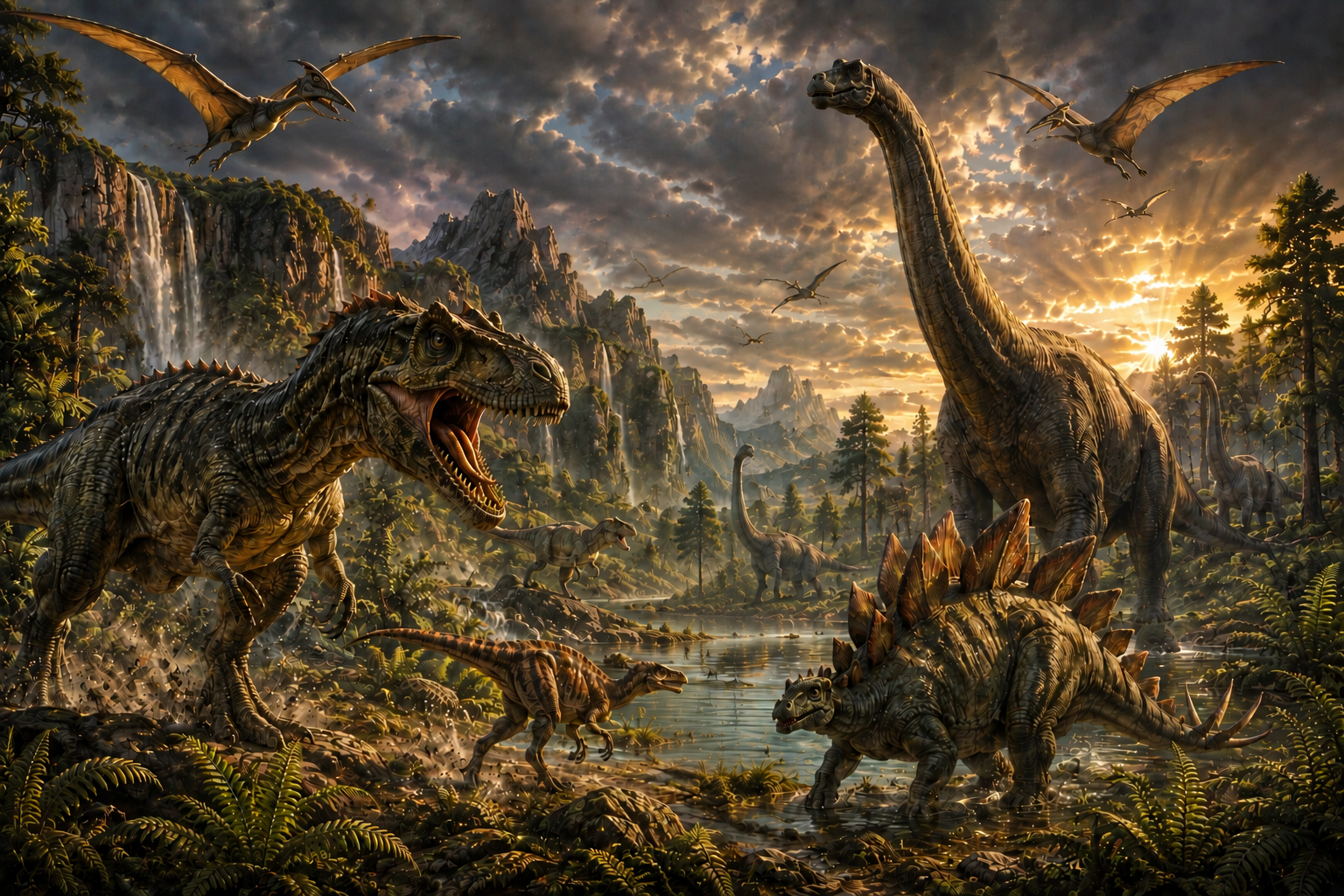
The Late Jurassic is the age most later imaginations mean when they dream of a dinosaur world. In North America, Africa, Europe and Asia, different ecosystems produce different casts, but the recurring pattern is unmistakable: enormous herbivores, heavily defended plant-eaters, formidable hunters and a sky alive with pterosaurs.
Living horizons
Diplodocus moves through open feeding country with a body stretched into extraordinary length. Mamenchisaurus carries one of the most extreme long-necked body plans of the age. Other giant sauropods—including Brachiosaurus- and Camarasaurus-type animals—divide the vegetation by height, browse, season and habitat.
They do not merely occupy landscapes. They change them. Repeated feeding opens woodland. Herd movement crushes vegetation and compacts soil. Dung returns nutrients to the ground. Carcasses become temporary ecosystems of their own. A sauropod herd is geography in motion.
The sovereign hunters
Allosaurus is among the defining predators of this world, hunting in ecosystems crowded with sauropods and stegosaurs. Ceratosaurus follows a different predatory build, while Torvosaurus adds another massive hunter to the same broad age.
The result is not a simple ladder with one unbeatable apex animal. Jurassic predator guilds overlap. Different hunters take different prey, use different terrain and compete over kills. A wounded giant can draw multiple carnivores from miles of river valley.
Armour answers teeth
Stegosaurus is one of the great defensive monsters of the Late Jurassic, carrying tall plates and a heavily armed tail into the feeding grounds of large theropods. Kentrosaurus makes the same evolutionary argument with an even more visibly spiked profile.
The sky changes quietly
Rhamphorhynchus and Pterodactylus cross Jurassic shorelines and islands. They remain successful aerial reptiles, but another lineage is now impossible to ignore.
Archaeopteryx, living roughly 149–145 million years ago, is one of the most celebrated Late Jurassic expressions of the dinosaur-to-bird transition. It is not a neat halfway rung on a ladder. It is part of a wider feathered theropod radiation in which avian features appear in combinations that do not map cleanly onto modern categories.
Small mammals also continue their own quieter expansion beneath the giants. They occupy nocturnal, arboreal, burrowing and insect-eating niches. The Jurassic belongs visually to dinosaurs, but the lineages that will inherit much of the post-Cretaceous world are already present.
Creatures of the Late Jurassic
03 · What the Jurassic leaves behind
The giants do not vanish at the boundary
The close of the Jurassic is not a mass-extinction curtain. Dinosaurian dynasties continue into the next period. Continents keep fragmenting. Regional ecosystems become increasingly distinct, and the long transformation of feathered theropods continues toward the extraordinary radiation of birds.
Dinosaur dynasties
Sauropods, theropods, armoured dinosaurs and many smaller lineages cross into the Cretaceous and continue to diversify.
Bird-line dinosaurs
Feathered theropods carry the dinosaurian inheritance into the air in increasingly specialised forms.
Mammalian persistence
Small mammals remain secondary in size but expand through ecological niches that reward nocturnal life, climbing, burrowing and dietary flexibility.
Buried inheritances
Mi-Go workings, serpent sanctuaries, elder ruins and fey-anchored wild places can survive geological change as relics, sealed sites or supernatural territories.
The next age will not replace the dinosaurs. It will transform the world around them. New plant communities, changing insect relationships, rising seas and increasingly separated continents will create the conditions for the last great dinosaur worlds.
04 · Using the Age of Giants in play
The Jurassic is still under the campaign world
More than a hundred million years later, the Age of Giants can return as creature, place, object or claim. A Jurassic adventure does not need to become a museum excursion. The important question is what survived—and who wants it now.
Primeval refuges
Hidden valleys, deep caverns, isolated islands and other protected environments can preserve lineages long after they disappear from the ordinary surface world.
Alien extraction sites
A Mi-Go mine sealed beneath later mountain-building may contain impossible alloys, biological archives, captive specimens or machinery that was never designed for human hands.
Ruins below ruins
A medieval fortress may stand above Roman stone, Bronze Age foundations, Neolithic ritual ground—and beneath all of them, a serpent or elder site millions of years older.
Monsters without a human past
A surviving Jurassic animal does not need a legend explaining its origin. Sometimes the monster is terrifying precisely because it is natural, ancient and completely indifferent to human history.
05 · Real deep time beneath the chronicle
Scientific reference points
The real chronology is the foundation. These sources support the geological boundaries, Jurassic ecology, fossil-record limitations and dinosaur-to-bird material used above.
International Commission on Stratigraphy
June 2026 International Chronostratigraphic Chart. The date labels on this page follow its Jurassic boundaries: c. 201.4, 174.7, 161.5 and 143.1 million years ago.
Natural History Museum — The Jurassic Period
Overview of Jurassic climate, Pangaea’s breakup, dinosaur diversification, plant life and the unusually incomplete Middle Jurassic terrestrial record.
Natural History Museum — Toarcian warming
Background to the rapid global warming episode and oceanic anoxia around 183 million years ago.
Natural History Museum — Archaeopteryx
Late Jurassic age, anatomy and the continuing debate over how Archaeopteryx fits within the broader dinosaur-to-bird transition.
Dates in deep time are revised as stratigraphic calibration improves. Older public references may still round the Jurassic–Cretaceous boundary to about 145 Ma; this page uses the June 2026 ICS value.
06 · Continue through deep time
The world keeps changing
The dinosaurs leave the Jurassic still dominant. Ahead lies a more fragmented world, changing plant communities and the final great expansion of dinosaur diversity before the catastrophe at the end of the Cretaceous.