
Kiseichuu Yūrei — The Hungry Spirit of the House
A widow keeps the western room shuttered though her daughter has been buried for three winters. Food disappears from the kitchen each night. At last a traveller hears a young voice ask for entrance—and sees a woman’s shadow at the door, even though no lamp burns behind her.
Kiseichuu Yūrei Statistics
Kiseichuu Yūrei — D&D 2024
Medium Undead, Neutral Evil · CR 8 (3,900 XP; PB +3)
AC 16 (spectral ward); Initiative +4 (14); HP 136 (16d8 + 64); Speed 0 ft., Fly 40 ft. (hover); in corporeal form 30 ft., no Fly.
| STR | DEX | CON | INT | WIS | CHA |
|---|---|---|---|---|---|
| 12 (+1) | 18 (+4) | 18 (+4) | 14 (+2) | 20 (+5) | 20 (+5) |
Saving Throws Dex +7, Wis +8, Cha +8; Skills Deception +8, Insight +8, Intimidation +8, Perception +8, Stealth +7; Resistances Cold, Necrotic, and Bludgeoning, Piercing and Slashing while Incorporeal; Damage Immunities Poison; Condition Immunities Charmed, Exhaustion, Frightened, Poisoned (also Grappled while Incorporeal); Senses Darkvision 60 ft., Life Sense 60 ft., Passive Perception 18; Languages Japanese and those known in life.
Traits
Life Sense. The spirit perceives the location of living creatures within 60 ft. unless they are behind total cover. It does not learn their names or motives.
Incorporeal Movement. While Incorporeal it moves through creatures and solid objects as difficult terrain, suffering 5 (1d10) Force damage if its turn ends inside an object. It cannot use Claw in that form.
Lifelike Guise. In Corporeal Form it appears warm and alive. A creature that examines it can discern the false appearance with a DC 16 Wisdom (Insight) check; magical detection of Undead still reveals its true nature.
Bound by Death. A creature that knowingly killed the spirit or deliberately concealed its murder has Disadvantage on saves against its Terrifying Presence and Draining Touch. Other relatives and innocent witnesses are not automatically culpable.
Rejuvenation. On reaching 0 HP, the yūrei reforms near its remains in 2d4 days unless the killing has been acknowledged and the dead given fitting rites, or the spirit is defeated with a consecrated Ofuda attached to its corporeal form.
Ofuda Ward. The spirit cannot willingly pass an entrance bearing a consecrated Ofuda. A creature within 5 ft. can use an Action to affix one while the spirit is Corporeal (DC 16 Dexterity [Sleight of Hand]). While attached, the spirit takes 7 (2d6) Radiant damage at the start of each turn. It can take an Action to remove the talisman with a successful DC 16 Wisdom saving throw. Consecration requires a shrine or divine spellcaster.
Actions
Multiattack. The yūrei makes two Draining Touch attacks in Incorporeal Form or two Claw attacks in Corporeal Form.
Draining Touch. Melee Attack Roll: +8, reach 5 ft., one living creature. Hit: 22 (4d8 + 4) Necrotic damage. The target makes a DC 16 Constitution saving throw. On failure, its HP maximum decreases by the Necrotic damage taken until it finishes a Long Rest or receives Greater Restoration.
Claw (Corporeal Form Only). Melee Attack Roll: +8, reach 5 ft., one creature. Hit: 18 (3d8 + 5) Slashing damage.
Bonus Actions
Corporeal Manifestation. The yūrei changes between Incorporeal and Corporeal Forms, changing its movement and available attacks as stated above.
Terrifying Presence (Recharge 5–6). Each enemy within 30 ft. that can see the spirit must succeed on a DC 16 Wisdom saving throw or have the Frightened condition for 1 minute. The target repeats the save at the end of each turn, ending the condition on a success. On a successful save, the target is immune to this spirit’s presence for 24 hours.
Kiseichuu Yūrei — D&D 2014
Medium Undead, Neutral Evil · CR 8 (3,900 XP)
AC 16 (spectral ward); HP 120 (16d8 + 48); Speed 0 ft., Fly 40 ft. (hover); in corporeal form 30 ft., no Fly.
| STR | DEX | CON | INT | WIS | CHA |
|---|---|---|---|---|---|
| 12 (+1) | 18 (+4) | 16 (+3) | 14 (+2) | 18 (+4) | 20 (+5) |
Saving Throws Dex +7, Wis +7, Cha +8; Skills Deception +8, Insight +7, Intimidation +8, Perception +7, Stealth +7; Resistances Cold, Necrotic, and Bludgeoning, Piercing and Slashing from nonmagical attacks while incorporeal; Damage Immunities Poison; Condition Immunities Charmed, Exhaustion, Frightened, Poisoned (also Grappled while Incorporeal); Senses Darkvision 60 ft., Life Sense 60 ft., Passive Perception 17; Languages Japanese and those known in life.
Traits
Life Sense. The spirit perceives the location of living creatures within 60 ft. unless they are behind total cover. It does not learn their names or motives.
Incorporeal Movement. While Incorporeal it moves through creatures and solid objects as difficult terrain, suffering 5 (1d10) Force damage if its turn ends inside an object. It cannot use Claw in that form.
Lifelike Guise. In Corporeal Form it appears warm and alive. A creature that examines it can discern the false appearance with a DC 16 Wisdom (Insight) check; magical detection of Undead still reveals its true nature.
Bound by Death. A creature that knowingly killed the spirit or deliberately concealed its murder has Disadvantage on saves against its Terrifying Presence and Draining Touch. Other relatives and innocent witnesses are not automatically culpable.
Rejuvenation. On reaching 0 HP, the yūrei reforms near its remains in 2d4 days unless the killing has been acknowledged and the dead given fitting rites, or the spirit is defeated with a consecrated Ofuda attached to its corporeal form.
Ofuda Ward. The spirit cannot willingly pass an entrance bearing a consecrated Ofuda. A creature within 5 ft. can use an action to affix one while the spirit is Corporeal (DC 16 Dexterity [Sleight of Hand]). While attached, the spirit takes 7 (2d6) Radiant damage at the start of each turn. It can take an action to remove the talisman with a successful DC 16 Wisdom saving throw. Consecration requires a shrine or divine spellcaster.
Actions
Multiattack. The yūrei makes two Draining Touch attacks in Incorporeal Form or two Claw attacks in Corporeal Form.
Draining Touch. Melee Spell Attack: +8 to hit, reach 5 ft., one living creature. Hit: 21 (4d8 + 3) Necrotic damage. The target makes a DC 16 Constitution saving throw. On failure, its HP maximum decreases by the Necrotic damage taken until it finishes a Long Rest or receives Greater Restoration.
Claw (Corporeal Form Only). Melee Spell Attack: +8 to hit, reach 5 ft., one creature. Hit: 18 (3d8 + 5) Slashing damage.
Terrifying Presence (Recharge 5–6). Each enemy the yūrei chooses within 30 ft. that can see it makes a DC 16 Wisdom saving throw or is frightened for 1 minute. The creature repeats the save at the end of each turn, ending the fear on a success. A successful save grants immunity to this spirit’s presence for 24 hours.
Bonus Actions
Corporeal Manifestation. The yūrei changes between Incorporeal and Corporeal Forms, changing its movement and available attacks as stated above.
Kiseichuu Yūrei — Pathfinder 1e
NE Medium Undead (Incorporeal) · CR 8 (XP 4,800)
Init +8; Senses Darkvision 60 ft., Life Sense 60 ft., Perception +18; Aura Terrifying Presence (60 ft., DC 22).
Defense
AC 20 (+4 Dex, +5 Deflection, +1 Dodge), Touch 20, Flat-Footed 15; in Corporeal Form AC 20 (+4 Dex, +5 Natural, +1 Dodge), Touch 15, Flat-Footed 15; HP 95 (10d8 + 50); Fort +3, Ref +7, Will +12; Defensive Abilities Rejuvenation and Incorporeal Traits; Immune Undead traits and ordinary attempts to Turn Undead (not positive-energy damage).
Offense
Speed Fly 80 ft. (perfect), in Corporeal Form 30 ft.; Melee Incorporeal Touch +11 (1d4 Constitution drain, Will DC 20 negates); Corporeal Melee 2 Claws +12 (1d4+5 each); Space/Reach 5 ft./5 ft.; Special Attacks Terrifying Presence, Draining Touch, Bound by Death.
Statistics
| STR | DEX | CON | INT | WIS | CHA |
|---|---|---|---|---|---|
| — (—) | 18 (+4) | — (—) | 14 (+2) | 20 (+5) | 20 (+5) |
Strength 20 (+5) while Corporeal; BAB +7; CMB/CMD — while Incorporeal; +12/27 while Corporeal; Feats Ability Focus (Terrifying Presence), Combat Reflexes, Dodge, Flyby Attack, Improved Initiative; Skills Bluff +18, Fly +25, Intimidate +26, Perception +18, Sense Motive +18, Stealth +25; Languages Japanese; Environment homes in Japan; Organisation solitary; Treasure none.
Special Abilities
Corporeal Manifestation (Su). The spirit may become Corporeal or Incorporeal as a Swift Action. It has a physical body, claws and Natural Armour in Corporeal Form, but loses Incorporeal Movement and Touch.
Terrifying Presence (Su). As a Free Action it unleashes a wave of dread within 60 ft. Living creatures must make a DC 22 Will save or become Panicked while in range and for 1d3 rounds after leaving. A natural 1 also requires a DC 22 Fortitude save: failure kills; success causes 3d6 damage. A successful Will save grants immunity to this spirit’s presence for 24 hours. This Charisma-based DC includes Ability Focus.
Draining Touch (Su). A living creature hit by its Incorporeal Touch makes a DC 20 Will save or suffers 1d4 Constitution drain. It must consume at least one point of Constitution daily to maintain its living guise.
Bound by Death (Ex). Those who knowingly aided in the murder or deliberately concealed it receive no save against the spirit’s racial Terrifying Presence or Draining Touch. Other relatives do not incur this penalty merely through kinship.
Life Sense (Su). The yūrei locates living creatures within 60 ft. as by Blindsight and judges the strength of their life-force as by Deathwatch.
Lifelike (Su). In Corporeal Form it appears alive; a suspicious observer may attempt a DC 20 Will save to see its true face. The guise fails after two weeks without feeding or on Hallowed ground. For an hour after feeding, ordinary disbelief cannot penetrate it, though magic that detects Undead still works.
Ofuda Weakness (Su). The spirit cannot enter a building through an entrance bearing a consecrated Ofuda. Attaching one to its Corporeal forehead requires a DC 19 Dexterity check, reduced to DC 15 after a successful Feint in the previous round. While attached the paper deals 1d6 damage each round. The yūrei can take a Standard Action and make a DC 25 Will save to remove it.
Rejuvenation (Su). If destroyed, the spirit returns near its hidden remains in 2d4 days. Exposing the murder and performing proper rites, or destroying it while a consecrated Ofuda is attached, prevents its return.
Kiseichuu Yūrei — D&D 3.5e
Medium Undead (Incorporeal), Neutral Evil · CR 8
Hit Dice 10d12 (65 HP); Init +4; Speed Fly 80 ft. (perfect); AC 19 (+4 Dex, +5 Deflection), Touch 19, Flat-Footed 15; Corporeal AC 19 (+4 Dex, +5 Natural), Touch 14, Flat-Footed 15; BAB/Grapple +5/— (Corporeal +10); Fort +3, Ref +7, Will +12.
Attack Incorporeal Touch +9 melee touch (1d4 Constitution drain, DC 20 Will negates); Full Attack one Incorporeal Touch +9; Corporeal Attack Claw +10 (1d4+5), Corporeal Full Attack two Claws +10 each; Space/Reach 5 ft./5 ft.
Ability Scores
| STR | DEX | CON | INT | WIS | CHA |
|---|---|---|---|---|---|
| — (—) | 18 (+4) | — (—) | 14 (+2) | 20 (+5) | 20 (+5) |
Strength 20 (+5) when corporeal; Skills Bluff +18, Craft (one) +15, Diplomacy +18, Hide +25, Intimidate +25, Listen +18, Move Silently +25, Search +15, Sense Motive +18, Spot +18; Feats Ability Focus (Terrifying Presence), Dodge, Flyby Attack, Necrotic Reserve (Libris Mortis); Racial Skills +8 Hide, Intimidate and Move Silently; Environment Japan; Organisation solitary; Treasure none; Advancement 11+ HD or class level; Level Adjustment —.
Special Attacks
Corporeal Manifestation (Su). Once on its turn as a Free Action, the yūrei may become physical or Incorporeal. Physical form uses Strength 20, claws and Natural Armour, and loses Incorporeal Touch.
Terrifying Presence (Su). As a Free Action at will it fills a 60-ft. radius with terror. DC 22 Will negates; failure causes Panic until the victim leaves the radius and for 1d3 rounds afterward. A natural 1 also requires a DC 22 Fortitude save, failure causing death and success 3d6 damage. The DC is Charisma-based and includes Ability Focus.
Draining Touch (Su). Its Incorporeal Touch forces a DC 20 Will save or deals 1d4 Constitution drain. It needs one point of Constitution per day to maintain its living appearance.
Bound by Death (Ex). Those who knowingly murdered it or concealed the murder have no saving throw against its racial powers. Innocent relatives are not automatically guilty.
Special Qualities
Life Sense (Su). Detect living beings within 60 ft. as if by Blindsight and judge their vitality as by Deathwatch.
Rejuvenation (Su). If destroyed, the spirit reforms near its remains in 2d4 days unless the crime is revealed and fitting rites performed, or it is destroyed with a consecrated Ofuda on its forehead.
Turn Immunity. Normal Turn Undead and Rebuke Undead cannot affect it.
Lifelike Appearance (Su). In Corporeal Form it appears alive. A suspicious observer may make a DC 20 Will save to penetrate the appearance; it fails on Hallowed ground or after fourteen days without feeding. For one hour after feeding it resists ordinary disbelief, but magical detection of Undead continues to function.
Ofuda Weakness (Su). A consecrated Ofuda seals an entrance against the yūrei. Placing one on its corporeal forehead requires a DC 19 Dexterity check (DC 15 after a successful Feint during the previous round). It deals 1d6 damage each round; a DC 25 Will save as a Standard Action removes it.
Undead Traits. No Constitution score; immune to Poison, Sleep, Paralysis, Stunning, mind-affecting effects and other conditions excluded by the Undead type.
The House That Hides a Murder
A mountain household in Japan has kept the west room shuttered for three winters. A servant says that its daughter died of fever; her mother cannot bring herself to answer. Every night a tray of food is taken to the door. Then travellers begin to disappear, and a young woman with warm hands and a familiar face walks the passage after dark.
The Kiseichuu Yūrei has returned from a violent death concealed by those who should have protected it. It holds the guilty captive to their own crime, drawing them into further wrongdoing. At first it feeds upon their fear; soon it demands living victims. The spirit keeps its murderers alive to suffer, forcing them to supply blood and life from strangers. It has become as cruel as those who wronged it.
What the Dead Demand
The ghost does not attack every family member on sight. Those who helped conceal the murder suffer its particular hatred. A servant who tried to intervene may be spared, while an elder who hid the body is made to bring the living to its door. It remembers insults, broken promises and the names spoken when it died. Yet the creature has lost all pity for strangers; its vengeance requires victims who had no share in its death.
When corporeal it appears warm and living, able to open a screen or pass through the house as a quiet relative. When incorporeal it drifts through walls and tracks the breathing of intruders. It seldom exposes its true shape until it knows whether the visitors carry sacred wards or weapons capable of harming the dead.
Signs of the Haunting
- Food left nightly outside a locked room, though no living member of the house is known to stay there
- A household whose elders offer conflicting accounts of a daughter’s death
- Footprints ending at an unbroken wall or a sealed screen
- A traveller returned pale, weakened and unable to explain the touch that robbed him of strength
- An ofuda renewed at the doorway whenever its writing fades
Hunting, Battle and Countermeasures
Before battle. The spirit wears its living appearance to learn who has come to the house. It lets servants speak for it. If the company seems powerful, it tries to separate them by opening a door, extinguishing a lantern or having a frightened relative summon one visitor alone.
First strike. The ghost throws off its disguise and fills the chamber with terror. It moves through a partition to strike a solitary opponent with its draining touch. It knows the guilty are particularly vulnerable, yet an innocent stranger may be the easier meal.
When pressed. The yūrei becomes corporeal to seize a key, bar a passage or deceive a companion who still believes its living face. Its apparent defeat is temporary if the murder remains hidden. The spirit returns to the remains and begins the torment anew.
Ending the haunting. Discover the body or its unmarked grave; uncover who killed the victim and who knowingly concealed the death; protect witnesses and give the dead proper rites. A consecrated ofuda seals a threshold and may be fixed to the corporeal ghost as it is defeated. A shrine keeper can prepare the ward with the blessing of the appropriate kami. Remove Curse can relieve other bindings afflicting the household, but does not by itself undo an unconfessed murder.
Three Encounters
The Daughter Behind the Screen. A prosperous family hires the adventurers to recover a stolen ancestral tablet. A maid reveals that the tablet contains the true account of a daughter’s death. Meanwhile the retainers have been abducting travellers for the ghost. Recovering the tablet exposes the guilty; rescuing the captives before the household erupts into violence prevents an innocent younger child from suffering for the elders’ crime.
The Priest’s Last Ofuda. Servants from the cursed house seek refuge in a shrine. The spirit cannot pass its consecrated threshold, but relatives threaten the keeper unless he surrenders the fugitives. Adventurers must protect the ward, expose the concealed murder and draw the manifested ghost where a second talisman can be placed upon it.
The Empty Road to Kii. Travellers vanish along a mountain road. Armed men have seized them to feed the daughter of a family they once served. The men’s leader begs the party to destroy the creature before it consumes his own household. The captives are still alive. Fighting the ghost without freeing them may leave them helpless in the hands of the same kidnappers.
The Price of Silence
A household cannot be judged by blood alone. Find who struck the fatal blow, who tried to prevent it, who hid the body and who has since been coerced. A servant’s testimony, a surviving letter, a named grave and the murdered person’s own remains can settle those questions. Slaying the ghost ends an encounter. Bringing the truth into the open and laying the dead to rest ends the haunting.
Origins, Sources and Artwork
Kiseichuu Yūrei is an original D&D 3.5e fan creature credited to Bhu in the Giant in the Playground archive. Corporeal manifestation, terror, life-draining touch, the binding of those responsible for murder, rejuvenation, life sense and the ofuda weakness derive from that creation. The two fifth-edition panels and Pathfinder 1e panel are original conversions, not official published monster entries.
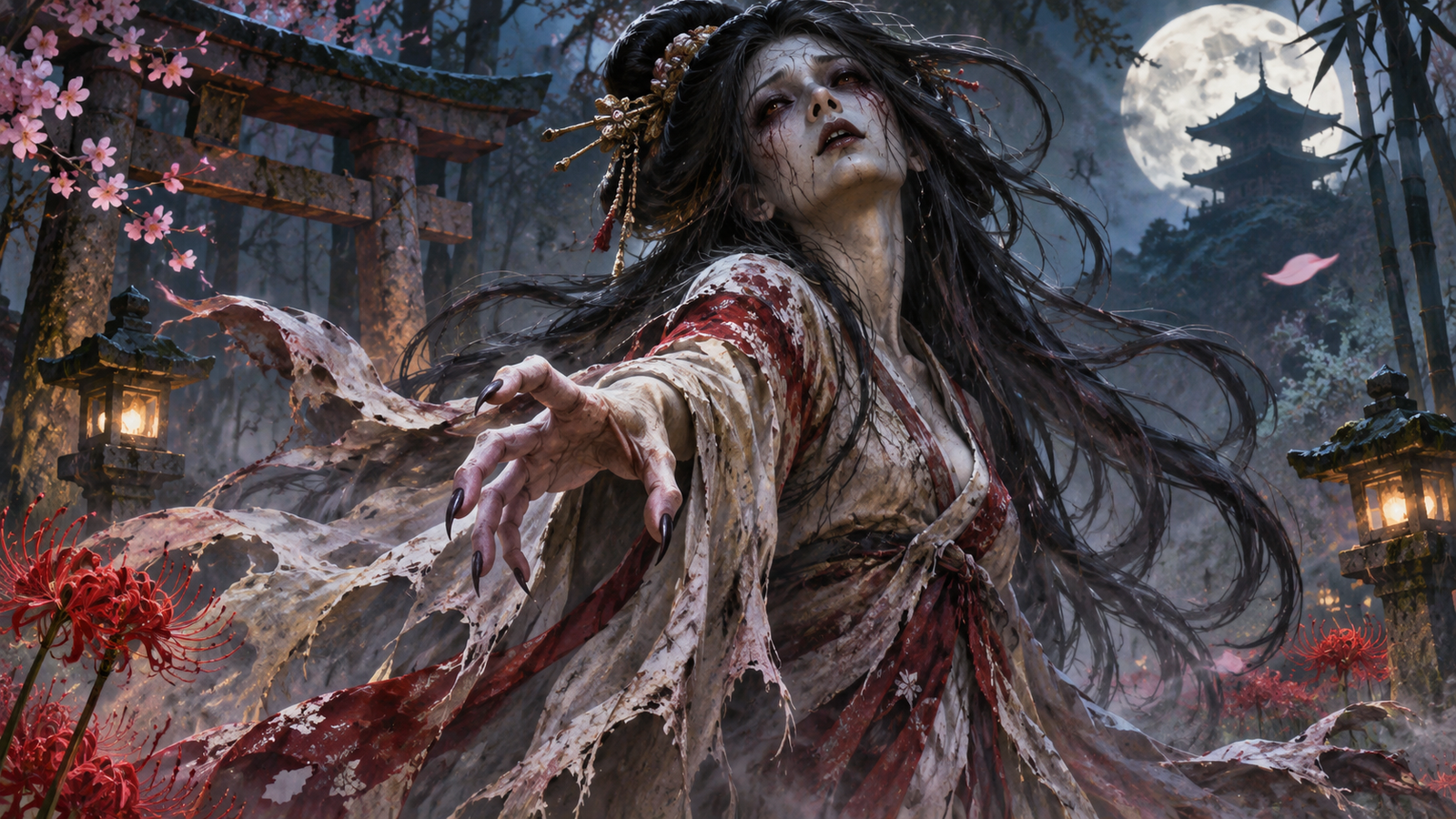
Japanese accounts of yūrei and vengeful spirits provide the creature’s wider setting; the particular household-parasite monster is not a separately verified traditional species. The hero artwork is an original painted dark-fantasy illustration created for this Kiseichuu Yūrei entry. Its moonlit shrine setting and ghostly appearance interpret the creature’s Japanese fantasy narrative rather than depicting a specific historical account or traditional image.
Follow the Funa-Yūrei, the Japanese Pantheon and the Undead Bestiary for neighbouring traditions and threats. The original fan author’s republication licence has not been independently verified; the source is credited rather than falsely declared official Open Game Content.
Keep this reference growing
If this page helped with your reading or game, you can support its upkeep or explore the curated books.
Explore the Bookshop — epics, classics and stories behind imagined worlds.