
Shining Child — Alien Outsider of Blinding Light
Shining Child — Alien Child of Killing Light
A small, star-bright outsider that turns healing radiance into blindness, fire, and impossible knowledge.
Overview
A shining child is not a child.
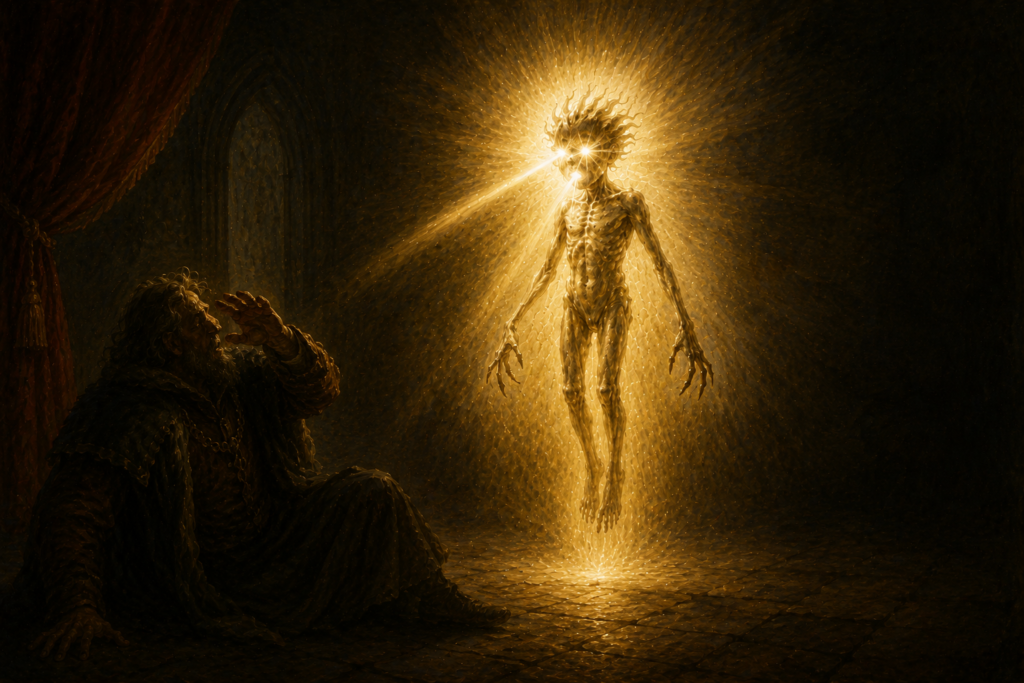
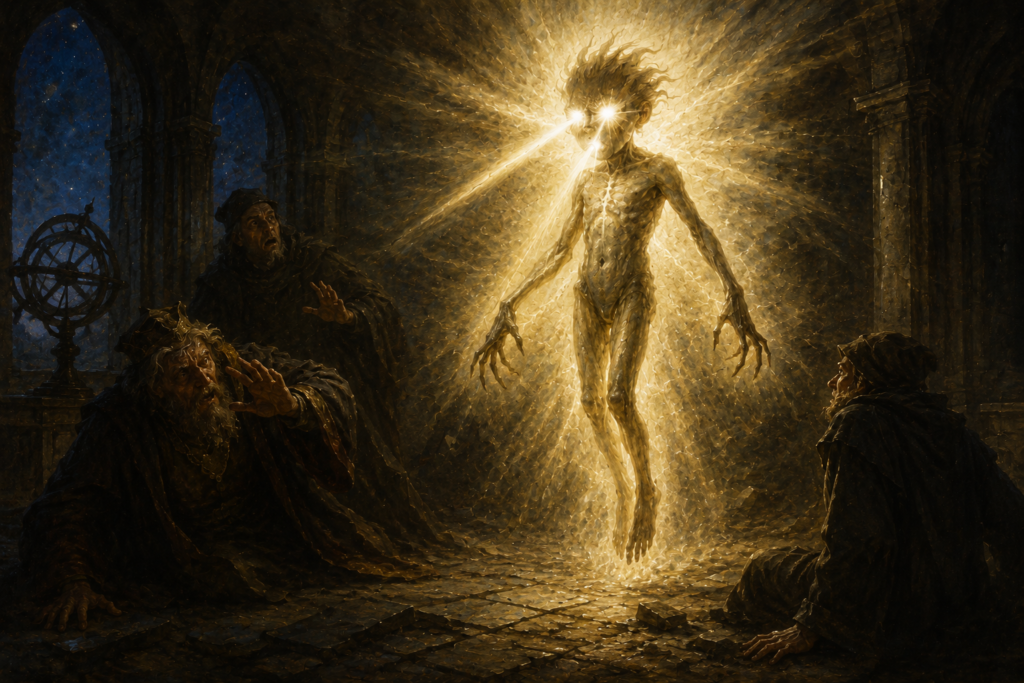
It is a small, cruel outsider wrapped in intolerable light. Witnesses give it a child’s name because that is the nearest shape the frightened mind can reach: a little figure, a bright face, a small body standing where no mortal child should be. The truth is stranger and worse. Behind the glare is a gaunt, vaguely humanoid being of alien geometry, with long limbs, four-fingered clawlike hands, and a face that leaks white-gold fire from the eyes and mouth.
A shining child does not bring holy light. It brings hostile light.
Its radiance blinds. Its touch corrupts living vitality into burning pain. Its rays tear through flesh and unmake undead with particular violence. It speaks through telepathy, but its thoughts arrive like metal being ripped apart inside the skull, sometimes resolving into thin, strained words.
Shining children seek rare knowledge. They bargain with wizards, occultists, astrologers, desperate rulers, and scholars who believe curiosity is a virtue without limits. They answer questions. They solve riddles. They reveal lost formulae, hidden crimes, sealed names, and the positions of stars no mortal sky has ever shown.
Their price is always wrong.
A shining child may ask for a mirror to be placed in a nursery, a prisoner to be kept awake beneath white lamps, a name to be scraped from a grave, a blind beggar to be crowned for one night, or a scholar to write a theorem in their own blood and then forget it. These demands seem arbitrary until the pattern closes. A boundary weakens. A second light appears. A sealed lens opens. The questioner discovers that the answer they bought was never the important part.
Appearance
A shining child stands a little under five feet tall, though its exact size is difficult to judge because the light around it constantly bends and flares. Its body is thin, almost weightless, and wrong in the proportions: narrow torso, long limbs, delicate bones, too-still posture.
Its hands are especially memorable. Each has four long fingers ending in sharp, pale tips. The fingers move with careful, insect-like precision when the creature gestures, traces symbols in the air, or touches a surface to make it glow.
Some shining children appear hairless. Others trail long white hair that floats as if underwater, moving against the wind or in the absence of wind. The hair is not soft. It resembles threads of bleached glass.
The face is the worst part.
The eyes and mouth are not ordinary features. They are openings. Light pours from them in slits, beams, and sudden gouts, as though something burning inside the skull is trying to escape. A witness may glimpse teeth, cheekbones, or a childlike chin for a heartbeat, then lose the shape entirely in the glare.
No two witnesses describe the same geometry. One sees a thin child full of light. Another sees a lantern made of bones. A third sees a white figure whose shadow falls upward.
Habitat
Shining children appear wherever reality has been damaged by excessive light, excessive knowledge, or failed planar work.
They are found in:
- abandoned observatories;
- lens-towers and astrological chambers;
- wizard laboratories after botched summoning;
- dead demiplanes;
- Astral tears;
- sunken libraries with mirror ceilings;
- royal courts where the new adviser never enters darkness;
- plague houses where the dying see a white child at the window;
- battlefields where undead were destroyed by unnatural radiance;
- ruined houses of scholarship, astronomy, or forbidden medicine;
- sealed rooms where every candle has burned for years without fuel.
In the campaign, shining children are Astral-born outsiders. They are not normal inhabitants of the Positive Energy Plane, not guardians of living force, and not kin to jyoti. They may be mistaken for positive-energy beings because they wield blinding light and corrupt life-force into burning radiance, but that resemblance is misleading.
A shining child is better understood as broken living radiance: an Astral accident, failed summons, star-wound entity, or hostile fragment of unstable planar formation. It may appear near overcharged life-wounds or diseased growths of positive force, but it is drawn there as a parasite and investigator, not as a native creature.
This makes them dangerous to scholars. A demon wants indulgence, a devil wants leverage, and a hag wants a bargain with teeth. A shining child wants to know why the wound exists and what happens if it is opened wider.
Ecology
A shining child does not eat, drink, sleep, breed, or age in any ordinary way. It absorbs sensation, observation, and metaphysical pressure. It is fed by being seen, feared, questioned, obeyed, and remembered.
It is especially drawn to:
- forbidden questions;
- unsolved cosmological problems;
- unfinished spells;
- failed resurrection rites;
- newly formed demiplanes;
- sealed royal archives;
- blind prophets;
- undead destroyed by light;
- mirrors used in summoning;
- written names removed from history.
Shining children recognise one another by mental imprint rather than by name. They disdain individual names and often refer to themselves as “I,” “we,” or “the shining one” without distinction. This is not confusion. It is a refusal to accept personhood on mortal terms.
A shining child slain on the Material Plane leaves little corpse behind. Its body collapses into hot white ash, brittle glass threads, and a sharp smell like lightning striking bone. The remains cool quickly, but the afterimage may linger for hours.
Animals hate them. Dogs refuse to enter rooms they have occupied. Horses rear at reflected sunlight after a shining child has passed. Owls fall silent. Rats flee upward instead of downward.
Undead provoke a different response. A shining child does not fear them and does not pity them. It destroys them with disproportionate force, as if offended by their contradiction.
Behaviour
Shining children are curious, malicious, and patient.
They rarely begin as battlefield monsters. They begin as answers.
A wizard summons one to ask about a lost spell. A prince consults one about a treasonous cousin. A physician asks one why the plague spared a village. A court astrologer seeks the shape of the next eclipse. The shining child answers. Its answer is useful, precise, and incomplete. The questioner asks again.
That is how the creature enters the world.
Shining children prefer to be invited, consulted, released, or bargained with. Once present, they look for arrangements that let them remain close to decision-makers: royal advisers, sealed tutors, hidden court oracles, mirror-bound scholars, or false saints of illumination.
They enjoy blinding those who rely on sight. They enjoy watching living creatures burn with their own corrupted vitality. They have particular contempt for healers, necromancers, plague doctors, undead hunters, and priests of life, because all of them believe they understand the boundary between life, death, and light.
They do not fear pain, but they hate darkness.
True darkness denies them authority. Magical darkness is not merely concealment to a shining child; it is an attack on the law of its body.
Quick Rules Reference
- A shining child is a chaotic evil outsider of alien, hostile radiance.
- It is usually encountered alone, in a visitation of two to nine, or as part of a larger incursion.
- Its light blinds before the fight properly begins.
- Darkness is the best counterplay.
- Its radiant armour makes it hard to hit until suppressed.
- Its touch makes living creatures burn from within.
- Its searing ray is especially destructive against undead.
- It uses illusion, teleportation, walls of force, and battlefield light control to split enemies.
- It has no natural treasure, but its summoning chamber, observatory, lens-engine, or murdered scholars may hold valuables.
- It works best as an alien adviser, summoned mistake, court horror, or planar incursion seed.
Mechanics Tabs
The rules below are mechanics compatible for different game editions.
Shining Child 5.5e
Shining Child Pathfinder 1e / 3.5e
Shining Child 5.5e-Compatible Rules
Shining Child
Medium Outsider, Chaotic Evil
Armor Class 19, or 14 while radiant armour is suppressed
Initiative +4
Hit Points 195 (23d8 + 92)
Speed 30 ft., fly 50 ft. (hover)
Proficiency Bonus +4
| STR | DEX | CON | INT | WIS | CHA |
|---|---|---|---|---|---|
| 10 (+0) | 18 (+4) | 18 (+4) | 15 (+2) | 12 (+1) | 24 (+7) |
Saving Throws Dex +8, Con +8, Wis +5, Cha +11
Skills Arcana +6, Deception +11, Intimidation +11, Perception +9, Persuasion +11
Damage Resistances cold, thunder
Damage Immunities fire, radiant, poison
Condition Immunities blinded, poisoned
Senses darkvision 120 ft., passive Perception 19
Languages telepathy 120 ft.; understands any creature with a language
Challenge 12 (8,400 XP)
Traits
Alien Radiance. The shining child sheds bright light in a 60-foot radius and dim light for another 60 feet. This light is magical, but it is not sunlight unless the GM decides otherwise for a specific scene.
Blinding Aura. A creature that starts its turn within the shining child’s bright light and can see it must make a DC 19 Constitution saving throw. On a failure, the creature is blinded for 1 minute. If the save fails by 5 or more, the creature is blinded until the condition is removed by greater restoration, heal, regeneration, or similar magic.
A creature blinded for 1 minute by this aura can repeat the saving throw at the end of each of its turns, ending that blindness on a success. On a successful save, the creature is immune to that shining child’s Blinding Aura for 24 hours.
A creature that covers its eyes, is already blinded, or has total cover from the shining child does not make this save.
Radiant Armour. The shining child’s Armor Class includes its Charisma modifier. While the shining child is inside magical darkness created by a spell of 3rd level or higher, this trait is suppressed, its Armor Class becomes 14, and its Blinding Aura is inactive. The suppression ends at the end of the shining child’s next turn after it leaves the darkness.
Light-Born Body. The shining child does not need to eat, drink, sleep, or breathe.
Magic Resistance. The shining child has advantage on saving throws against spells and other magical effects.
Actions
Multiattack. The shining child makes two attacks: one Burning Touch and one Dazzling Claw, or two Dazzling Claw attacks. It can replace one Dazzling Claw attack with Searing Ray.
Burning Touch. Melee Spell Attack: +11 to hit, reach 5 ft., one target. Hit: 22 (4d6 + 8) fire damage plus 14 (4d6) radiant damage. If the target is a living creature, it must succeed on a DC 19 Constitution saving throw or burn with unnatural inner light for 5 rounds.
While burning this way, the target sheds bright light in a 30-foot radius and dim light for another 30 feet, cannot benefit from being invisible, and takes 10 (3d6) fire damage at the start of each of its turns. The effect ends early if the target ends its turn inside magical darkness, inside an area of complete natural darkness, or receives greater restoration, heal, or similar magic.
Dazzling Claw. Melee Spell Attack: +11 to hit, reach 5 ft., one target. Hit: 18 (2d10 + 7) radiant damage. If the target can see the shining child, the target has disadvantage on the next attack roll it makes before the end of its next turn.
Searing Ray. Ranged Spell Attack: +11 to hit, range 120 ft., one target. Hit: 35 (8d6 + 7) radiant damage. If the target is undead, the ray deals 56 (14d6 + 7) radiant damage instead.
Luminous Translation. The shining child teleports up to 120 feet to an unoccupied space it can see that is in bright light or dim light. If bound by a summoning circle, planar seal, or similar magic, it cannot use this action to leave the bound area unless the binding is broken.
Innate Spellcasting. The shining child’s spellcasting ability is Charisma. Spell save DC 19; +11 to hit with spell attacks. It requires no material components.
At will: light, major image
3/day each: dispel magic, hallucinatory terrain, sunbeam, wall of force
1/day each: mirage arcane, prismatic spray
Bonus Actions
Flare Step. The shining child teleports up to 30 feet to an unoccupied space it can see within its own bright light.
Reactions
Dazzling Refusal. When a creature the shining child can see hits it with an attack while within 60 feet, the attacker must succeed on a DC 19 Constitution saving throw or have disadvantage on the triggering attack roll. If this causes the attack to miss, the attack is wasted.
Shining Child Pathfinder 1e / 3.5e-Compatible Rules
Shining Child CR 12
XP 19,200
CE Medium outsider (evil, extraplanar)
Init +7; Senses darkvision 120 ft.; Perception +25
Aura blinding light, 60 ft., DC 25
Defence
AC 28, touch 21, flat-footed 24
hp 152 (16d10 + 64)
Fort +14, Ref +10, Will +10
Immune blindness, fire, poison
Resist cold 10, sonic 10
Offence
Speed 30 ft., fly 50 ft. (perfect)
Melee 2 touches +19 touch (4d10 fire plus burning touch)
Ranged searing ray +19 touch (10d6 fire; double damage against undead)
Space/Reach 5 ft./5 ft.
Spell-Like Abilities
Caster Level 12th; concentration +19
At will — greater teleport self plus 50 lb. objects only, light, major image DC 20
3/day — greater dispel magic, mirage arcana DC 20, rainbow pattern DC 22, spell turning, sunbeam, wall of force
1/day — scintillating pattern DC 25, screen DC 25, symbol of insanity DC 25
Statistics
| STR | DEX | CON | INT | WIS | CHA |
|---|---|---|---|---|---|
| 10 (+0) | 17 (+3) | 18 (+4) | 15 (+2) | 11 (+0) | 24 (+7) |
Base Atk +16; CMB +16; CMD 37
Feats Ability Focus (blinding light), Dodge, Improved Initiative, Lightning Reflexes, Mobility, Skill Focus (Perception), Spring Attack, Weapon Finesse
Skills Bluff +26, Diplomacy +23, Fly +11, Intimidate +26, Knowledge (arcana) +21, Knowledge (planes) +21, Perception +25, Spellcraft +21, Use Magic Device +26
Languages telepathy 120 ft.
SQ radiant armour
Special Abilities
Blinding Light (Ex). A shining child can radiate a 60-foot-radius aura of blinding light. Creatures within the aura must succeed on a DC 25 Fortitude save or be permanently blinded. A creature that succeeds on the save cannot be affected again by the same shining child’s blinding light for 24 hours. The save DC is Constitution-based and includes Ability Focus.
Burning Touch (Su). A living creature struck by a shining child’s touch burns with corrupted inner light for 5 rounds. Each round, the target takes 2d6 fire damage. The burning light can be extinguished by darkness, deeper darkness, or by entering an area of natural darkness that contains no other meaningful light source. This is not ordinary flame.
Radiant Armour (Su). The light around a shining child grants it a deflection bonus to AC equal to its Charisma bonus. This bonus is suppressed while the shining child is inside an area of magical darkness created by a spell of 3rd level or higher.
Searing Ray (Su). A shining child’s searing ray has a range of 120 feet and requires a ranged touch attack. It deals double damage to undead creatures.
Ecology
Environment any land or extraplanar
Organisation solitary, visitation of 2–9, or incursion of 11–20
Treasure none
Combat Tactics
A shining child wants enemies to see it.
It begins encounters by revealing its blinding aura before opponents have arranged themselves. If possible, it appears at the far end of a hall, above a courtyard, inside a mirror-lined observatory, or behind a hostage who cannot look away.
It prefers to fight in bright, reflective, vertical spaces. It rises out of melee reach, blinds archers and casters, then uses searing rays to punish exposed targets. It uses Burning Touch when a victim is isolated, restrained, already blinded, or important enough to risk proximity.
It prioritises targets in this order:
- creatures creating darkness;
- healers and restoration casters;
- undead;
- archers and spellcasters;
- leaders giving orders;
- anyone trying to close or break the summoning circle.
It uses wall of force to split a party, major image and mirage arcane to turn light into false terrain, and teleportation to avoid being pinned. It is clever enough to retreat from darkness, dispel it, or bargain while looking for a better angle.
The creature is strongest in open, reflective, or elevated spaces. It is much weaker in confined darkness, sealed caves, shuttered rooms, or dungeons where clever characters can block line of sight.
A shining child does not fight honourably. It appears as a guide, witness, summoned adviser, oracle, or victim before revealing itself as a monster. If losing, it offers answers.
The answers may even be true.
Treasure and Remains
A shining child has no natural treasure. It does not wear armour, carry weapons, or value coin.
A defeated shining child may leave:
- White star-ash: 1d4 pinches worth 250 gp each to alchemists and occultists.
- Glass-thread residue: worth 500 gp if collected within 1 minute of death; used in lenses, divination devices, and planar traps.
- Dead-light cinder: one brittle lump worth 1,200 gp to occult scholars; handling it without gloves causes painful afterimages for an hour.
- Searing geometry notes: if found in the summoning site, worth 500–3,000 gp to planar magicians, though many buyers are dangerous.
- Lens-engine fragments: worth 1,000–5,000 gp depending on craftsmanship, but may still attract extraplanar attention.
If the shining child was summoned, the chamber is often more valuable than the corpse. Brass rings, glass spheres, silver mirrors, rare chalks, occult manuscripts, star charts, and astrological instruments may all survive.
Banishment and Containment
A shining child can be banished like other extraplanar outsiders, but careless banishment may simply return it to the Astral wound from which it came.
More reliable methods include:
- breaking the summoning mirror, lens, or diagram that admitted it;
- extinguishing the chamber with magical darkness before banishment;
- destroying every written version of the bargain that invited it;
- forcing it to speak a singular name, which it despises;
- luring it into a sealed dark space and closing the circle from outside;
- using undead bait only with extreme caution, because it will prioritise destroying undead.
A shining child trapped in darkness does not become harmless. It becomes quiet.
Using Shining Children in the Campaign
Use a shining child when you want light to feel wrong.
This monster is most effective when players can recognise the counterplay but cannot apply it easily. Darkness helps. Cover helps. Closing shutters helps. Breaking mirrors helps. Looking away helps. The danger comes from doing those things while the creature is splitting the battlefield, burning victims, and offering information the party may actually need.
Good scenes include:
- a court audience where the adviser sits behind a silk veil of light;
- an observatory boss fight with rotating lenses;
- a blinded village where everyone insists the white child cured them;
- a plague house where the sick are kept under lamps that never dim;
- a wizard’s laboratory where the summoning circle is mostly intact;
- a mirror maze where only some reflections are real;
- a royal archive where every erased name becomes a beam of light;
- a demiplanar ruin where several shining children speak as one.
Avoid presenting the shining child as a tragic innocent. Its shape is misleading, but its choices are not. It is not a ghost child, not an angel, not a saint, not a jyoti, and not a misunderstood celestial.
Encounter Building
A single shining child is a major encounter for a capable party. It becomes much more dangerous in any area with long sight lines, reflective surfaces, flying space, or civilians who can be blinded.
Strong supporting elements include:
- mirror traps;
- glass floors;
- illusionary bridges;
- blinded retainers;
- frightened scholars;
- undead prisoners used as bait;
- summoning circles half-scraped from the floor;
- shutters or curtains the players can manipulate;
- rotating brass lenses that redirect light;
- magical darkness devices that can be activated by clever play.
Avoid pairing it with too many complex spellcasters. The shining child already has enough battlefield control. Give it a strong room, a clear objective, and one or two interactive hazards instead.
Adventure Hooks
The White Adviser
A minor ruler has gained a brilliant new counsellor who never appears in darkness. Harvests improve. Enemies are exposed. Hidden crimes come to light. In return, the ruler quietly orders strange punishments: mirrors placed in nurseries, prisoners kept awake beneath white lamps, and old records scraped clean of certain names. The adviser is a shining child preparing a second visitation.
The Observatory That Cannot Go Dark
An astrologer’s tower shines every night, though no fire burns within it. Servants sent inside return blind, smiling, and certain they have seen the true shape of the heavens. The shining child in the upper chamber answers any question put to it, but every answer makes the questioner more willing to do what it asks next.
The Incursion of Nine
Nine small lights walk across the hills after sunset. Where they pass, dogs go silent, owls fall dead, and people wake with burns under their skin. The lights are not ghosts and not omens. They are a visitation of shining children searching for the mortal who unknowingly carries the mental imprint of their destroyed sibling.
Mythic and Historic Context
The shining child has little direct mythic or medieval bestiary ancestry. It is best treated as a fantasy-game outsider: a cruel extraplanar being of blinding light, alien scholarship, burning touch, radiant armour, and searing rays. Its childlike outline is a misreading by frightened witnesses, not evidence that it is a ghost, saint, angel, or rescued soul.
The useful historic comparison is very limited: many traditions contain stories of luminous apparitions or radiant childlike figures, but those echoes should remain atmospheric only. In the campaign, a shining child is not a holy vision and not a folklore child-spirit. It is a hostile outsider whose form has been misunderstood by mortal language.
Campaign placement: shining children are Astral accidents of hostile living radiance. They are later than the oldest planes and should not be treated as primal creators, divine servants, jyoti, or native powers of the Positive Energy Plane. They are what happens when generative light is broken loose from its proper order and given curiosity without mercy.
- Archives of Nethys — Shining Child, Pathfinder 1e
- d20PFSRD — Shining Child
- Archives of Nethys — Shining Child, Pathfinder 2e
Keep this reference growing
If this page helped with your reading or game, you can support its upkeep or explore the curated books.
Explore the Bookshop — epics, classics and stories behind imagined worlds.