
Dziriak — The Forest That Remembers You
D’ziriak — The Forest That Remembers You
Symbiotic Architects of the Deep Growth
Appearance
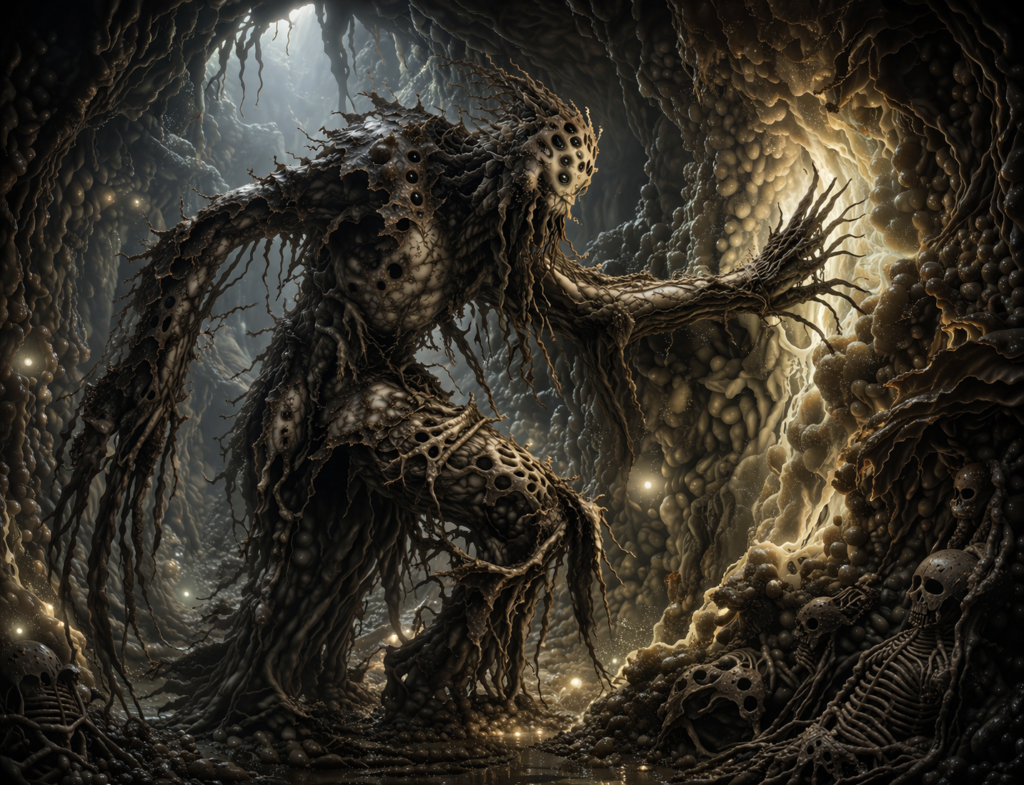
A D’ziriak is man-sized only in the loosest sense. Its body is a deliberate compromise between humanoid form and something far older and more invasive. Dark plates of polished chitin sheath the shoulders, ribs, forearms, and thighs, while softer flesh remains exposed between them, often threaded with faint fungal veining beneath the skin. The limbs are slightly too long, the joints too loose, the posture too balanced, as if the creature has been rebuilt for spaces where men were never meant to move.
The face is what lingers in memory. At first glance it seems almost elven, even refined, but the details do not hold. The eyes are too dark, too reflective, or too still. The cheekbones and brow may be edged with fine chitin ridges. The jaw opens a little too wide. In some, a pale fungal bloom gathers at the temples, throat, or spine, suggesting that the body is not merely altered, but still in the act of becoming.
No two D’ziriak look entirely alike. Each bears a different balance of flesh, plate, and growth, as though individuality has not been erased, but redirected into controlled mutation.
Behaviour
D’ziriak are patient to the point of menace. They do not waste motion, do not speak without purpose, and do not rush toward violence when time can do more damage than claws. In conversation they are often calm, observant, and disconcertingly reasonable. They ask questions that seem harmless, yet always circle toward usefulness, adaptability, and weakness.
This composure is not mercy. It is method.
A D’ziriak studies living things the way an engineer studies material. It judges what can endure, what can be reshaped, and what must be discarded. Even when peaceful, it carries the sense that it is measuring the world for incorporation. It does not need to hate an enemy to alter, infect, or consume them. It only needs to decide they belong in the next stage of growth.
Habitat
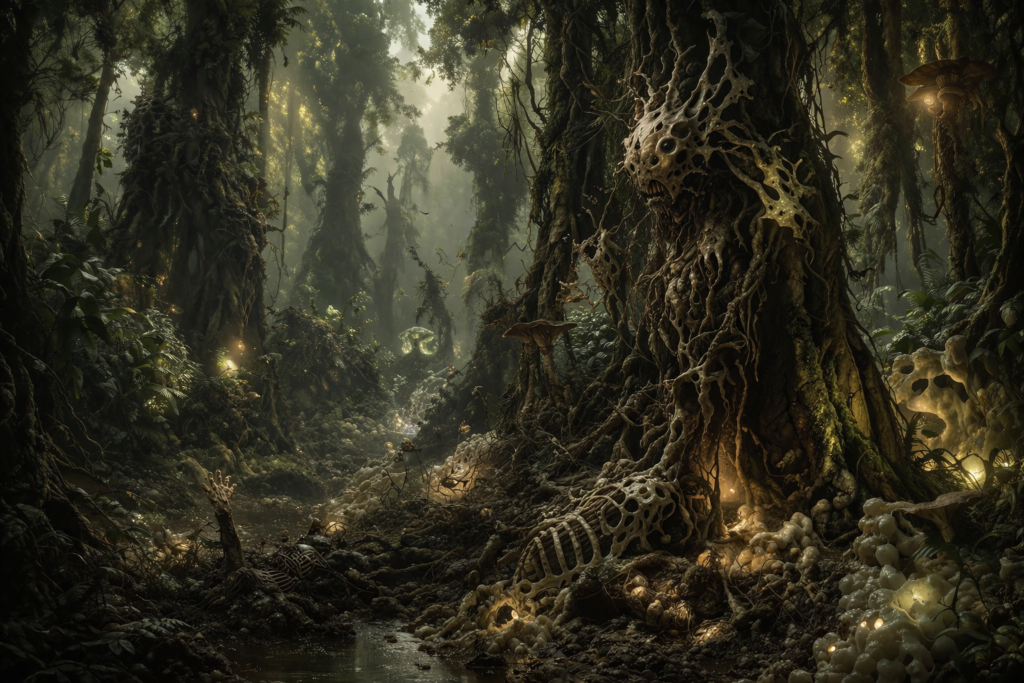
D’ziriak dwell in the deep earth, but not in the fashion of miners or masons. They do not carve halls from stone. They cultivate enclosed ecosystems of fungus, resin, mineral accretion, and living tissue, shaping them over years into chambers, tunnels, brood-vaults, and defensible warrens.
Their domains feel wrong even before their inhabitants are seen. Walls are slightly soft or faintly ridged beneath the hand. Surfaces glisten with a living damp. Air hangs thick with humidity, spores, and the smell of rot carefully kept from collapse. Passages narrow or widen over time. Chambers are sealed, digested, and regrown elsewhere. Defensive structures thicken where intrusion has occurred.
A D’ziriak colony is not a settlement built in hostile terrain. It is hostile terrain taught to organize itself.
Modus Operandi
D’ziriak expand by seeding first and arriving second.
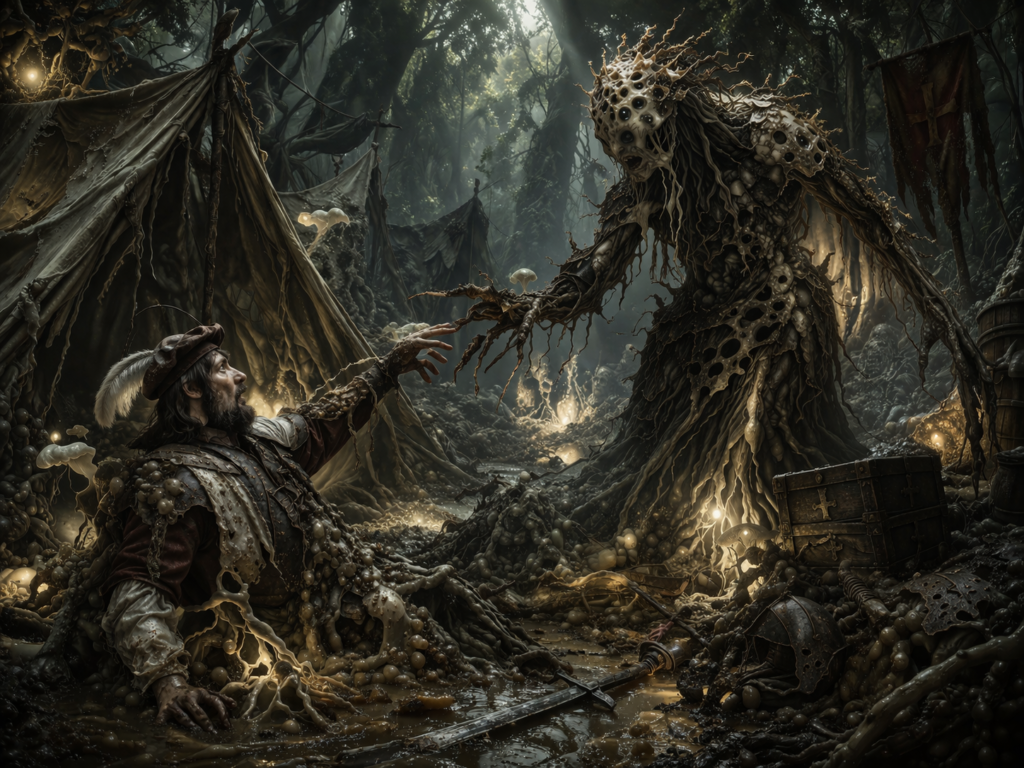
Their advance begins with spores in the air, fungal traces in water, symbiotic organisms introduced into vermin, beasts, and neglected corners of the dark. At first the signs are easy to dismiss: strange growth on stone, insects gathering in unusual numbers, an abandoned passage taking on the feel of a place no longer empty. Then the change deepens. Local life begins to shift. Surfaces become more hospitable to hidden growth. Breathing grows unpleasant. Native creatures grow sick, altered, or territorial.
By the time D’ziriak appear openly, the ground has often been prepared for them. In direct conflict they prefer isolation, attrition, and environmental control. They divide groups, exploit enclosed spaces, and force enemies to fight while already compromised by spores, fear, or the living architecture around them. They do not simply attack intruders. They let the intruder discover, too late, that the battlefield has been turning against them for days.
Motivation
D’ziriak believe that life in isolation is a flawed state. Flesh alone is weak. Independence is wasteful. Survival, adaptation, and continuity come through integration into a larger living system.
This is not metaphor to them. It is creed expressed as biology.
They do not seek conquest merely to rule. They seek to connect, absorb, and improve according to their own terrible standard of function. A creature that resists them is not morally offensive in their eyes, merely incomplete. A creature that yields is not enslaved, but made useful. This makes them deeply difficult to negotiate with. They can understand fear, grief, or disgust, but such feelings have little authority in their value system.
What makes the D’ziriak frightening is not madness, but conviction. They know exactly what they are doing, and they believe the future belongs to whatever can best survive by changing.
In the World
D’ziriak are strongest as a creeping threat rather than a sudden revelation. Their presence is felt in advance through altered ecosystems, infested ruins, breathing tunnels, sickly damp growth, and the unnerving suspicion that a place is becoming organized around alien life. Individual D’ziriak may appear as scouts, traders, emissaries, or quiet observers along deep roads, but even these encounters carry the pressure of something larger and already underway.
Used well, they turn a region into a question of contamination and time. The threat is not simply whether they can kill. It is how much of the surrounding world has already been prepared for their kind, and how much of what seems natural is now part of their design.
D’ziriak 5.5
D’ziriak, Pathfinder
D’ziriak
Symbiotic Architects of the Deep Growth
Medium aberration, lawful evil
Armor Class 16 (chitinous plating)
Hit Points 136 (16d8 + 64)
Speed 30 ft., climb 30 ft.
| STR | DEX | CON | INT | WIS | CHA |
|---|---|---|---|---|---|
| 14 (+2) | 16 (+3) | 18 (+4) | 14 (+2) | 15 (+2) | 13 (+1) |
Saving Throws Con +8, Int +6, Wis +6
Skills Insight +6, Perception +6, Stealth +7, Survival +6
Damage Resistances necrotic, poison
Condition Immunities poisoned
Senses darkvision 120 ft., tremorsense 30 ft. while in contact with organic ground, passive Perception 16
Languages Undercommon, Terran; telepathy 60 ft. with creatures infected by its spores
Challenge 9 (5,000 XP)
Proficiency Bonus +4
Traits
Adaptive Symbiosis. Once on each turn, when the D’ziriak takes acid, cold, fire, lightning, or thunder damage, it can gain resistance to that damage type until the end of its next turn.
Living Terrain. The D’ziriak ignores difficult terrain created by fungus, roots, organic growth, rubble, or undergrowth. It can climb organic surfaces, including walls and ceilings, without making ability checks.
Spore Haze. A 10-foot-radius cloud of drifting spores surrounds the D’ziriak. The area is lightly obscured for creatures other than D’ziriaks. A creature infected by a D’ziriak’s spores treats this area as difficult terrain.
Actions
Multiattack. The D’ziriak makes two attacks: two Chitin Blade attacks, or one Chitin Blade attack and one Infecting Touch.
Chitin Blade. Melee Weapon Attack: +7 to hit, reach 5 ft., one target.
Hit: 10 (2d6 + 3) slashing damage plus 7 (2d6) poison damage.
Infecting Touch. Melee Weapon Attack: +7 to hit, reach 5 ft., one creature.
Hit: 8 (1d10 + 3) necrotic damage, and the target must succeed on a DC 16 Constitution saving throw or become Infected.
Spore Burst (Recharge 5–6). The D’ziriak releases a dense cloud of symbiotic spores in a 20-foot-radius sphere centered on itself. Each creature of its choice in that area must make a DC 16 Constitution saving throw, taking 21 (6d6) poison damage on a failed save, or half as much damage on a successful one. A creature that fails the save is also Infected.
Bonus Actions
Symbiotic Shift. The D’ziriak alters its body to meet immediate threat. Until the start of its next turn, it gains one of the following benefits:
- advantage on attack rolls
- advantage on saving throws
- resistance to bludgeoning, piercing, and slashing damage
Reactions
Spore Reflux. When a creature within 5 feet of the D’ziriak hits it with a melee attack, the attacker must succeed on a DC 16 Constitution saving throw or take 7 (2d6) poison damage.
Infected
An infected creature is partially colonized by D’ziriak spores. At the start of each of its turns, it takes 5 (1d10) necrotic damage. It also has disadvantage on Wisdom (Perception) and Wisdom (Survival) checks, and the D’ziriak can communicate telepathically with it while it remains within 60 feet.
The infected creature repeats the saving throw at the end of each of its turns, ending the effect on a success. If it fails this saving throw three times before the effect ends, the infection stabilizes and lasts for 24 hours.
Treasure
A D’ziriak colony does not value treasure as surface dwellers do, but its chambers often contain absorbed remains, preserved tools, and reclaimed valuables. A typical lair cache includes 120–300 gp in mixed coinage, often embedded in resin or fungal mass; 1d4 organic valuables such as amber-bound jewelry, preserved bone carvings, resin-coated relics, or spore-treated cloth worth 50–150 gp each; and 1d2 useful consumables such as antitoxin, potions of healing, or fungal alchemical preparations.
There is also a 25% chance of a magic item suited to endurance, adaptation, or bodily resilience, such as a periapt of health, cloak of protection, or ring of mind shielding. Rarely, a colony chamber contains a living relic: an item altered by symbiotic growth that reacts subtly to its bearer and can serve as a plot hook.
Encounter Role
The D’ziriak is a controller-corruptor built for enclosed or overgrown battlefields. It weakens enemies through infection, punishes close engagement, and uses terrain to slow already compromised foes. It should feel patient, adaptive, and increasingly dangerous the longer the fight lasts.
D’ziriak
This four-armed creature looks like a cross between a human and a black and ochre termite. Its body and arms display glowing runes.
D’ziriak CR 3
XP 800
N Medium outsider (extraplanar)
Init +2; Senses darkvision 120 ft., low-light vision; Perception +9
DEFENSE
AC 16, touch 12, flat-footed 14 (+2 Dex, +4 natural)
hp 26 (4d10+4)
Fort +2, Ref +6, Will +6
OFFENSE
Speed 30 ft.
Melee 2 claws +6 (1d6+1 plus grab)
Special Attacks dazzling burst
Spell-Like Abilities (CL 3rd; concentration +6)
1/day—plane shift (self only, to Plane of Shadow only)
STATISTICS
Str 13, Dex 15, Con 12, Int 13, Wis 14, Cha 16
Base Atk +4; CMB +5 (+9 grapple); CMD 17
Feats Combat Reflexes, Weapon Focus (claw)
Skills Climb +8, Knowledge (arcana) +8, Knowledge (planes) +8, Perception +9, Sense Motive +9, Stealth +9, Survival +7, Use Magic Device +8
Languages D’ziriak; telepathy 100 ft.
SQ glow
SPECIAL ABILITIES
Dazzling Burst (Su)
Once per day, a d’ziriak can cause its body to flare with intense, colorful light as a swift action. Non-d’ziriaks within a 20-foot radius must make a DC 13 Fortitude save or be dazzled for 1 minute. After using this ability, the d’ziriak’s brilliant glow is extinguished for 24 hours. This ability is a light effect, and creatures that cannot see are immune to it. The save DC is Constitution-based.
Glow (Ex)
The colorful runes that decorate a d’ziriak’s body create dim light in a 20-foot radius from its body.
ECOLOGY
Environment any land (Plane of Shadow)
Organization solitary, pair, swarm (3–20), or hive (21–100)
Treasure standard
Natives of the Plane of Shadow, d’ziriaks are a very mysterious race of human-sized insectoids. From their partially buried hive cities rise spires and steeples adorned with alchemical fire and illusory flame, dim beacons of sanctuary in the foreboding twilight. The d’ziriaks remain staunchly neutral in most affairs, and are typically happy to converse with travelers via their eerie telepathy (their own language of buzzes and chitters is an obscure one known by few outside their race), but their unknown, obscure goals lead most others to regard this race with caution.
The average d’ziriak is 7 feet tall and has four arms, two legs, a termite-like abdomen, and a mandibled visage somewhere between that of insect and human. Two of its arms are large and possess sharp claws, while the other two are relatively small and used for fine manipulations, not combat. Strangely for a race native to the realm of shadows, the d’ziriaks have a colorful collection of runic shapes, almost like glowing tattoos, upon their chitinous flesh. These runes help to denote what role in d’ziriak society each of these beings serves.
D’ziriaks rarely travel off the Plane of Shadow except on orders of their rulers, and prefer to live their lives out in their hive cities. They remain open to trade and diplomacy with any brave enough to travel the Plane of Shadow, and are valued by many both on and off their plane for their artisans’ ability to weave light into tangible art and create weapons of great quality and beauty.
Section 15: Copyright Notice
Pathfinder Roleplaying Game Bestiary 2, © 2010, Paizo Publishing, LLC; Authors Wolfgang Baur, Jason Bulmahn, Adam Daigle, Graeme Davis, Crystal Frasier, Joshua J. Frost, Tim Hitchcock, Brandon Hodge, James Jacobs, Steve Kenson, Hal MacLean, Martin Mason, Rob McCreary, Erik Mona, Jason Nelson, Patrick Renie, Sean K Reynolds, F. Wesley Schneider, Owen K.C. Stephens, James L. Sutter, Russ Taylor, and Greg A. Vaughan, based on material by Jonathan Tweet, Monte Cook, and Skip Williams.
Keep this reference growing
If this page helped with your reading or game, you can support its upkeep or explore the curated books.
Explore the Bookshop — epics, classics and stories behind imagined worlds.