
Wakwak, Terror of the Night Roofs
Wakwak, Terror of the Night Roofs
The wakwak is a flesh-rending hunter of the Philippine night — one of the dreaded aswang forms whose cry drifts through darkness while the creature itself comes silently nearer.
Lore
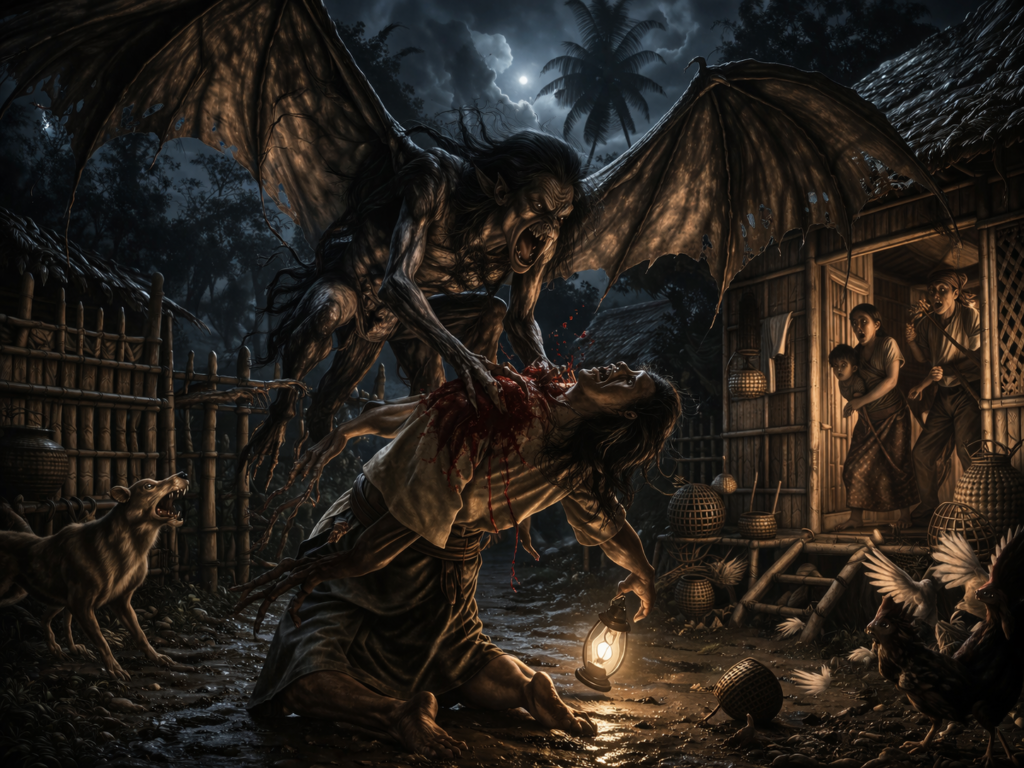
The wakwak is one of the feared night-hunting forms within the aswang world of the islands: a vampiric, bird-like predator known for its dreadful cry, its sudden descent from darkness, and the terror of realizing that the sound has grown fainter because the creature itself has come close. It belongs to the fear of the open night above the village, of unseen wings beyond the roofline, of something descending from darkness upon the living.
The wakwak is strongest when treated as a named and recognizable hunting type within the wider aswang tradition, not as a creature with one perfectly fixed form in every place. In one place it may be spoken of as a bird-like vampire with ripping talons. In another it may be remembered as a winged night fiend whose cry deceives the listener about distance. In another it may blur with neighboring aswang traditions while still keeping its own central identity. What remains constant is the experience it creates: the night cry, the overhead approach, the sudden strike, and the sense that the darkness above human habitation is not empty.
It belongs to bamboo groves, coconut stands, rice-field margins, village paths, riversides, mangrove edges, upland tracks, and the dark belts of trees beyond settled ground. It moves naturally through humid air, insect-filled dark, drifting mist, moonlit roofs, and the uncertain boundary between household safety and the greater living dark. It is a creature of the tropical night as people actually endure it, not of distant ruins or invented wilderness.
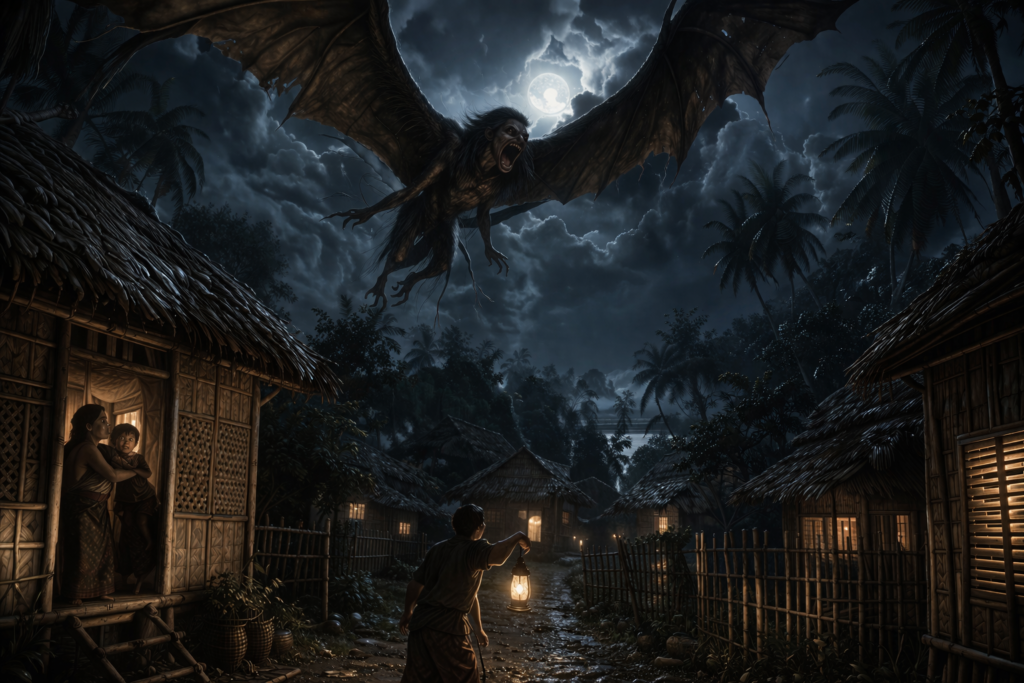
The wakwak is feared not only because it kills, but because it alters behavior. Once it is believed to be near, people do not linger outside after dark. Children are called in. Lamps are guarded. Roofs are checked. The barking of dogs, the panic of poultry, the silence of certain night sounds, and the wrong rhythm of wings all become signs that something more than an ordinary predator is moving nearby. Its terror is social as much as physical. It presses on households, kinship, watchfulness, and nightly custom.
A wakwak does not belong to tombs or castles. It belongs to the living settlement and the dangerous spaces around it. It hunts where people still move after sundown: along footpaths, near riverbanks, in clearings beside houses, through groves behind villages, over fishing landings, beside isolated huts, at the edge of fields, or where the sick, pregnant, wounded, or unwary are thought to be vulnerable. It does not make the world uncanny by changing one distant place. It makes the ordinary night untrustworthy.
Appearance
A wakwak should not be imagined as a simple oversized bird. It is better understood as an aswang-like night predator whose shape sits disturbingly between human, bat, and carrion bird. At first glance, especially in poor light, it may seem almost man-sized, lean and angular, but when it unfolds fully for the hunt it becomes all wing, hook, claw, and predatory intent.
Its wings may be leathery and bat-like in some tellings, yet its movement and silhouette should still carry something avian: a hooked downward turn, a snapping descent, a perching stillness before violence, a head movement too quick and too precise. The body should feel unnaturally light and yet violently powerful in the strike. Its limbs are long, thin, and dangerous, ending in talons made for grasping, tearing, and opening flesh. The face may preserve some hint of humanity, or it may seem more wholly transformed, but in either case it should feel like a thing that belongs above roofs in darkness, not on the ground among the living.
Its eyes should read clearly in night encounters: watchful, predatory, and disturbing in low light. The mouth may be human enough to make it worse, or hooked and flesh-rending enough to suggest a predator shaped for tearing meat, depending on the emphasis you want, but the creature should never become a generic harpy or a mere monster-bird. It must remain distinctly wakwak: a night hunter of the aswang world.
Behaviour
A wakwak is a deliberate predator, not a mindless beast. It watches, chooses, circles, and descends. It prefers the vulnerable, the isolated, and the poorly protected. It may stalk a settlement for several nights before attacking, learning who returns home late, which houses keep poor watch, where dogs bark first, and where the lamps burn lowest.
Its cry is one of its most frightening features. The sound does not merely announce its presence. It unsettles the listener because it seems to suggest distance while the creature itself closes in. People hear it, judge it far off, relax too soon, and then discover too late that the sound has lied.
When the wakwak attacks, it prefers speed, surprise, and bodily ruin. It descends hard, tears with talons, rends flesh, and withdraws before organized resistance can fully form. It should feel cruel and efficient rather than berserk. A wakwak does not linger to be admired as a dramatic monster. It strikes like a thing made for panic and disruption.
Outside the immediate hunt, the wakwak may perch unseen above a roof, in a tree, on a ruined structure, or along a cliff face, listening and waiting. It is patient enough to remain motionless for long periods, letting fear do part of the work. It becomes most effective when the people below know something is near but cannot yet prove where.
Habitat
The wakwak belongs to the night world of villages, groves, tree belts, rivers, wetlands, field margins, coastal thickets, and upland dark.
Its resting places are best imagined as concealed roosts rather than lairs in the dungeon sense. A balete tree, a dark mangrove cluster, a vine-choked ruin, a hollow above a river gorge, a hidden perch in a tall stand of bamboo, an abandoned watch structure, or some avoided patch of overgrowth near a settlement are all stronger homes for it than a cave full of treasure. Even when there are bones, cloth scraps, blood-dark signs, or stolen ornaments nearby, the place should feel like a base for hunting and concealment rather than a beast’s nest.
A wakwak is most effective when its habitat overlaps directly with human life. It should not live so far away that only adventurers ever meet it. It should exist just beyond where ordinary people feel safe to walk after sunset.
Modus Operandi
A wakwak hunts from above, from concealment, and from uncertainty. It circles, watches, listens, then dives. It prefers broken formation, exposed victims, and dim or unstable light. It attacks roofs, courtyards, paths, field edges, and riverbanks where people are briefly isolated from help.
Its first advantage is fear. Its second is vertical movement. Its third is that people rarely see it clearly before someone is already bleeding. In combat terms, it should be built around sudden descent, ripping attacks, repositioning upward or into darkness, and forcing victims to look up while danger moves in from another angle.
It should avoid standing toe-to-toe on the ground unless trapped, wounded, or maddened by hunger. A wakwak that simply lands and trades blows loses much of what makes it frightening. It should dive, rake, retreat, circle, cry from darkness, and reappear where torchlight is weakest. Roof beams, branches, rafters, cliff edges, and shadowed perches are all part of its battlefield.
Its attacks should feel savage and immediate: slashed shoulders, opened backs, torn throats, blood in the yard before the victim ever sees the full outline of the attacker. Even where it kills quickly, the real pressure of the wakwak is that it destroys the sense that the dark overhead is empty.
Motivation
At its simplest, the wakwak is driven by hunger, malice, and the desire to hunt human beings under cover of darkness.
But because it belongs to the wider aswang tradition, it can also be tied to deeper causes. It may be a creature in its own right, a form assumed by another aswang, the result of curse or inherited corruption, or the outward expression of a bloodline touched by older evil. That flexibility is useful. It lets the wakwak remain recognizably itself while still fitting into broader supernatural logic.
What matters most is that its motives remain predatory, intimate, and local. This is not a conqueror, schemer, or ancient mastermind unless a particular story pushes it that way. The wakwak is frightening because it makes ordinary people feel hunted in the dark around their own homes.
Using the Wakwak in a Campaign
A wakwak works best when introduced through sound, altered routine, and social fear before the creature is ever seen properly. Dogs bark at the wrong hour. Poultry panic. A distant cry is heard over the fields. A fisherman does not return. A wound is found on someone who swears nothing was there a moment before. People begin lighting extra lamps, closing shutters, and refusing to walk alone after dark.
Good roles for a wakwak include a village terror preying on the vulnerable, a night hunter circling a riverside settlement, a blood-soaked thing roosting above an upland track, an aswang-related predator tied to one cursed household, or a recurring unseen threat whose cry becomes more feared each night until the party finally tracks it into the dark.
Used properly, the wakwak is not just another flying monster. It is a regional embodiment of a specific dread: that the dark above the house is inhabited, that the night call lies about distance, and that what descends from the unseen air may already have chosen who it means to tear open.
Wakwak 5.5
Wakwak, Pathfinder
Wakwak
Medium monstrosity, chaotic evil
Armor Class 16 (natural armor)
Hit Points 127 (15d8 + 60)
Speed 20 ft., climb 20 ft., fly 70 ft.
| STR | DEX | CON | INT | WIS | CHA |
|---|---|---|---|---|---|
| 18 (+4) | 18 (+4) | 18 (+4) | 10 (+0) | 15 (+2) | 13 (+1) |
Saving Throws Dex +8, Con +8, Wis +6
Skills Perception +6, Stealth +8, Survival +6
Damage Resistances necrotic; bludgeoning, piercing, and slashing from nonmagical attacks
Senses darkvision 120 ft., passive Perception 16
Languages understands Common and one regional tongue but rarely speaks
Challenge 8 (3,900 XP)
Proficiency Bonus +3
Traits
Night Hunter. The wakwak has advantage on Dexterity (Stealth) checks made in dim light or darkness. While in dim light or darkness, it can take the Hide action as a bonus action.
False Distance Cry. Creatures that hear the wakwak have disadvantage on Wisdom (Perception) checks made to determine its location by sound alone.
Flyby. The wakwak doesn’t provoke opportunity attacks when it flies out of an enemy’s reach.
Predator of the Vulnerable. Once on each of its turns, the wakwak deals an extra 7 (2d6) damage to one creature it hits with a melee attack if that creature is prone, surprised, frightened, or has no ally within 5 feet of it.
Actions
Multiattack. The wakwak makes three attacks: one with its Bite and two with its Talons, or one with its Dive Rake and two with its Talons.
Bite. Melee Weapon Attack: +8 to hit, reach 5 ft., one target. Hit: 11 (2d6 + 4) piercing damage plus 7 (2d6) necrotic damage.
Talons. Melee Weapon Attack: +8 to hit, reach 5 ft., one target. Hit: 13 (2d8 + 4) slashing damage.
Dive Rake. Melee Weapon Attack: +8 to hit, reach 5 ft., one target. Hit: 18 (4d6 + 4) slashing damage, and the target must succeed on a DC 16 Strength saving throw or be knocked prone. The wakwak can then fly up to half its flying speed without provoking opportunity attacks.
Rend the Fallen. The wakwak tears into one prone creature within 5 feet of it. The target must make a DC 16 Constitution saving throw, taking 27 (6d8) slashing damage on a failed save, or half as much damage on a successful one. The wakwak can’t use this action again until it has moved at least 20 feet on one of its turns.
Wakwak Cry (Recharge 5–6). The wakwak releases its uncanny hunting cry. Each creature of the wakwak’s choice within 60 feet that can hear it must succeed on a DC 14 Wisdom saving throw or become frightened until the end of the wakwak’s next turn. Until this effect ends, an affected creature also has disadvantage on Wisdom (Perception) checks. A creature that fails this saving throw while it has no ally within 5 feet of it also has its speed reduced by 10 feet until the effect ends.
Bonus Actions
Shadowed Ascent. The wakwak moves up to half its flying speed to a roofline, branch, rafter, ledge, or similar perch it can reach. This movement does not provoke opportunity attacks.
Reactions
Sudden Veer. When the wakwak is hit by a ranged attack while flying, it gains a +3 bonus to AC against that attack, potentially causing it to miss.
Tactics
A wakwak should not stand and fight fairly on the ground unless trapped. It circles in darkness, cries from uncertain distance, dives on isolated targets, and retreats upward before defenders can close around it. It prefers to strike victims who are alone, frightened, wounded, prone, or caught away from strong light.
Treasure
A wakwak does not keep treasure as a guardian, miser, or collector of wealth. What is found in its roost is the leavings of predation: things taken from the dead, torn from the living, or carried off in panic and bloodshed. Its hoard should feel intimate, accidental, and disturbing rather than rich.
Most wakwak treasure consists of small personal possessions rather than organized wealth. Earrings, hairpins, knives, amulets, finger-rings, bracelets, beads, belt ornaments, religious charms, fishhooks, children’s trinkets, small coin purses, and household keepsakes are all more fitting than chests of coin. Bloodstained cloth, torn sashes, broken combs, snapped prayer strings, and ornaments still tangled in hair or fabric are especially appropriate. Even when coin is present, it should usually appear in small scattered amounts, carried by victims rather than stored deliberately.
A typical wakwak roost may contain 300 to 1,200 gp in mixed valuables, though much of that value comes from jewelry, ornaments, silver pieces, and personal objects rather than currency alone. The important thing is not abundance. It is recognition. The party should be able to look at the finds and understand that these belonged to people.
A wakwak’s treasure becomes strongest in play when it creates aftermath. Good finds include:
- A wedding ornament still stained with old blood. This may identify one of the monster’s victims and reopen grief, vengeance, or suspicion in a nearby settlement.
- A child’s amulet or charm. Proof that the creature has preyed on the young, or that a family’s protections failed when they mattered most.
- A fisherman’s blade or ferryman’s token. Evidence that the wakwak hunts not only near houses, but along river crossings, landing places, and water routes after dark.
- A religious charm, saint-token, anting-anting, or household protection that did not save its bearer. This can raise questions about whether the charm failed, was broken, was the wrong protection for this creature, or was overcome by greater malice.
- A cluster of earrings, rings, or hair ornaments from several victims. Not treasure in the triumphant sense, but proof of repeated predation over time.
- A keepsake tied to one missing person long believed gone elsewhere. Something that turns absence into certainty.
- A bloodstained pouch of coin hidden among roots, rafters, or nesting debris. Not because the wakwak values money, but because it carried off the body and the purse remained with it.
A wakwak’s roost should also reflect how it lives. Treasure may be caught in roots, wedged in beams, half-buried in droppings, tangled in nesting material, or lying among bones, feathers, scraps of cloth, and old blood-dark stains. A roofspace roost may contain household objects dropped between rafters. A balete tree lair may hold ornaments snagged in bark and hanging roots. A mangrove roost may mix valuables with mud, shells, reeds, and water-damaged remains. Nothing should feel stacked, sorted, or kept with pride. This is not custody. It is predation.
For play purposes, it helps to think of wakwak treasure in three layers:
- Immediate remains: the valuables still on or near the latest victim, such as a knife, charm, ring, sash ornament, or small coin pouch.
- Roost scatter: the broader accumulation of jewelry, keepsakes, tokens, and personal possessions left among bones, stains, roots, beams, or nesting debris.
- Story objects: one or two items that matter beyond value — proof of identity, proof of repeated attacks, a failed protection charm, a missing heirloom, or an object tying the wakwak to a household, route, or old killing.
The most important principle is this: a wakwak’s treasure should make the party think first about who was taken, not what was gained. It should feel less like looting a monster’s hoard and more like standing among the visible remains of fear, hunger, and repeated loss.
Wakwak
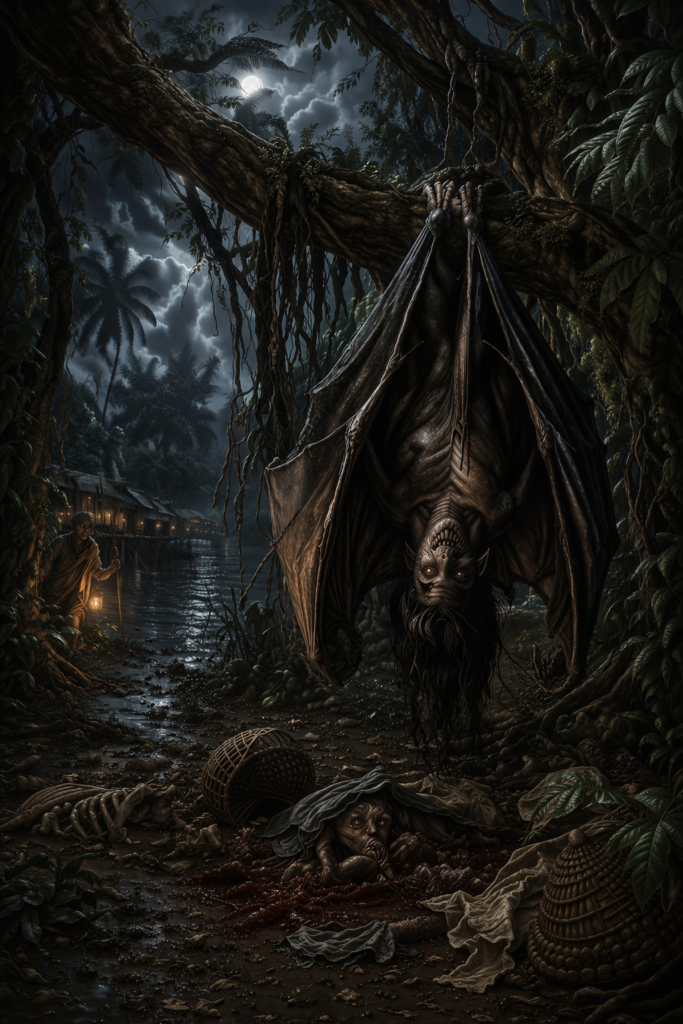
This hideous creature has the head of a leering old woman growing from the body of a great furry bat. Its legs are tipped with sharp claws and a long tongue whips from between its slavering jaws. Its wings have a razor-sharp edge, stained brown with dried blood.
Taken from Creature Codex
Wakwaks are horrific vampiric beasts native to jungles. Unlike many such blood-drinkers, wakwaks are vicious fighters and are as likely to outright kill a victim as they are to leave them drained but alive. Although wakwaks can suck the blood from victims delicately, they are every bit as eager to lick up the leavings of a gore-soaked corpse. Their favorite food is a still-beating humanoid heart, and such victuals give these creatures an unnatural vitality.
Male wakwaks do exist, although they are very rare; about ten females exist for every male. Mating rights are the subject of brutal fights between females that often leave multiple wakwaks dead. Wakwaks are poor parents, leaving their children on their own shortly after birth. Even baby wakwaks have shapeshifting powers, however, and juveniles typically live out their lives disguised as bats until they are strong enough to tackle large prey.
A wakwak stands about three feet tall and weighs 40 pounds. Their wingspan stretches out to ten feet. They are clumsy on the ground, scrabbling on their wings and feet like a bat, but are very maneuverable in the air. Nocturnal, they typically sleep in high trees during the day while transformed into a bat.
Wakwak CR 5
XP 1,600
CE Medium magical beast
Init +4; Senses darkvision 60 ft., Perception +6, scent
Defense
AC 17, touch 15, flat-footed 12 (+4 Dex, +1 dodge, +2 natural)
hp 51 (6d10+18)
Fort +8, Ref +9, Will +3; evasion
Offense
Speed 20 ft., fly 40 ft. (good)
Melee bite +8 (1d4+2 plus grab), 2 claws +8 (1d6+2), 2 wings +6 (1d6+1 plus bleed)
Special Attacks bleed (1d6),blood drain (1d3 Con), eat heart, grab
Statistics
Str 15, Dex 18, Con 16, Int 7, Wis13, Cha 14
Base Atk +6; CMB +8 (+12 grapple); CMD 23
Feats Dodge,Hover, Multiattack
Skills Fly +12, Perception +6, Stealth +9
Languages Common
SQ change shape (fruit bat (as hawk) or dire bat, beast shape II),soundwarp
Ecology
Environment warm forests
Organization solitary, pair or flock (3-6)
Treasure incidental
Special Abilities
Eat Heart (Su) A wakwak can eat the heart of a foe that it slays with a coup de grace effect. If it does so, it gains the benefits of a false life spell (CL 6th) and gains a +2 enhancement bonus to Strength and Dexterity that lasts for 10 minutes.
Soundwarp (Su) The distance penalties for Perception checks used to detect a wakwak are reversed within 100 feet. Thus, a creature 100 feet away from a wakwak may make Perception checks against it at no penalty, but a creature 10 feet or closer to a wakwak take a -10 penalty on their Perception checks.
Keep this reference growing
If this page helped with your reading or game, you can support its upkeep or explore the curated books.
Explore the Bookshop — epics, classics and stories behind imagined worlds.