
 Buy me a coffee
Pard: Phantom Predator of the Untamed Wilderness
The Pard — A Phantom-Spotted Stalker of the Wilds Whose Silent Grace and Razor Cunning Make It One of Nature’s Deadliest Hunters.
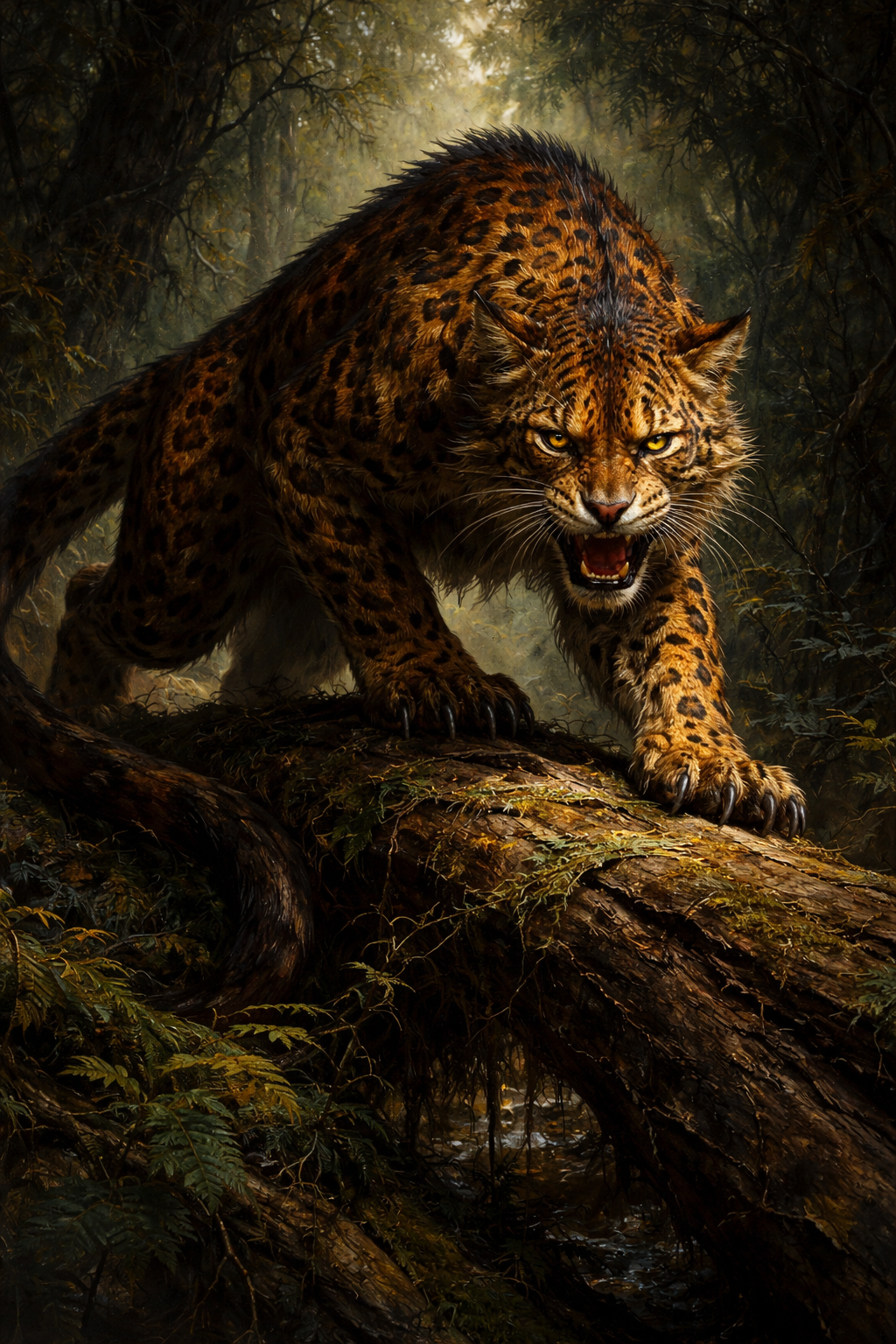
The pard is a massive, elusive great cat of the deep wilderness, revered in ancient bestiaries as the primal ancestor of all spotted predators. Larger and more cunning than a leopard, the pard is a master of patience and ambush, capable of stalking prey for hours—or even days—before striking with explosive speed. Though it appears to be a natural beast, many sages suspect the pard possesses a trace of ancient primal magic that allows it to vanish into shadow and move through dense terrain almost unseen.
Lore
“Where the birds fall silent and the forest holds its breath, the pard is already near.”
Hunters say a pard can stalk a traveler for three days without leaving a single track behind.
Ancient chronicles describe the pard as one of the oldest predators of the wild world, a creature whose lineage stretches back to the earliest ages of nature. Its name appears in countless bestiaries, where it is portrayed as the perfect embodiment of stealth, patience, and predatory instinct.
Medieval natural philosophers believed the pard to be the progenitor of many great feline beasts. Some even claimed that the legendary panther was born from the union of a lion and a pard, a myth that elevated the pard to near-mythic status among scholars and hunters alike.
Appearance
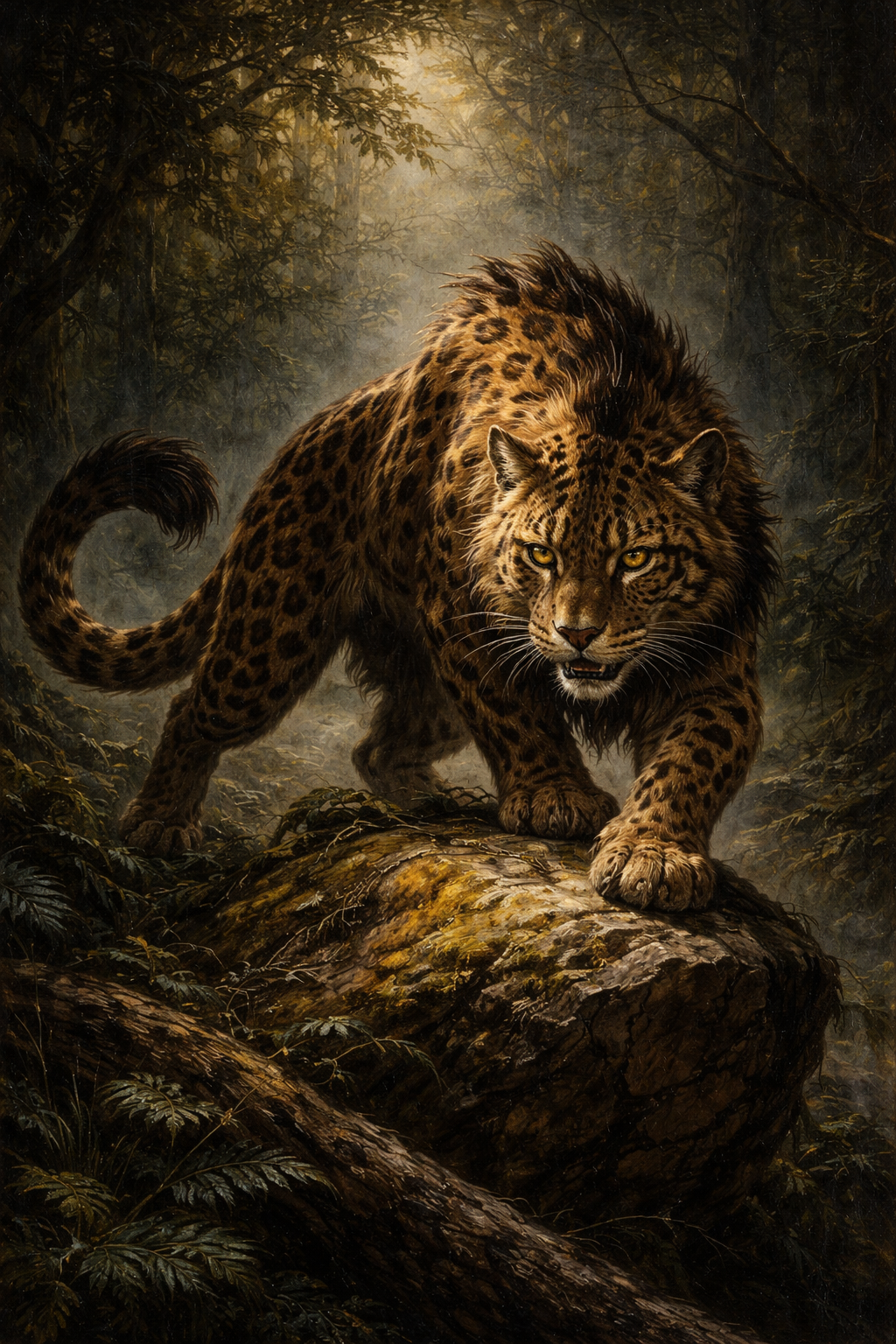
The pard resembles an immense leopard or panther, larger and more powerfully built than its mundane relatives. Standing nearly as tall as a pony at the shoulder and stretching more than ten feet from nose to tail, the creature’s body is lean, flexible, and heavily muscled.
Its coat ranges from rich gold to smoky amber, marked with dark rosettes that break up its outline in foliage and shadow. The pard’s eyes—often emerald, amber, or molten gold—reflect a keen predatory awareness.
Broad padded paws allow it to move almost without sound, while its long tail provides balance during leaps and climbs. Its jaws carry curved ivory fangs capable of piercing armor or crushing bone, and its retractable claws are long, hooked, and razor sharp.
When crouched in brush or perched along branches, a pard seems almost to dissolve into its surroundings.
Behaviour
Pards are solitary, highly territorial hunters. They display extraordinary patience, often observing prey from concealment for hours before attacking.
Unlike many predators, the pard rarely wastes energy on reckless pursuits. Instead it studies its prey carefully, waiting until the perfect moment when the target is isolated, distracted, or vulnerable.
Older pards show remarkable cunning. They may circle camps, test traps, or deliberately drive prey into terrain where escape becomes impossible.
When threatened or cornered, a pard becomes fiercely aggressive and fights with frightening speed and agility.
Habitat
Pards favor dense forests, tangled jungles, rocky highlands, and deep river valleys where broken terrain and heavy vegetation allow them to stalk unseen.
Each pard controls a vast territory that can span dozens of miles. Within this range it maintains several hidden dens—often caves, fallen tree hollows, or elevated rocky ledges.
Travelers may pass through a pard’s territory many times without ever seeing the creature that watches them from the shadows.
Modus Operandi
The pard hunts primarily through stealth and ambush. It moves silently through brush, along cliff edges, or through tree branches before launching a sudden, devastating leap.
The creature attempts to pin prey beneath its weight and deliver a killing bite to the throat or spine. If the first attack fails, the pard retreats immediately and resumes stalking, often attacking again from a new direction.
Against groups, the pard targets stragglers first, isolating victims before committing to a full assault.
Motivation
The pard is driven by instinct—hunger, territory, and survival. Yet older specimens exhibit a fierce territorial pride, defending their hunting grounds against rival predators and intruding humanoids.
Some sages believe particularly ancient pards develop a rudimentary strategic awareness, treating their territory almost as a domain to be ruled.
Ecology
As apex predators, pards regulate populations of deer, boar, and other large animals. They are opportunistic hunters and will prey on livestock or unwary travelers when natural prey becomes scarce.
A pard typically maintains several resting dens across its territory. Cubs are rare and remain hidden for months while they learn the silent stalking techniques essential for survival.
Scholars & Rumours
Natural philosophers debate whether the pard is merely an unusually large species of leopard or something older and stranger. Some claim the creature’s uncanny stealth cannot be explained by natural means alone.
Others point to ancient manuscripts suggesting the pard once gave rise to the mythical panther. If those legends hold any truth, the pard may be the ancient root of many great feline monsters that haunt the wild places of the world.
Pard 2024 5.5e
Pard Pathfinder
Pard
Large Beast, Unaligned
Armor Class 14 (natural armor)
Hit Points 95 (10d10 + 40)
Speed 50 ft., climb 30 ft.
| STR | DEX | CON | INT | WIS | CHA |
|---|---|---|---|---|---|
| 18 (+4) | 17 (+3) | 18 (+4) | 4 (−3) | 14 (+2) | 8 (−1) |
Saving Throws Dex +6, Wis +5
Skills Perception +7, Stealth +9
Senses darkvision 60 ft., passive Perception 17
Languages —
Challenge 5 (1,800 XP)
Proficiency Bonus +3
Traits
Apex Stalker. The pard has advantage on Dexterity (Stealth) checks made in forests, jungles, or rocky terrain.
Keen Senses. The pard has advantage on Wisdom (Perception) checks that rely on hearing or smell.
Ambusher. During the first round of combat, the pard has advantage on attack rolls against any creature that hasn’t taken a turn yet.
Pounce. If the pard moves at least 20 feet straight toward a creature and then hits it with a Claw attack on the same turn, the target must succeed on a DC 15 Strength saving throw or be knocked prone. If the target is prone, the pard can make one Bite attack against it as a Bonus Action.
Actions
Multiattack. The pard makes two attacks: one with its Bite and one with its Claws.
Bite. Melee Attack Roll: +7, reach 5 ft.
Hit: 15 (2d10 + 4) piercing damage.
Claws. Melee Attack Roll: +7, reach 5 ft.
Hit: 11 (2d6 + 4) slashing damage.
Bonus Actions
Sudden Leap. The pard jumps up to 20 feet to an unoccupied space it can see. This movement doesn’t provoke opportunity attacks.
Tactics
A pard prefers to stalk prey from concealment, using trees, rocks, or tall grass as cover before launching a sudden pouncing attack. It targets isolated creatures first and withdraws quickly if a fight turns against it. When defending its territory or cubs, however, the pard fights with relentless ferocity.
Pard
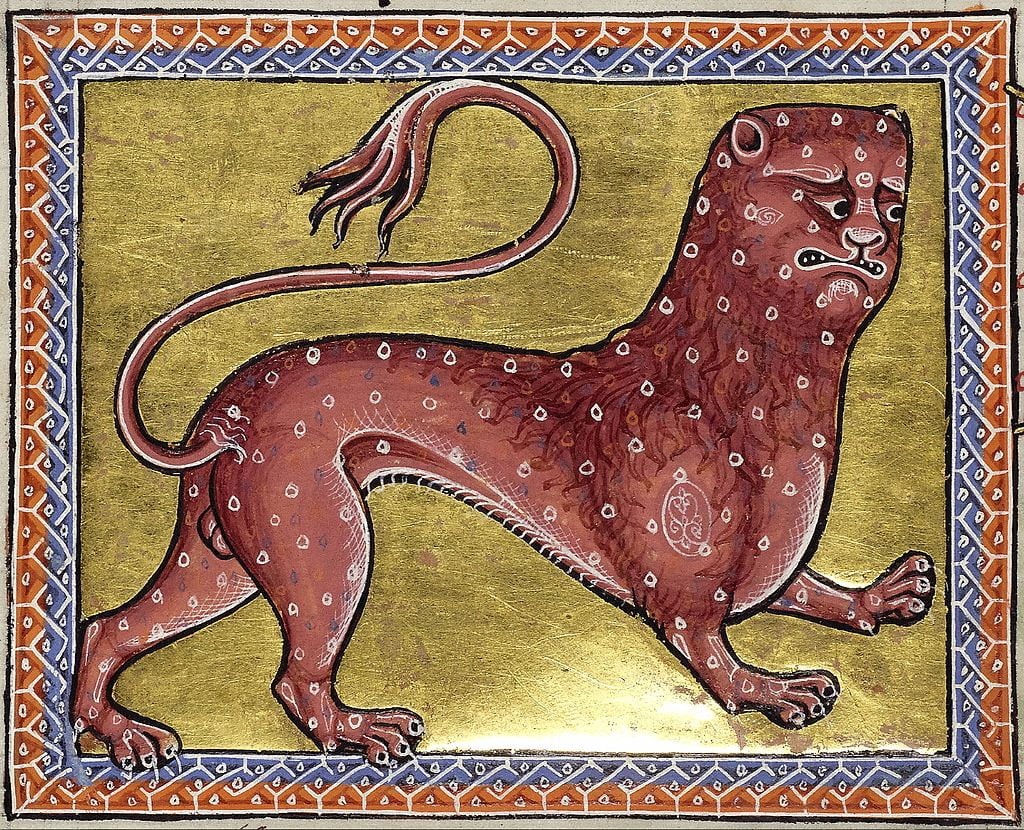
This brightly-colored feline blur resembles a cheetah with longer fur and lynx-like ears, and seems to scorch the air as it moves.
Pard CR 3
XP 800
CN Medium magical beast
Init +7; Senses darkvision 60 ft., low-light vision, scent; Perception +6
DEFENSE
AC 20, touch 18, flat-footed 12 (+7 Dex, +1 dodge, +2 natural
hp 26 (4d10+4)
Fort +5, Ref +11, Will +2; +4 vs. poison
Defensive Abilities evasion, improved uncanny dodge, uncanny dodge; DR 5/magic; Resist electricity 10, fire 10
OFFENSE
Speed 120 ft.
Melee bite +12 (1d6+2), 2 claws +7 (1d4+1)
Special Attacks phasing attack
STATISTICS
Str 15, Dex 24, Con 12, Int 4, Wis 13, Cha 11
Base Atk +4; CMB +6; CMD 24 (28 vs. trip)
Feats Dodge, MobilityB, Spring AttackB, Weapon Finesse, Wind StanceB
Skills Acrobatics +15 (+27 when jumping), Perception +6, Stealth +15; Racial Modifiers +4 Acrobatics (+16 when jumping), +4 Stealth
Languages telepathy (empathy) 60 ft.
SPECIAL ABILITIES
Empathy (Su)
Pards can transmit complex emotions and basic ideas to other pards. When interacting with other kinds of creatures, they can only convey simple emotions such as anger, fear, and curiosity.
Phasing Attack (Su)
As a full-round action, a pard can shift itself partially out of phase, damaging any creature it moves through. This works like the overrun combat maneuver, but the pard must move at least 30 feet and it gains a +4 bonus on the check. If it succeeds, the target takes 2d6 points of fire damage. If it exceeds a creature’s CMD by 5 or more, it stuns the creature for 1 round instead of knocking it prone.
The target can make an attack of opportunity, but at a –4 penalty. If the target forgoes an attack of opportunity provoked by this maneuver, it can try to avoid the pard by attempting a DC 19 Reflex save; if successful, it takes only half damage.
The pard can only deal phasing attack damage to each target once per round, no matter how many times its movement takes it over a target creature. When using this ability, the pard can move through up to 5 feet of any solid object, barrier, or difficult terrain as if it were a normal open square. The pard cannot end its movement inside a creature or solid barrier. This ability counts as trample for the purposes of effects that enhance or protect against trample. The save DC is Dexterity-based.
ECOLOGY
Environment temperate or warm forests or plains
Organization solitary, pair, or den (1–2 adults and 1–4 cubs)
Treasure incidental
Pards are alien catlike creatures known for their unnatural swiftness. They have sleek, short-furred bodies and long legs built for speed. Their color and markings vary widely, even among members of the same family, ranging through every color imaginable, with some bearing stripes, others spots, and a few solid-colored coats. Adult pards are 6 feet long and weigh 100 pounds.
Pards are carnivores and usually hunt small game and larger birds (such as swans), though many have developed a fondness for the flesh of gnomes and quicklings. Smarter than common beasts, pards are semi-intelligent, mate for life, and have a complex social structure. Pards also possess a form of telepathy they use to communicate amongst themselves, and can use this on a limited basis to confront intruders or create mutually beneficial alliances.
Section 15: Copyright Notice
Pathfinder Roleplaying Game Bestiary 4 © 2013, Paizo Publishing, LLC; Authors: Dennis Baker, Jesse Benner, Savannah Broadway, Ross Byers, Adam Daigle, Tim Hitchcock, Tracy Hurley, James Jacobs, Matt James, Rob McCreary, Jason Nelson, Tom Phillips, Stephen Radney-MacFarland, Sean K Reynolds, F. Wesley Schneider, Tork Shaw, and Russ Taylor.