
Catoblepas — The Downward-Looking Death Beast
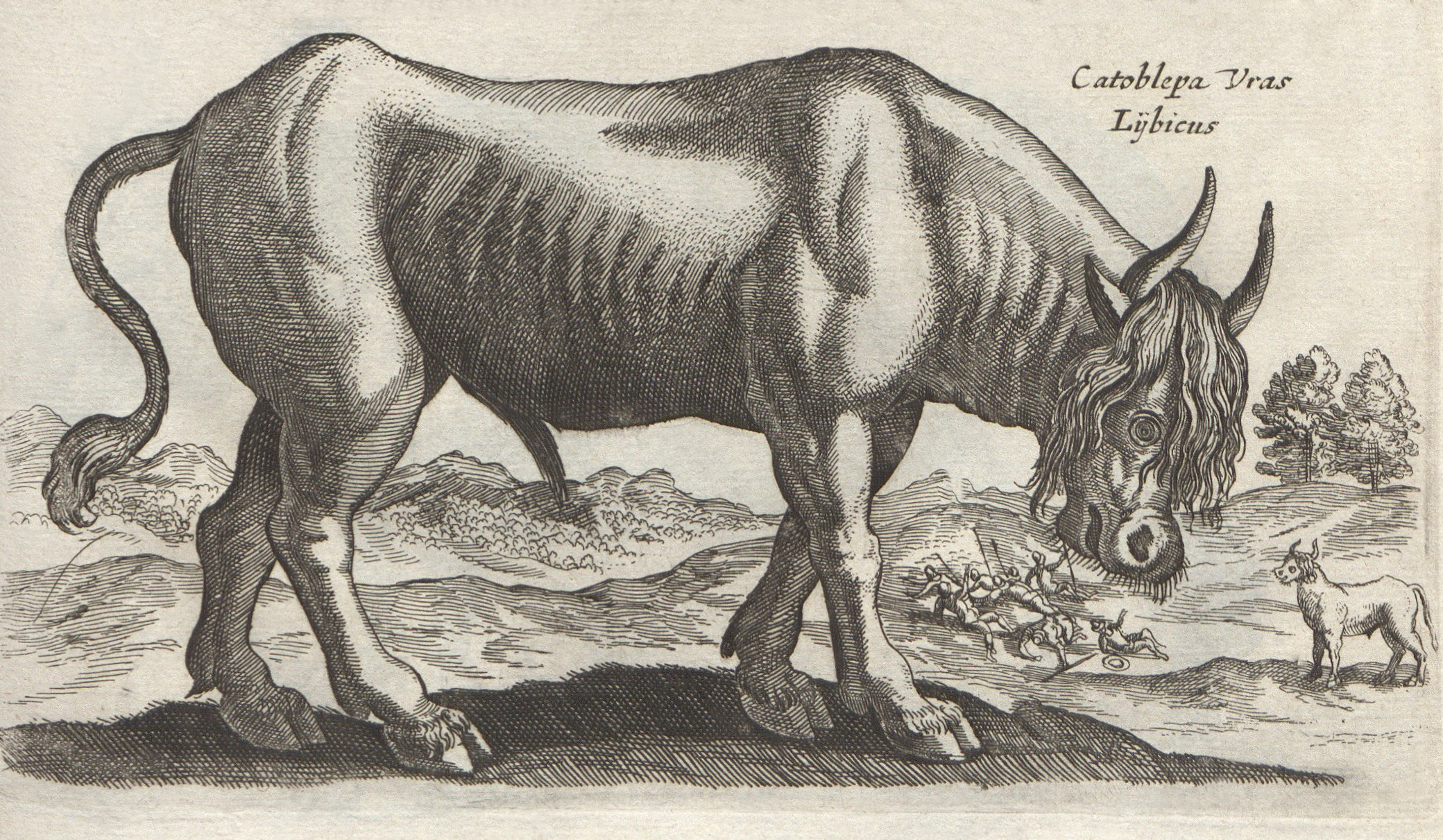
A foul-breathed African marsh beast whose heavy head hangs toward the ground—and whose gaze becomes deadly when it rises.
The catoblepas is an African monster built around one terrible contradiction: its head is so heavy that it normally hangs toward the earth, yet raising that head is what makes the beast most dangerous. Pliny says that anyone who meets its eyes dies; Aelian instead describes a bull-sized animal whose reeking breath poisons the air and kills creatures that approach. Later fantasy traditions combine both ideas into a swamp-dwelling brute with toxic breath, lethal eyes and enough bulk to smash aside anything between it and food.
At a Glance
Rules by Edition
Catoblepas
Large Monstrosity, Unaligned
AC 15; Initiative +0 (10)
HP 95 (10d10 + 40)
Speed 30 ft., Swim 20 ft.
19 (+4)
10 (+0)
18 (+4)
5 (−3)
14 (+2)
8 (−1)
Saving Throws Con +7, Wis +5
Skills Perception +5
Immunities Poison; Poisoned
Senses Darkvision 60 ft.; Passive Perception 15
Languages —
CR 5 (1,800 XP); PB +3
Traits
Stench. A creature that starts its turn within 10 feet of the catoblepas must succeed on a DC 15 Constitution saving throw or have the Poisoned condition until the start of its next turn. On a success, it is immune to this catoblepas’s Stench for 24 hours.
Heavy Head. The catoblepas cannot make opportunity attacks with Deathly Glare. Its ordinary posture keeps its eyes close to the ground until it deliberately raises its head.
Actions
Gore. Melee Attack Roll: +7, reach 10 ft. Hit: 15 (2d10 + 4) Piercing damage.
Fetid Breath (Recharge 5–6). Constitution Saving Throw: DC 15, each creature in a 30-foot Cone. Failure: 27 (6d8) Poison damage and the Poisoned condition until the end of the creature’s next turn. Success: Half damage only.
Deathly Glare (Recharge 6). One creature the catoblepas can see within 30 feet must make a DC 15 Constitution saving throw. On a failed save, it takes 36 (8d8) Necrotic damage; on a successful save, it takes half as much. A creature that cannot see the catoblepas is unaffected.
Catoblepas
Large monstrosity, unaligned
Armor Class 15 (natural armor)
Hit Points 95 (10d10 + 40)
Speed 30 ft., swim 20 ft.
19 (+4)
10 (+0)
18 (+4)
5 (−3)
14 (+2)
8 (−1)
Saving Throws Con +7, Wis +5
Skills Perception +5
Damage Immunities poison
Condition Immunities poisoned
Senses darkvision 60 ft., passive Perception 15
Languages —
Challenge 5 (1,800 XP)
Traits
Stench. A creature that starts its turn within 10 feet of the catoblepas must succeed on a DC 15 Constitution saving throw or be poisoned until the start of its next turn. On a successful save, it is immune to this catoblepas’s Stench for 24 hours.
Actions
Gore. Melee Weapon Attack: +7 to hit, reach 10 ft., one target. Hit: 15 (2d10 + 4) piercing damage.
Fetid Breath (Recharge 5–6). The catoblepas exhales poison in a 30-foot cone. Each creature there must make a DC 15 Constitution saving throw, taking 27 (6d8) poison damage and becoming poisoned until the end of its next turn on a failure, or half damage without the condition on a success.
Deathly Glare (Recharge 6). One creature the catoblepas can see within 30 feet must make a DC 15 Constitution saving throw, taking 36 (8d8) necrotic damage on a failed save or half as much on a successful one. A creature that cannot see the catoblepas is unaffected.
Catoblepas CR 12
XP 19,200
N Large magical beast
Init −1; Senses darkvision 60 ft., low-light vision; Perception +25; Aura stench (30 ft., DC 23, 10 rounds)
Defense
AC 27, touch 8, flat-footed 27 (−1 Dex, +19 natural, −1 size)
hp 161 (14d10+84)
Fort +15, Ref +8, Will +8
SR 23
Offense
Speed 40 ft., swim 20 ft.
Melee bite +18 (3d6+5), gore +18 (2d8+5/19–20), 2 hooves +16 (1d8+2)
Space 10 ft.; Reach 10 ft.
Special Attacks breath weapon (60-ft. cone, poison, Fort DC 23, usable every 1d4 rounds), trample (4d6+7, DC 22)
Statistics
Str 20, Dex 8, Con 22, Int 5, Wis 15, Cha 10
Base Atk +14; CMB +20; CMD 29 (33 vs. trip)
Feats Diehard, Endurance, Improved Critical (gore), Improved Iron Will, Iron Will, Multiattack, Skill Focus (Perception)
Skills Perception +25, Swim +13; Racial Modifiers +8 Swim
Languages Aklo
Poison Breath (Ex)
A catoblepas’s horrid breath fills a 60-foot cone with poison gas. Breath—contact; save Fort DC 23; frequency 1/round for 6 rounds; effect 1d6 Con damage; cure 3 consecutive saves. The save DC is Constitution-based.
Ecology
Environment any swamps
Organization solitary, pair or herd (3–6)
Treasure incidental
Catoblepas
Large Magical Beast
Hit Dice 14d10+84 (161 hp)
Initiative −1
Speed 40 ft. (8 squares), swim 20 ft.
Armor Class 27 (−1 size, −1 Dex, +19 natural), touch 8, flat-footed 27
Base Attack/Grapple +14/+23
Attack gore +18 melee (2d8+5/19–20)
Full Attack bite +18 melee (3d6+5), gore +18 melee (2d8+5/19–20), 2 hooves +16 melee (1d8+2)
Space/Reach 10 ft./10 ft.
Special Attacks poison breath, trample 4d6+7
Special Qualities darkvision 60 ft., low-light vision, spell resistance 23, stench
Saves Fort +15, Ref +8, Will +8
Abilities Str 20, Dex 8, Con 22, Int 5, Wis 15, Cha 10
Skills Listen +12, Spot +13, Swim +13
Feats Diehard, Endurance, Improved Critical (gore), Improved Iron Will, Iron Will, Multiattack, Skill Focus (Spot)
Environment swamps
Organization solitary, pair or herd (3–6)
Challenge Rating 12
Treasure incidental
Poison Breath (Ex)
Every 1d4 rounds, the catoblepas can breathe a 60-foot cone of poison. Fortitude DC 23; initial and secondary damage 1d6 Constitution. The save DC is Constitution-based.
Stench (Ex)
Living creatures within 30 feet must succeed on a DC 23 Fortitude save or be sickened for 10 rounds. A creature that saves is immune to that catoblepas’s stench for 24 hours.
Behaviour
A catoblepas is not a cunning ambusher. It dominates by being too dangerous to approach. It spends long periods feeding in marsh vegetation and on poisonous roots, tolerating nearby animals only while they keep their distance. When something challenges it, the creature raises its mane, exposes its mouth and fills the air with foul breath before committing its weight to a charge.
Its own stench blunts its ability to interpret other strong smells. It responds more reliably to movement, disturbance and direct intrusion than to scent trails. Herds spread over a marsh rather than standing shoulder to shoulder, leaving pockets of poisoned air and churned mud between them.
Signs Before Initiative
- A sweet, rotten smell hangs over water even when the wind changes.
- Fish float dead in shallow pools near a heavily churned bank.
- Reeds and saplings are broken at chest height along a broad feeding path.
- Other large animals avoid an otherwise rich stretch of grazing land.
- A bull-like track ends where deep mud shows a heavy body resting almost in the water.
If Violence Starts
The catoblepas first tries to make approaching it miserable. It turns its breath across clustered enemies, uses stench to break close formations and only then commits to gore, bite or trample. A creature that attacks from beyond the breath’s reach is more likely to draw a slow advance than a clever pursuit.
In water it uses depth and reeds as protection, submerging most of its body while keeping enough of the head clear to breathe. Campaign accounts of catoblepas using poisonous breath below the water explain stretches of marsh suddenly emptied of fish and amphibians.
Homes, Haunts and Range
Ancient writers place the catoblepas in Africa, especially Aithiopian country and the region around a great western river or spring. In play it belongs in the African Bestiary, particularly swamp belts, Nile-connected wetlands and remote river basins.
Related legendary African beasts include the Ethiopian Bull, the Yale and the Manticore.
Using a Catoblepas in an Encounter
The silent marsh. Birds, frogs and insects vanish from one arm of a river. The water is still drinkable upstream.
The broken causeway. A catoblepas has learned that stone roads remain firm during flood season and now feeds directly across the only safe crossing.
The captive guardian. A ruler claims to have domesticated one. The chains are real; the obedience depends on magic nobody has checked in years.
The poisoned fishery. A village blames rivals for killing its fish until the party finds a herd feeding just beyond the reed beds.
Classical Sources
Aelian — On Animals 7.6
Aelian describes a bull-sized African animal with a shaggy brow, downward-looking eyes, a mane that rises when threatened and foul breath capable of killing nearby animals. See the collected translation at Theoi.
Pliny — Natural History
Pliny instead emphasises the creature’s impossibly heavy head and instantly fatal gaze. The later engraving used as the hero is a public-domain Jan Jonston image preserved on Wikimedia Commons.
Rules Sources and Licensing
The 5.5e/2024 and 5e/2014 blocks are original compatibility adaptations combining the classical poisonous-breath and deadly-gaze traditions. They do not reproduce a closed-source fifth-edition monster entry.
The Pathfinder 1e statistics derive from open game material in Pathfinder Roleplaying Game Bestiary 2, © 2010 Paizo Publishing, LLC. The D&D 3.5e block is a page-specific compatibility conversion built from those mechanics.
Keep this reference growing
If this page helped with your reading or game, you can support its upkeep or explore the curated books.
Explore the Bookshop — epics, classics and stories behind imagined worlds.