
Swan Maiden – Fey Shapechanger and Feather-Cloak Bride
Swan Maiden – Fey Shapechanger and Feather-Cloak Bride
White-Winged Bride of Lake, Sky, and Stolen Return

A swan maiden is a supernatural woman who moves between human shape and swan shape through a feather robe, swan-skin, white cloak, veil, or other garment of transformation. She belongs to lake, river, marsh, sky, fey court, sacred bloodline, or otherworldly water-road. In human form, she may seem like a noble bride, wandering singer, silent widow, strange wife, lake-hermit, or foreign lady whose eyes keep returning to windows, water, and migrating birds. In swan form, she becomes a white bird of unnerving intelligence, graceful enough to seem sacred and watchful enough to seem judicial.
Her beauty is not the point. Her freedom is.
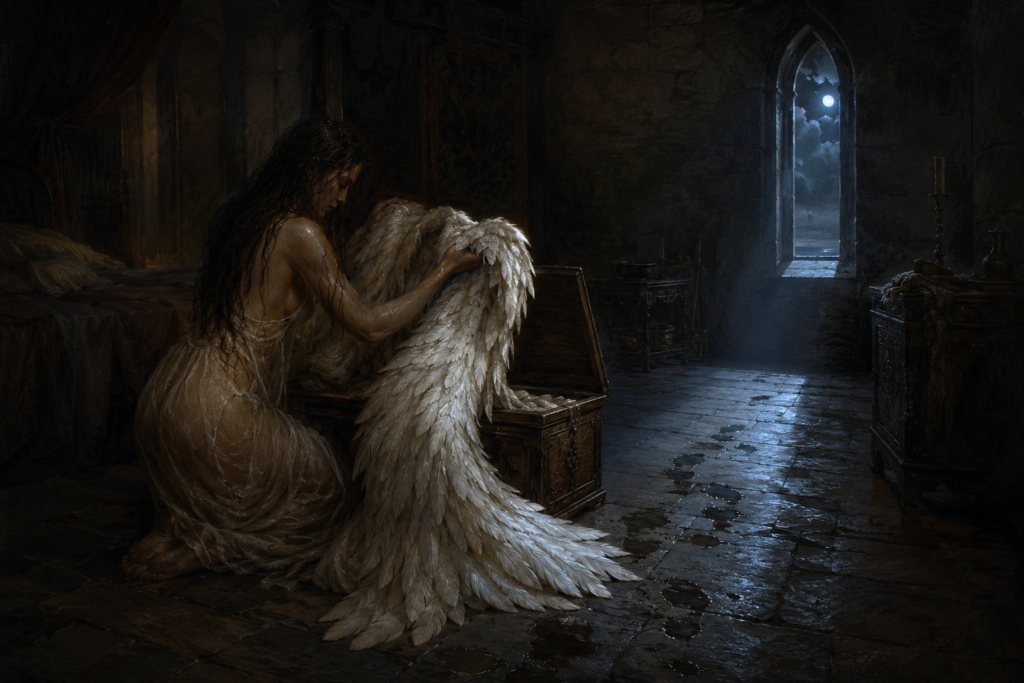
The oldest danger surrounding a swan maiden is not what she does to mortals, but what mortals do to her. In the classic tale-pattern, a mortal sees bird-maidens bathing, steals one maiden’s feather garment, and prevents her from flying home. The theft is often softened in later retellings as romance, but the sharper version is far stronger for play: the stolen cloak is not a love-token. It is the thing that lets her leave.
A swan maiden may love, marry, bear children, and remain in the mortal world by choice. That distinction matters. A freely sworn swan bride can bless a bloodline, protect a lake, teach prophetic songs, or guide a family through famine and war. A stolen one brings silence, winter, omen-birds, broken vows, and eventual judgement.
The key question in every swan maiden story is simple: could she leave?
If the answer is no because someone hid, sold, burned, locked away, or warded her cloak, the marriage, household, or noble claim built on that captivity is poisoned at the root.
Overview
A swan maiden appears where water opens into another world. She may descend to a lake with her sisters, come at dusk to a reed marsh, bathe in a sacred pool, or land beside a river beneath winter stars. Some are fey. Some are lake spirits. Some are celestial bird-women attached to prophecy, mourning, purity, or sacred kingship. Some are descendants of old swan-brides and mortal houses, carrying the ache of both bloodlines.
She is not a harpy, siren, alkonost, angel, or decorative bird-woman. Her identity is built around transformation, theft, marriage, captivity, return, and consequence. She becomes most powerful in play when her presence turns a household or courtly scandal into a supernatural case. A lord may call her his wife. A village may call her blessed. Her children may call her mother. Her own kin may call her stolen. The truth may depend on a single white garment hidden in a chest, shrine, attic, tower, merchant’s vault, or grave.
A swan maiden does not need to be evil to be dangerous. Her grief can call storms. Her song can make liars confess. Her kin may descend on a lake in white-winged judgement. Her abandoned children may inherit prophecy, divided loyalty, or a longing for a sky they have never seen. If her cloak is returned freely, she may bless a house for generations. If it is burned, sold, nailed beneath an altar, or locked away by a jealous spouse, the place may become haunted by swans that never migrate and brides who dream of locked wings.
When her cloak is recovered, she usually leaves. That departure may be grief, justice, rescue, punishment, or return to self. She may take her children, call them later, bless them from afar, or abandon the house that used her body to build its fortune. The story should hurt because she is not a monster fleeing defeat. She is a person returning to herself.
Appearance
In human form, a swan maiden has the poise of something not made for walls. She may be pale or dark, young or ancient-looking, noble or barefoot, but she always carries an impression of distance. Her movements are graceful, but not ornamental. They are the careful movements of a creature conserving strength until the road home opens.
Her eyes often hold the colour of deep water under cloud. Her hair may be white, silver, black as wet reeds, gold like dawn on water, or ordinary until moonlight touches it. She stands near doorways, watches birds cross the sky, listens before speaking, and grows still when anyone mentions locked rooms, dowry chests, wedding garments, or hidden keys.
Her feather garment is her true sign. It may be:
- a cloak of white swan feathers;
- a folded swan-skin soft as wet linen;
- a mantle clasped with silver;
- a robe sewn with hidden down;
- a veil, girdle, or crown that completes the transformation;
- a plain-looking garment that reveals its nature only in wind, moonlight, or water-reflection.
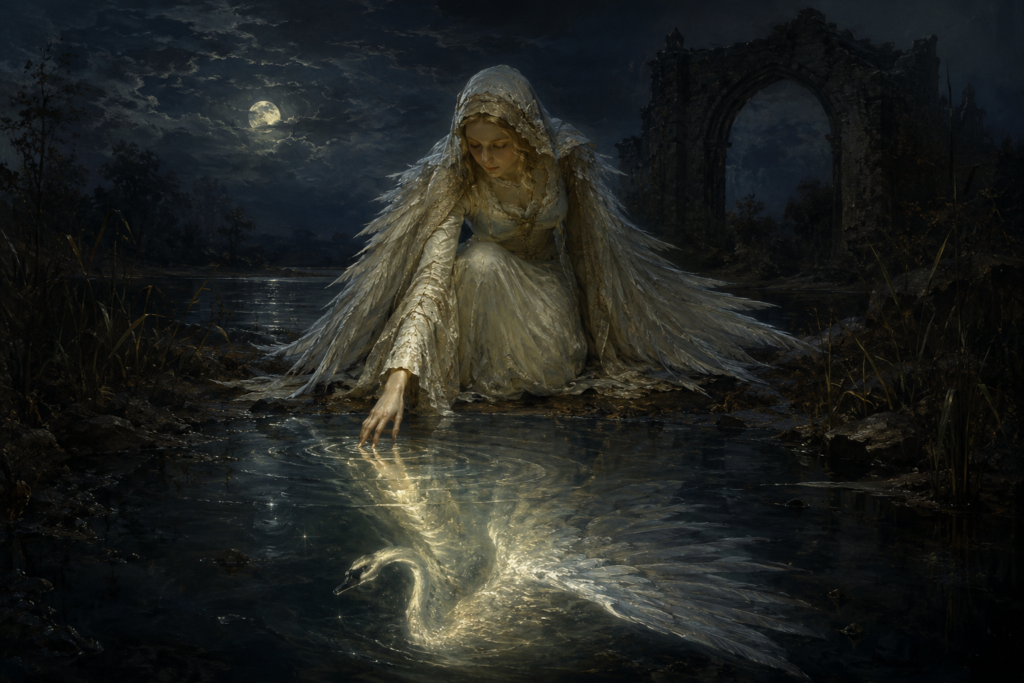
When she transforms, the change is natural rather than grotesque. Her bones lighten, her arms become wings, her neck lengthens, her feet darken, and her human sorrow becomes the unreadable stillness of a swan. In bird form, she is usually larger than an ordinary swan and carries human awareness in her gaze.
A captive swan maiden often dresses carefully, but never completely. Something is always missing: no cloak in winter, no veil at rites, no wedding jewels from her own people, no white garment in a house full of locked chests.
Habitat
Swan maidens appear in places of water, migration, and threshold. They favour remote lakes, holy wells, reed marshes, river mouths, snow-fed pools, misty islands, fey crossings, burial lakes, old hunting grounds, lonely noble estates, and winter migration routes where the mortal sky lies thin against the otherworld.
They rarely belong in dry dungeons or ordinary monster lairs. Their strongest locations have beauty, silence, and implied trespass: a pool where no hunter should look, a lake where no bride should weep, a locked attic where feathers are kept under cedar and iron.
A single swan maiden may remain among mortals for years if her cloak is hidden. A free one rarely remains long in one household unless she does so by oath, love, debt, sacred duty, or chosen exile.
Ecology
A swan maiden is not usually a breeding monster species. She is better treated as one of an otherworldly people, court, sisterhood, lake-lineage, celestial company, or fey-blooded family. Her nature is social, legal, and spiritual rather than merely biological.
Children of swan maidens are important campaign material. They may inherit:
- a longing for water or sky;
- prophetic dreams;
- the ability to speak with birds;
- strange grace in battle, song, or dance;
- resistance to cold and drowning;
- white hair, feather marks, or black swan eyes;
- divided legal status between mortal house and otherworld kin;
- a curse if their mother’s cloak was stolen.
A dynasty descended from a willing swan bride may be blessed. A dynasty descended from a stolen swan maiden may be beautiful, doomed, and haunted by inheritance crimes no court wants to examine.
Behaviour
A free swan maiden is cautious, courteous, and difficult to command. She may accept hospitality, but she never forgets its terms. She may give gifts, warnings, or songs, but she does not casually surrender her name, cloak, or place of origin. She understands that admiration can become possession very quickly.
A captive swan maiden may appear calm for years. This calm is not surrender. She learns the house, the keys, the servants, the children, the lord’s weaknesses, and the seasons of the birds. She may love her children fiercely and still leave when her cloak is found.
A wronged swan maiden rarely answers violence with simple violence. Her punishments are social, hereditary, symbolic, and environmental. She may curse a house so no bride remains willingly, make wedding vows fail, call swans to strip seed grain from fields, turn a family lake black each winter, fill locked chests with the smell of marsh-water, or cause children to dream of another mother’s sky.
Combat Tactics
A swan maiden should not fight like a claw-and-bite monster unless cornered. Her first tactics are escape, exposure, curse, and oath-pressure.
In human form, she uses song, command of birds, water magic, fey glamour, and truth-binding speech. She may force a thief to reveal where the cloak is hidden, silence a liar, open locked doors, or make a household hear wings beating inside the walls.
In swan form, she is fast, evasive, and difficult to net. She uses water, mist, height, and distance. If pursued across a lake, she may vanish into fog, call other swans to confuse archers, or lead enemies onto treacherous ice.
She fights directly only when her cloak, children, sisters, sacred water, or freely sworn household are threatened. Even then, she should feel like a wronged noble or fey spirit defending her personhood, not like a random wilderness encounter.
When Swan Maidens Appear
A swan maiden works best when the adventure is not solved by killing her. Use her for rescue, court scandal, bloodline curse, fey diplomacy, sacred lake mystery, missing mother story, false romance exposed as captivity, personhood trial, or supernatural inheritance dispute.
She is especially strong in late medieval play because marriage, inheritance, property, oath, household authority, and noble legitimacy all matter. The swan maiden turns those institutions into a supernatural wound.
Mechanics Tabs
The rules below are mechanics compatible for different game editions.
Swan Maiden 5.5e / 2024
Swan Maiden Pathfinder 1e / 3.5e
Swan maiden 3.0e
Swan Maiden 5.5e / 2024-Compatible Version
Medium Fey, Typically Neutral or Chaotic Good
Armor Class 14
Initiative +4
Hit Points 66 (12d8 + 12)
Speed 30 ft., swim 30 ft.
Proficiency Bonus +3
| STR | DEX | CON | INT | WIS | CHA |
|---|---|---|---|---|---|
| 10 (+0) | 18 (+4) | 12 (+1) | 13 (+1) | 16 (+3) | 18 (+4) |
Saving Throws Dex +7, Wis +6, Cha +7
Skills Insight +6, Nature +4, Perception +6, Performance +7, Persuasion +7, Stealth +7
Damage Resistances Cold; Bludgeoning, Piercing, and Slashing damage from nonmagical attacks while in swan form
Condition Immunities Charmed, but only against a creature that currently possesses her swan cloak
Senses Passive Perception 16
Languages Sylvan, one regional mortal language; speaks with swans and waterbirds
Challenge 5 (1,800 XP)
Traits
Swan Cloak. The swan maiden’s transformation depends on a feather cloak, swan-skin, mantle, veil, or similar garment. While she possesses and can wear the cloak, she can use White-Winged Shape. If the cloak is stolen, hidden, destroyed, warded against her, or kept beyond her reach, she cannot willingly enter swan form.
The cloak is not ordinary treasure. A creature that knowingly steals, hides, sells, burns, or magically binds the cloak becomes marked by Theft of Return.
Theft of Return. A creature marked by Theft of Return cannot benefit from being magically disguised from the swan maiden. The swan maiden knows the marked creature on sight, even if it changes shape or uses illusion magic, unless the effect is created by a spell of 7th level or higher.
The marked creature also has Disadvantage on Charisma checks made to convince the swan maiden that it means her no harm.
The mark ends if the cloak is freely returned, the swan maiden forgives the creature, or a powerful fey, divine, or curse-breaking rite ends the offence.
White-Winged Shape. As a Bonus Action, the swan maiden transforms into a Large swan or back into her humanlike form. Her statistics are the same in each form, except that in swan form she has a walking speed of 10 feet, a flying speed of 60 feet, and cannot wield weapons or manipulate objects requiring hands. Equipment she wears or carries merges into the form, except the swan cloak, which remains part of the transformation.
She reverts to humanlike form if she dies.
Water-Road Grace. The swan maiden ignores Difficult Terrain created by water, mud, reeds, snow, shallow ice, or marshland. She can move across the surface of calm water during her turn, but sinks if she ends her turn there without flying, swimming, or standing on solid support.
Oath-Ear of the White Lake. The swan maiden has Advantage on Wisdom (Insight) checks made to determine whether a creature is lying about a promise, marriage, guest-right, hidden object, child, cloak, or oath.
Not Charmed by Captivity. A creature that possesses, hides, or controls the swan maiden’s cloak cannot charm her. If she is already Charmed by that creature when it gains possession of the cloak, the Charmed condition immediately ends.
Sorrow of the Taken Bride. When the swan maiden is within 1 mile of her hidden cloak, she knows the direction of it at dawn, dusk, and moonrise unless the cloak is shielded by lead, running water, or magic of 6th level or higher.
Actions
Multiattack. The swan maiden makes two attacks, using Feather-Knife, Wing Buffet, or Swan-Beak in any combination.
Feather-Knife. Melee or Ranged Attack Roll: +7 to hit, reach 5 ft. or range 30/90 ft., one target. Hit: 8 (1d8 + 4) Piercing damage plus 7 (2d6) Cold damage. The blade, feather, or splinter of lake-ice vanishes after the attack.
Wing Buffet. Melee Attack Roll: +7 to hit, reach 5 ft., one target. Hit: 9 (2d4 + 4) Bludgeoning damage. If the target is Medium or smaller, it must succeed on a DC 15 Strength saving throw or be pushed 10 feet.
Swan-Beak. Swan Form Only. Melee Attack Roll: +7 to hit, reach 5 ft., one target. Hit: 11 (2d6 + 4) Piercing damage.
Song of the Hidden Chest. The swan maiden sings a song of finding. One creature of her choice within 60 feet that can hear her must make a DC 15 Wisdom saving throw. On a failed save, the target must truthfully answer one question about the location, possession, concealment, sale, destruction, or magical warding of the swan maiden’s cloak or another personally bound object. On a successful save, the creature is immune to this swan maiden’s Song of the Hidden Chest for 24 hours.
A creature does not need to share a language with the swan maiden to understand the question if the question concerns the cloak.
White Lake Rebuke. The swan maiden targets one creature within 60 feet that she can see and that has stolen, hidden, carried, bought, sold, damaged, or knowingly concealed her swan cloak. The target must make a DC 15 Charisma saving throw. On a failed save, it takes 21 (6d6) Psychic damage and is Frightened of the swan maiden until the end of its next turn. On a successful save, it takes half as much damage and is not Frightened.
If the target currently possesses the cloak, it has Disadvantage on the saving throw.
Mist of Departure. The swan maiden creates a 20-foot-radius sphere of mist centred on herself. The mist lasts for 1 minute, moves with her, and heavily obscures the area. She and creatures she chooses can see through the mist. The mist ends early if dispersed by a strong wind.
Once she uses this action, she cannot use it again until she finishes a Short or Long Rest.
Bonus Actions
Slip the Net. The swan maiden attempts to escape a grapple, restraint, manacle, net, rope, or nonmagical bond. She has Advantage on the check. If the restraint was created by a creature marked by Theft of Return, she can also move up to 15 feet without provoking Opportunity Attacks after escaping.
Call of the Waterbirds. The swan maiden calls ordinary waterbirds, swans, geese, herons, ducks, or gulls within 1 mile. Until the start of her next turn, attack rolls against her have Disadvantage if she is outdoors near water, reeds, marshland, or open sky.
Once she uses this bonus action, she cannot use it again until she finishes a Short or Long Rest.
Reactions
Feather Between the Blade. When the swan maiden or a creature within 5 feet of her is hit by an attack, she adds +3 to the target’s AC against that attack, potentially causing it to miss. White feathers, spray, or sudden wing-shadow briefly turn aside the blow.
Cry Against the Thief. When a creature marked by Theft of Return hits the swan maiden with an attack, the attacker must succeed on a DC 15 Wisdom saving throw or have Disadvantage on the next attack roll it makes before the end of its next turn.
Curse: House of Locked Wings
If a creature burns, destroys, desecrates, or permanently binds a swan maiden’s cloak to prevent her return, she may lay this curse before dawn next touches water.
The curse affects one household, bloodline, manor, ship, or sworn company connected to the offender. Until the curse ends:
- wedding vows made by members of the cursed house are accompanied by the sound of beating wings;
- birds refuse to nest under the house’s roofs;
- children of the house dream of cold lakes and locked chests;
- Charisma checks made by members of the house to arrange marriages, secure dowries, or conceal domestic crimes are made with Disadvantage;
- once per year, usually in winter, a serious public secret concerning marriage, inheritance, captivity, or hidden kin comes to light.
The curse can be ended by returning or restoring the cloak, confessing the crime before lawful and sacred witnesses, compensating the victim or her kin, and receiving the swan maiden’s forgiveness or judgement from a suitable fey, divine, or ancestral authority.
This curse is not meant to replace ordinary combat. It is a campaign consequence for a grave offence.
Notes
Running the Swan Cloak. The cloak is a bound personal object, not random loot. A character who takes it accidentally may face suspicion. A character who understands what it is and still hides it has committed a serious supernatural and legal offence.
Can the Swan Maiden Transform Without the Cloak? Normally, no. The cloak is the transformation key. A powerful elder swan maiden, queen of swans, celestial version, or mythic version may have a backup rite, but the standard creature should remain cloak-bound because that is the central folklore identity.
What Happens if the Cloak Is Destroyed? Destroying the cloak should not casually kill the swan maiden unless a specific darker variant says so. Better consequences are exile from swan form, a major curse, fey trial, loss of her way home, or transformation into a grief-bound spirit until the cloak is remade.
Is the Swan Maiden Evil if She Curses a Household? Not necessarily. The curse is a legal, fey, and spiritual consequence for theft of personhood. It may still harm innocents, which makes it morally complicated, but the original offence matters.
Can She Be a Player Ally? Yes. A rescued swan maiden can become a patron, witness, guide, healer of waterlands, fey-court contact, prophetic singer, or dangerous claimant in a noble inheritance dispute.
Swan Maiden Pathfinder 1e / 3.5e-Compatible Version
CR 5
XP 1,600
N Medium fey (shapechanger)
Init +4; Senses low-light vision; Perception +14
Defense
AC 18, touch 14, flat-footed 14
hp 52 (8d6+24)
Fort +5, Ref +10, Will +9
DR 5/cold iron
Resist cold 10
Immune charm effects from a creature currently possessing her swan cloak
Offense
Speed 30 ft., swim 30 ft.; fly 60 ft. in swan form
Melee feather knife +8 (1d6+4 plus 1d6 cold)
Ranged feather knife +8 (1d6+4 plus 1d6 cold)
Special Attacks song of the hidden chest, white lake rebuke
Spell-Like Abilities CL 8th; concentration +12
At will — detect magic, feather fall, speak with animals
3/day — charm animal, fog cloud, hideous laughter, suggestion
1/day — bestow curse, locate object, water breathing
Statistics
Str 10, Dex 18, Con 16, Int 13, Wis 16, Cha 19
Base Atk +4; CMB +4; CMD 18
Feats Dodge, Mobility, Skill Focus (Perform [sing]), Weapon Finesse
Skills Bluff +15, Escape Artist +15, Fly +15, Handle Animal +12, Knowledge (nature) +12, Perception +14, Perform (sing) +18, Sense Motive +14, Stealth +15, Swim +11
Languages Sylvan plus one regional mortal language; speaks with swans and waterbirds
SQ swan cloak, swan shape, water-road grace, theft of return
Ecology
Environment temperate lakes, marshes, rivers, fey crossings, sacred pools
Organization solitary, pair, sisterhood (3–7), or court delegation (2–6 plus attendants)
Treasure incidental; swan cloak, silver clasp, feather charms, lake pearls, song-scrolls
Special Abilities
Swan Cloak (Su). A swan maiden’s transformation depends on a personal feather cloak, swan-skin, mantle, veil, or similar garment. While she possesses and can wear the cloak, she may use swan shape. If the cloak is stolen, hidden, destroyed, warded against her, or kept beyond her reach, she cannot willingly enter swan shape.
The cloak is a bound personal object, not ordinary treasure. A creature that knowingly steals, hides, sells, burns, or magically binds the cloak becomes marked by theft of return.
Swan Shape (Su). As a standard action, a swan maiden may transform into a Large swan or back into her humanlike form. This ability functions as beast shape II, except the swan form is always a swan and the effect has no duration limit. In swan form, she gains a fly speed of 60 feet and cannot wield weapons or manipulate objects requiring hands.
She reverts to humanlike form when slain.
Theft of Return (Su). A creature marked by theft of return cannot conceal itself from the swan maiden through mundane disguise. The swan maiden gains a +10 bonus on Perception and Sense Motive checks to recognise that creature, even through ordinary disguise, altered clothing, or false identity.
Illusion, polymorph, or other magic can conceal the creature normally, but the swan maiden gains a +4 bonus on saving throws or caster level checks made to pierce or resist such deception.
The mark ends if the cloak is freely returned, the swan maiden forgives the offender, or an appropriate break enchantment, remove curse, limited wish, wish, miracle, or fey judgement ends the offence.
Water-Road Grace (Su). A swan maiden ignores difficult terrain caused by shallow water, mud, reeds, snow, marshland, and natural ice. She may move across the surface of calm water during her turn, but sinks if she ends her turn there without flying, swimming, or standing on solid support.
Song of the Hidden Chest (Su). As a standard action, the swan maiden sings to one creature within 60 feet. The target must succeed at a DC 18 Will save or truthfully answer one question about the location, possession, concealment, sale, destruction, or magical warding of the swan maiden’s cloak or another personally bound object. This is a sonic, mind-affecting compulsion effect. A creature that succeeds is immune to that swan maiden’s Song of the Hidden Chest for 24 hours.
The save DC is Charisma-based.
White Lake Rebuke (Su). As a standard action, the swan maiden targets one creature within 60 feet that has stolen, hidden, carried, bought, sold, damaged, or knowingly concealed her swan cloak. The target must succeed at a DC 18 Will save or take 6d6 points of nonlethal damage and become shaken for 1d4 rounds. If the target currently possesses the cloak, it takes lethal damage instead and suffers a –2 penalty on the saving throw.
The save DC is Charisma-based.
House of Locked Wings (Su). If a creature burns, destroys, desecrates, or permanently binds a swan maiden’s cloak to prevent her return, the swan maiden may lay a curse on the offender’s household, bloodline, manor, ship, or sworn company. This functions as bestow curse, but its effects are social, hereditary, and omen-based rather than a simple numerical penalty.
A typical curse imposes a –4 penalty on Charisma-based checks made by members of the cursed house to arrange marriages, conceal domestic crimes, claim disputed inheritance, or swear false oaths concerning kinship, marriage, captivity, or hidden property. Once per year, a major concealed secret concerning the household’s marriages, captives, heirs, or locked-away persons is exposed through supernatural omen, confession, dream, or public accident.
The curse may be ended by returning or restoring the cloak, confessing the crime before lawful and sacred witnesses, compensating the victim or her kin, and receiving the swan maiden’s forgiveness or equivalent fey, divine, or ancestral judgement.
Notes
Cloak Dependency. The cloak dependency is intentional. Removing it weakens the folklore identity. Use stronger exceptions only for elder swan queens, celestial swan spirits, or mythic figures.
Captivity and Consent. A swan maiden may live among mortals, marry, and have children by choice. The table question is whether she could leave. If her cloak was hidden, the household’s claim over her is morally and legally compromised.
Destroyed Cloaks. A destroyed cloak should usually create story consequences rather than immediate death. Suitable outcomes include exile from swan form, a curse, a fey court case, or a quest to remake the cloak from moonlit feathers, lake-silver thread, and voluntary witness.
Treasure. The swan cloak is not normal treasure. Taking it creates immediate moral, legal, and supernatural consequences. If the swan maiden freely entrusts it to a character, that trust should matter more than its market value.
Swan maiden 3.0e
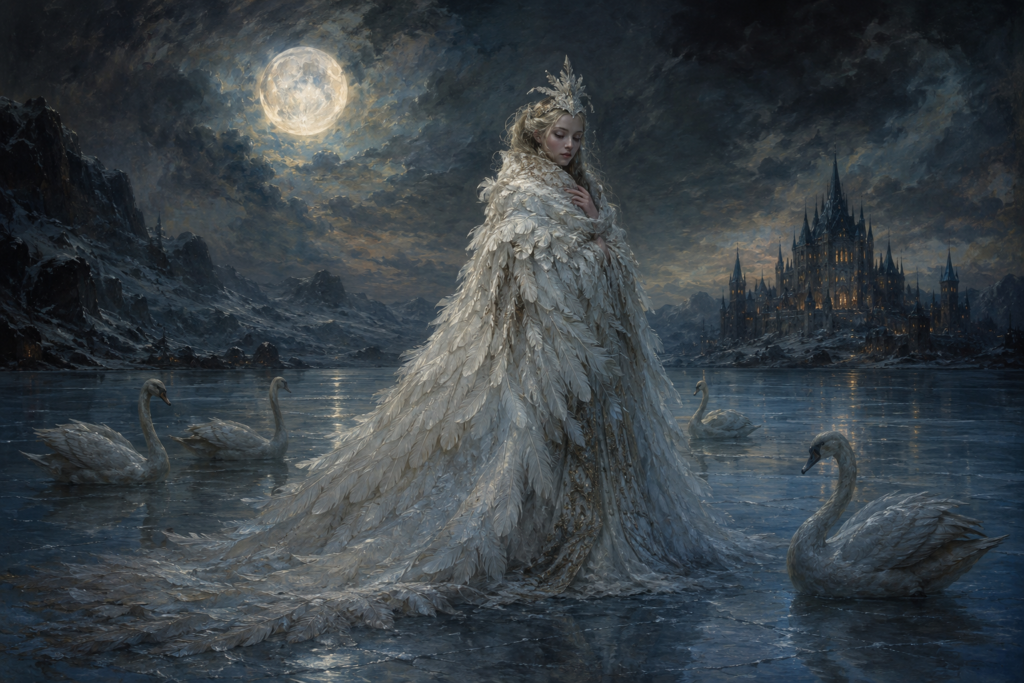
This tall, regal woman is clad in a long cloak of pristine white swan feathers and silvery armor with a winged helm.
Swan maidens are fey shapechangers who vow to protect unspoiled wilds from the encroachment of civilization or evil. They live in small flocks along secluded lakeshores. Because stealing a swan maiden’s cloak robs her of her shapechanging ability, most maidens avoid humanoids and take up armor and weapons to defend themselves.
Swan Maiden CR 6
XP 2,400
CG Medium fey (shapechanger)
Init +5; Senses low-light vision; Perception +14
DEFENSE
AC 20, touch 15, flat-footed 15 (+4 armor, +4 Dex, +1 dodge, +1 natural)
hp 55 (10d6+20)
Fort +5, Ref +12, Will +8
DR 5/cold iron; Resist cold 10, electricity 10; SR 17
OFFENSE
Speed 30 ft., fly 40 ft. (good)
Melee mwk rapier +11 (1d6+1/18–20)
Ranged longbow +10 (1d8/×3)
Spell-Like Abilities (CL 10th; concentration +12)
At will—dancing lights
1/day—confusion (DC 16), deep slumber (DC 15), entangle (DC 13), glitterdust (DC 14), major image (DC 15)
STATISTICS
Str 13, Dex 20, Con 15, Int 10, Wis 12, Cha 15
Base Atk +5; CMB +10; CMD 22
Feats Agile Maneuvers, Dodge, Flyby Attack, Skill Focus (Perception), Weapon Finesse
Skills Acrobatics +11, Bluff +10, Fly +20, Knowledge (nature) +8, Perception +14, Sense Motive +9, Stealth +20; Racial Modifiers +4 Stealth
Languages Common, Sylvan
SQ change shape (trumpeter swan, beast shape I), feather cloak, trackless step, transformation ritual
SPECIAL ABILITIES
Feather Cloak (Su)
Without her feather cloak, a swan maiden can’t use her change shape ability.
Transformation Ritual (Su)
A swan maiden can transform a willing good female humanoid into a swan maiden via a ritual that takes 24 hours. The humanoid loses her class and racial abilities.
ECOLOGY
Environment temperate lakes or swamps
Organization solitary, pair, or flock (3–10)
Treasure standard (chain shirt, masterwork longsword, longbow with 20 arrows, other treasure)
Section 15: Copyright Notice
Pathfinder Roleplaying Game Bestiary 4 © 2013, Paizo Publishing, LLC; Authors: Dennis Baker, Jesse Benner, Savannah Broadway, Ross Byers, Adam Daigle, Tim Hitchcock, Tracy Hurley, James Jacobs, Matt James, Rob McCreary, Jason Nelson, Tom Phillips, Stephen Radney-MacFarland, Sean K Reynolds, F. Wesley Schneider, Tork Shaw, and Russ Taylor.
Treasure
A swan maiden does not usually hoard coin, but her story may involve precious objects: silver clasps shaped like wings, lake pearls, prophetic song-scrolls, fey wedding rings, feather charms, white-gold hairpins, water-silver thread, or dowry chests filled with false documents.
The swan cloak itself should not be treated as casual loot. If taken without consent, it creates legal, fey, and moral consequences. If freely entrusted to a character, that trust matters more than market value.
Scaling Swan Maidens
Young Swan Maiden
Use this version for a recently awakened swan-woman, fugitive bride, young lake spirit, or noncombatant supernatural person.
Suggested D&D 5.5e Challenge: 2
Suggested Pathfinder 1e / 3.5e CR: 2
Reduce hit points by half, remove Multiattack, remove White Lake Rebuke, reduce House of Locked Wings to omen-only effects, and make her primary tools escape, song, and transformation.
Elder Swan Bride
Use this version for a powerful fey bride, matriarch of a lake bloodline, ancient otherworld wife, or swan-court judge.
Suggested D&D 5.5e Challenge: 8–10
Suggested Pathfinder 1e / 3.5e CR: 9
Increase hit points, raise save DCs by 2, allow Mist of Departure 3/day, strengthen House of Locked Wings, and give her stronger fey judgement magic such as geas, greater invisibility, control water, or equivalent powers.
Queen of the White Lake
Use this version only when the swan maiden is a named mythic ruler, celestial swan spirit, lake sovereign, or ancestral founder.
Suggested D&D 5.5e Challenge: 13+
Suggested Pathfinder 1e / 3.5e CR: 13+
She is no longer helpless without the cloak, but she is still spiritually wounded by its loss. She may transform by royal rite, summon swan courts, curse kingdoms, command winter waters, and judge marriages, oaths, and stolen brides across an entire region.
Adventure Hooks
The Chest Beneath the Marriage Bed
A noblewoman has not left her husband’s manor in eighteen years. Every winter, swans gather around the frozen lake and beat their wings against the ice until blood marks the snow. The lord asks the party to end the haunting. The answer lies in a cedar chest beneath the marriage bed, where a white feather cloak is folded beneath iron keys and old love letters.
The Bride Who Flew Home
A lord’s wife vanishes from a locked tower, leaving only wet footprints, white feathers, and three sleeping children. The lord offers a reward for her return. Her sisters offer a greater reward if the party proves the marriage was never freely sworn.
The Children of the White Lake
Three noble children begin changing after their mother’s death. One dreams in birdsong. One grows down beneath the shoulder blades. One walks into the lake at night and returns dry. Their grandmother insists the family blood is blessed. The swans on the lake gather like witnesses.
The Burned Cloak
A jealous husband burned his wife’s swan-skin to keep her mortal forever. She survived, but something in the lake did not. Now flightless swans crawl from the reeds, every wedding in the district ends in screaming, and the wife’s shadow still has wings.
The Swan Court’s Demand
A delegation of white-cloaked strangers arrives at a human court and demands the return of seven feather garments stolen over seven generations. Some belong to women long dead. Some belong to wives still living. One belongs to the queen.
Source, Folklore, and Mythic Context
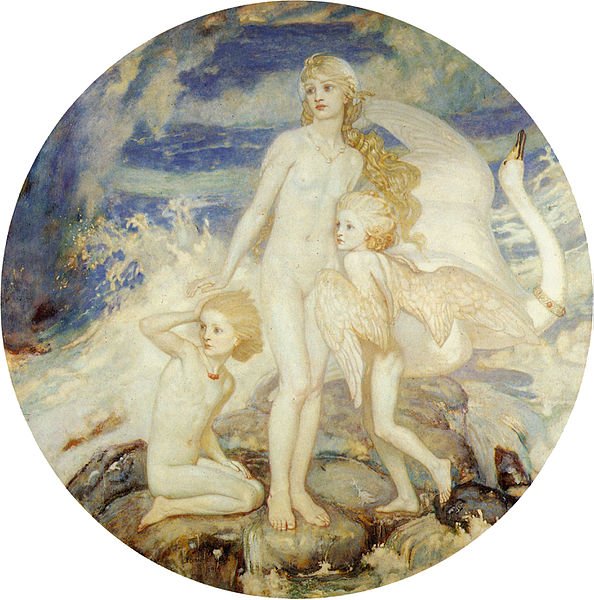
The Swan Maiden belongs to a widespread family of tales about supernatural women, bird-wives, animal brides, stolen garments, and return to the otherworld. The common pattern involves maidens who remove feather garments to bathe, a mortal who steals or hides one garment, and a bride who eventually recovers her means of transformation and departs. The story is commonly associated with the Swan Maiden tale-type, while motif indexes also identify the swan coat or feather garment as the object that allows the maiden to resume swan form.
Useful public folklore references include D. L. Ashliman’s Swan Maiden collection and Motif D0361.1, Swan Maiden resumes swan form by putting on swan coat. These sources preserve the central image that makes the creature distinct: the garment is not decoration, but the means of return.
The Swan Maiden also overlaps with the larger animal-wife and stolen-skin tradition, including selkie-wife tales and other supernatural bride stories in which a hidden skin, robe, feather dress, or covering prevents return to the original realm. This makes the creature especially useful in roleplaying material because the central object is never just clothing. It is the visible sign of freedom, bodily identity, and access to home.
Later literary, artistic, and theatrical traditions often soften swan-woman material into beauty, tragedy, or romance, but the older story-pattern retains a harder question: what does love mean when one person has hidden the other’s means of escape? A campaign version should preserve that question rather than reducing the swan maiden to a decorative fey encounter.