
Zombie — Reanimated Corpse
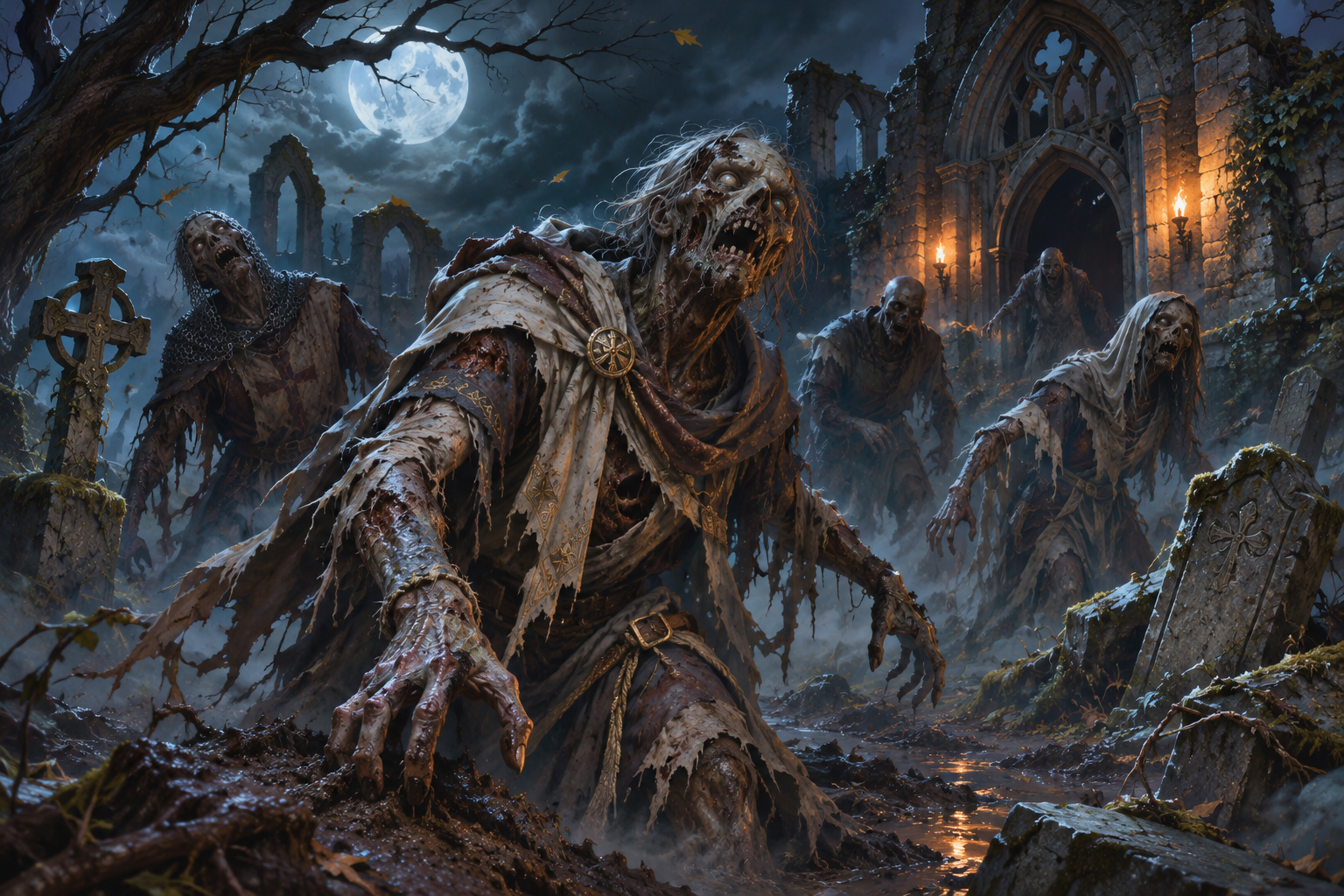
A corpse walks the mill road with mud in its burial shroud. It does not recognise the living; it follows the last command laid upon its bones.
At a Glance
| Creature | Zombie — a dead body animated by necromancy |
|---|---|
| Nature | Mindless, Neutral Evil Undead; obeys a simple command or attacks without strategy |
| Threat | CR 1/4 in D&D 2024 and 2014; the published human example is CR 1/2 in Pathfinder 1e and D&D 3.5e |
| Places | Battlefield trenches, mass graves, flooded cellars, roadside cemeteries and ruined watchtowers |
| Signs | Stiff footprints from graves, soil beneath the nails, broken burial cloth and a body repeatedly walking the same route |
| Combat | Slow pursuit, close-range blows and sheer refusal to stop |
| Counterplay | Isolate the source of animation, block a narrow route, hold high ground and use the selected rules for turning and resisting its durability |
Zombie Statistics
Zombie — D&D 2024
Medium Undead, Neutral Evil · CR 1/4 (50 XP; PB +2) · SRD 5.2.1
AC 8; Initiative −2 (8); HP 15 (2d8 + 6); Speed 20 ft.
| STR | DEX | CON | INT | WIS | CHA |
|---|---|---|---|---|---|
| 13 (+1) | 6 (−2) | 16 (+3) | 3 (−4) | 6 (−2) | 5 (−3) |
Saving Throw Wis +0; Immunities Poison damage; Exhaustion and Poisoned conditions; Senses Darkvision 60 ft., Passive Perception 8; Languages understands two languages known in life but cannot speak.
Traits
Undead Fortitude. When damage reduces the zombie to 0 HP, it makes a Constitution saving throw against DC 5 + damage taken, unless the damage was Radiant or the result of a Critical Hit. On success it drops to 1 HP instead.
Actions
Slam. Melee Attack Roll +3, reach 5 ft. Hit: 5 (1d8 + 1) Bludgeoning damage.
Source: Zombie, D&D 2024 Basic Rules, SRD 5.2.1 under CC BY 4.0.
Zombie — D&D 2014
Medium Undead, Neutral Evil · CR 1/4 (50 XP) · SRD 5.1
AC 8; HP 22 (3d8 + 9); Speed 20 ft.
| STR | DEX | CON | INT | WIS | CHA |
|---|---|---|---|---|---|
| 13 (+1) | 6 (−2) | 16 (+3) | 3 (−4) | 6 (−2) | 5 (−3) |
Saving Throw Wis +0; Damage Immunity Poison; Condition Immunity Poisoned; Senses Darkvision 60 ft., Passive Perception 8; Languages understands those known in life but cannot speak.
Traits
Undead Fortitude. If damage reduces the zombie to 0 HP, it makes a Constitution saving throw with DC 5 + damage taken, unless the damage is Radiant or comes from a Critical Hit. Success leaves it at 1 HP instead.
Actions
Slam. Melee Weapon Attack +3 to hit, reach 5 ft., one target. Hit: 4 (1d6 + 1) Bludgeoning damage.
Source: Zombie, D&D 2014 Basic Rules, SRD 5.1 under CC BY 4.0.
Human Zombie — Pathfinder 1e
NE Medium Undead · CR 1/2 (200 XP)
Initiative +0; Senses Darkvision 60 ft., Perception +0; AC 12, touch 10, flat-footed 12 (+2 natural); HP 12 (2d8 + 3); Fort +0, Ref +0, Will +3; DR 5/slashing; Defences Undead traits.
Speed 30 ft.; Melee Slam +4 (1d6+4).
| STR | DEX | CON | INT | WIS | CHA |
|---|---|---|---|---|---|
| 17 (+3) | 10 (+0) | — | — | 10 (+0) | 10 (+0) |
BAB +1; CMB +4; CMD 14; Bonus Feat Toughness; Skills None; Languages None.
Special Qualities
Staggered (Ex). The zombie can take a move or a standard action in a round, not both. It cannot take a full-round action.
Environment Any; Organisation Any; Treasure None.
Source: Pathfinder RPG Bestiary — Zombie (Paizo, 2009; OGL 1.0a). This is the published human zombie example.
Human Commoner Zombie — D&D 3.5e
NE Medium Undead · CR 1/2
HD 2d12+3 (16 hp); Initiative −1; Speed 30 ft. (cannot run); AC 11 (+2 natural, −1 Dex), touch 9, flat-footed 11; BAB/Grapple +1/+2; Space/Reach 5 ft./5 ft.; Fort +0, Ref −1, Will +3.
Attack Slam +2 melee (1d6+1) or club +2 melee (1d6+1); Full Attack one slam or one club attack; Special Qualities Damage Reduction 5/slashing, Darkvision 60 ft., Undead traits, Single Actions Only.
| STR | DEX | CON | INT | WIS | CHA |
|---|---|---|---|---|---|
| 12 (+1) | 8 (−1) | — | — | 10 (+0) | 1 (−5) |
Skills None; Feat Toughness; Languages None.
Special Qualities
Single Actions Only (Ex). The zombie may make one attack or take one move action each round. It can move and attack in the same round only as a charge.
Environment Any; Organisation Any; Treasure None.
Source: D&D 3.5e SRD — Zombie, OGL 1.0a. Published human commoner zombie example.
A zombie is a corpse made to move by necromancy, not a living creature changed by hunger. It remembers no loved ones, makes no bargains and cannot explain its orders. One may march beneath a forgotten war banner; another still carries a spade because its maker told it to empty the graveyard.
The body bears the marks of its death and burial: soil pressed into the mouth, wet cloth, stiff limbs and wounds that should have ended all movement. The spell or curse that rouses it gives those remains a simple, dreadful purpose.
A zombie advances until the obstacle is gone, the order is fulfilled or its magic fails. A clever commander makes the dead dangerous by setting them to guard a narrow stair, drag stones from a city wall or walk endlessly towards a threatened gate. The zombie itself does not devise that plan.
Where the Dead Still March
On the edge of a battlefield, an old drummer’s body rises whenever the last light leaves the trench. It beats the same three strokes, turns towards the ruined standard and begins its march. The army is long gone, but the enchantment still holds. Other zombies wait in shallow pits beneath a town gate, ready to rise when the command word is spoken.
Signs of Necromancy
- Burial clothes dragged along a road, with no returning tracks
- Broken earth at the same depth in graves far apart
- Stiff figures walking a single route even when a bridge has collapsed
- A guarded ruin where corpses resume their posts every time a warning bell sounds
Three Marches of the Dead
The Corpse at the Ford. A drowned messenger has been ordered to carry a sealed letter to a distant commander. It repeatedly attempts to cross the river and attacks anyone who tries to take the message. Characters can restrain it, read the still-dry letter or follow its route to discover who gave the order.
The Watch Below the Wall. Eight corpses stand under a breached city wall, holding old stones against the gap. They attack only those approaching the breach. The necromancer may have raised them with Animate Dead. The party can cross elsewhere or find the hidden necromancer who arranged their labour, but anyone who treats the corpses as mindless enemies may overlook the intelligent will directing them.
The Door That Opens at Sunset. A tomb door remains locked all day. At dusk, a zombie emerges, walks around the surrounding burial plot and returns before dawn. Its movements trace the boundary of a hidden chamber; following it can reveal the grave robber who used necromancy to protect stolen treasure.
Temperament and Limitations
A common zombie cannot negotiate, feign loyalty, invent a trap or interpret complicated instructions. It moves towards a target or repeats the task it has been given. That makes it predictable in small encounters but frightening in numbers. A clever master can direct a mass of zombies to block streets, destroy crops or exhaust a garrison without expecting the bodies to think for themselves. A broken bridge, a barred gate or a vigilant watch may stop the procession more effectively than a sword; the true enemy is often the mind that gave the dead their orders.
Other Dead Servants
A Fast Zombie is more dangerous on open ground; an Apocalypse Zombie belongs to a different, outbreak-driven horror. A Skeleton serves the same kind of necromancer with a lighter frame, while a Crawling Hand is a smaller animated relic. None should inherit the common zombie’s powers unless its own rules give them.
Sources and Licences
The printed D&D 2024 zombie understands Common plus one other language. This campaign replaces that universal language with one learned in mortal life, retaining two languages understood but no speech.
D&D 2024 Basic Rules, Zombie (SRD 5.2.1, CC BY 4.0); D&D 2014 Basic Rules, Zombie (SRD 5.1, CC BY 4.0); Pathfinder RPG Bestiary, Zombie (Paizo Publishing, 2009, OGL 1.0a); D&D 3.5e SRD, Zombie Template and Human Commoner Example (OGL 1.0a).
Return to the Undead Bestiary for the full range of restless spirits, graveyard predators and deathless servants.
Full Open Game License 1.0a and Section 15 notices
OPEN GAME LICENSE Version 1.0a
The following text is the property of Wizards of the Coast, Inc. and is Copyright 2000 Wizards of the Coast, Inc (“Wizards”). All Rights Reserved.
1. Definitions: (a)”Contributors” means the copyright and/or trademark owners who have contributed Open Game Content; (b)”Derivative Material” means copyrighted material including derivative works and translations (including into other computer languages), potation, modification, correction, addition, extension, upgrade, improvement, compilation, abridgment or other form in which an existing work may be recast, transformed or adapted; (c) “Distribute” means to reproduce, license, rent, lease, sell, broadcast, publicly display, transmit or otherwise distribute; (d)”Open Game Content” means the game mechanic and includes the methods, procedures, processes and routines to the extent such content does not embody the Product Identity and is an enhancement over the prior art and any additional content clearly identified as Open Game Content by the Contributor, and means any work covered by this License, including translations and derivative works under copyright law, but specifically excludes Product Identity. (e) “Product Identity” means product and product line names, logos and identifying marks including trade dress; artifacts; creatures characters; stories, storylines, plots, thematic elements, dialogue, incidents, language, artwork, symbols, designs, depictions, likenesses, formats, poses, concepts, themes and graphic, photographic and other visual or audio representations; names and descriptions of characters, spells, enchantments, personalities, teams, personas, likenesses and special abilities; places, locations, environments, creatures, equipment, magical or supernatural abilities or effects, logos, symbols, or graphic designs; and any other trademark or registered trademark clearly identified as Product identity by the owner of the Product Identity, and which specifically excludes the Open Game Content; (f) “Trademark” means the logos, names, mark, sign, motto, designs that are used by a Contributor to identify itself or its products or the associated products contributed to the Open Game License by the Contributor (g) “Use”, “Used” or “Using” means to use, Distribute, copy, edit, format, modify, translate and otherwise create Derivative Material of Open Game Content. (h) “You” or “Your” means the licensee in terms of this agreement.
2. The License: This License applies to any Open Game Content that contains a notice indicating that the Open Game Content may only be Used under and in terms of this License. You must affix such a notice to any Open Game Content that you Use. No terms may be added to or subtracted from this License except as described by the License itself. No other terms or conditions may be applied to any Open Game Content distributed using this License.
3. Offer and Acceptance: By Using the Open Game Content You indicate Your acceptance of the terms of this License.
4. Grant and Consideration: In consideration for agreeing to use this License, the Contributors grant You a perpetual, worldwide, royalty-free, non-exclusive license with the exact terms of this License to Use, the Open Game Content.
5. Representation of Authority to Contribute: If You are contributing original material as Open Game Content, You represent that Your Contributions are Your original creation and/or You have sufficient rights to grant the rights conveyed by this License.
6. Notice of License Copyright: You must update the COPYRIGHT NOTICE portion of this License to include the exact text of the COPYRIGHT NOTICE of any Open Game Content You are copying, modifying or distributing, and You must add the title, the copyright date, and the copyright holder’s name to the COPYRIGHT NOTICE of any original Open Game Content you Distribute.
7. Use of Product Identity: You agree not to Use any Product Identity, including as an indication as to compatibility, except as expressly licensed in another, independent Agreement with the owner of each element of that Product Identity. You agree not to indicate compatibility or co-adaptability with any Trademark or Registered Trademark in conjunction with a work containing Open Game Content except as expressly licensed in another, independent Agreement with the owner of such Trademark or Registered Trademark. The use of any Product Identity in Open Game Content does not constitute a challenge to the ownership of that Product Identity. The owner of any Product Identity used in Open Game Content shall retain all rights, title and interest in and to that Product Identity.
8. Identification: If you distribute Open Game Content You must clearly indicate which portions of the work that you are distributing are Open Game Content.
9. Updating the License: Wizards or its designated Agents may publish updated versions of this License. You may use any authorized version of this License to copy, modify and distribute any Open Game Content originally distributed under any version of this License.
10. Copy of this License: You MUST include a copy of this License with every copy of the Open Game Content You Distribute.
11. Use of Contributor Credits: You may not market or advertise the Open Game Content using the name of any Contributor unless You have written permission from the Contributor to do so.
12. Inability to Comply: If it is impossible for You to comply with any of the terms of this License with respect to some or all of the Open Game Content due to statute, judicial order, or governmental regulation then You may not Use any Open Game Material so affected.
13. Termination: This License will terminate automatically if You fail to comply with all terms herein and fail to cure such breach within 30 days of becoming aware of the breach. All sublicenses shall survive the termination of this License.
14. Reformation: If any provision of this License is held to be unenforceable, such provision shall be reformed only to the extent necessary to make it enforceable.
15. COPYRIGHT NOTICE
Open Game License v 1.0a Copyright 2000, Wizards of the Coast, Inc.
System Reference Document Copyright 2000-2003, Wizards of the Coast, Inc.; Authors Jonathan Tweet, Monte Cook, Skip Williams, Rich Baker, Andy Collins, David Noonan, Rich Redman, Bruce R. Cordell, John D. Rateliff, Thomas Reid, James Wyatt, based on original material by E. Gary Gygax and Dave Arneson.
Pathfinder Roleplaying Game Core Rulebook © 2009, Paizo Publishing, LLC; Author: Jason Bulmahn, based on material by Jonathan Tweet, Monte Cook, and Skip Williams.
Pathfinder RPG Bestiary © 2009, Paizo Publishing, LLC; Author: Jason Bulmahn, based on material by Jonathan Tweet, Monte Cook, and Skip Williams.
Keep this reference growing
If this page helped with your reading or game, you can support its upkeep or explore the curated books.
Explore the Bookshop — epics, classics and stories behind imagined worlds.