
Dire Boar (Daeodon)
Dire Boar (Daeodon)
A dire boar is a bone-jawed monster of forest edge, broken field, bad road, and raider country, a brutal charging beast whose tusks turn panic, mud, and open ground into a killing line.
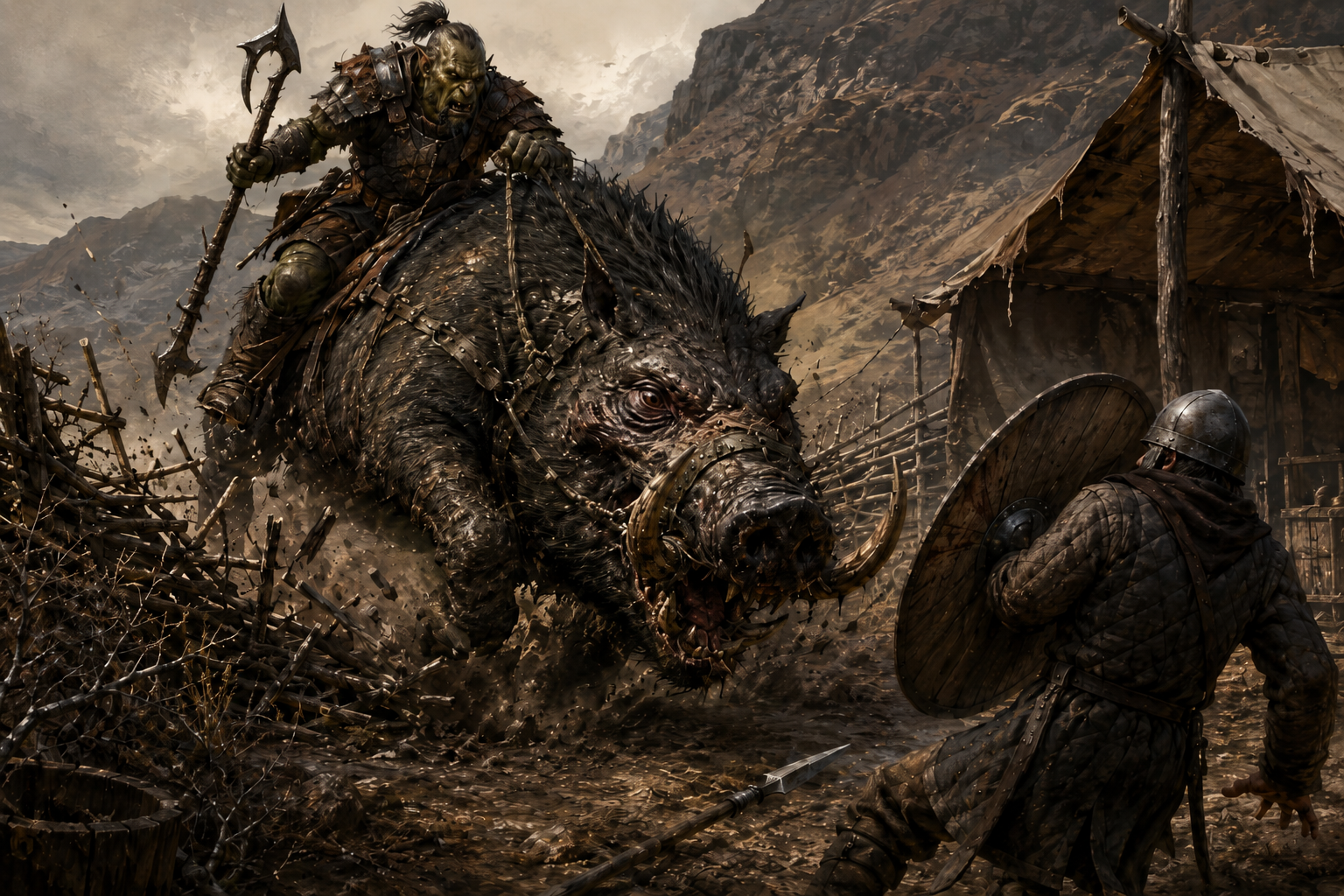
The dire boar is a huge, violent beast of torn hedges, broken roads, badlands raids, and old hunting woods. It is heavier in the skull, harsher in the jaw, and more brutal in the charge than any ordinary boar. When it breaks from cover, it does not merely attack; it changes the shape of the encounter.
Most people meet a dire boar before they see it. They find the orchard churned into mud, the dead hound, the horse that refuses the path, the shield split below the rim, or the old road scored by tusks and hooves. By the time the animal itself appears, the danger has already announced itself.
A dire boar is not subtle. It is hunger, territory, weight, fear, and impact. It belongs wherever the ground is broken, the cover is close, and the first mistake can become a collision.
In badlands and broken hill-country, orcs sometimes capture or breed dire boars as brutal shock mounts. They are not elegant cavalry animals. They are living battering rams, used where intimidation, weight, rough-ground movement, and the first violent breach matter more than discipline or speed.
Appearance
A dire boar stands high at the shoulder, with a heavy neck, wedge-shaped head, coarse bristles, slabbed flanks, and tusks built for ripping rather than display. Its skull looks too large for its body until it begins to charge; then the whole animal makes sense.
The back rises steeply. The snout is muddy, the jaw heavy, the eyes small and watchful under crusted bristle. Old males may carry broken tusks, torn ears, healed spear wounds, burrs in the hide, and the stink of carrion in the mane.
Boar-mounts used by orcs are usually marked by iron nose-rings, scarred flanks, crude saddle frames, chain harness, patched hide armour, and old goad wounds. A trained dire boar is never truly tame; even the best-handled beast still looks one bad noise away from turning the battlefield into a stampede.
Behavior
Dire boars are omnivorous, but they are not harmless rooters. They dig, graze, scavenge, raid orchards, tear open nests, feed on carcasses, and attack wounded creatures that cannot get clear. They are particularly dangerous where human activity has already weakened the land: battlefields, abandoned farms, winter roads, plague-empty hamlets, and hunting grounds where wounded animals are common.
They are not evil. A dire boar does not hate heroes, obey darkness, or seek ruin for its own sake. It attacks because something is too close, too loud, too wounded, too threatening, or standing between it and escape.
Its danger comes from certainty. Once committed, it is hard to turn. Dogs may fail before it. Horses may refuse before riders understand why. People who have hunted ordinary boar often make the worst mistakes, because they think they know what they are facing.
A trained dire boar is still not a calm animal. Orc handlers rely on hunger, dominance, heavy tack, chains, hooked goads, and brutal familiarity rather than true gentling. A routed boar-mount can be as dangerous to its own side as to its enemies.
Habitat
Dire boars favour broken country where cover meets open ground. Deep forest alone is less useful to them than forest edge, thorn scrub, abandoned orchard, muddy road, old battlefield, riverbank, hunting preserve, ruined pasture, or overgrown boundary hedge.
A dire boar’s range is easy to read if the party pays attention. Trees are scored at shoulder height. Saplings are snapped rather than bent. Mud is churned into deep slots. Mushrooms, roots, bones, and buried rubbish are torn up in wide, violent patches. Tracks often run in straight bursts between cover and feeding ground.
They are most dangerous in places that give them a charging lane: a cart road through trees, a bank between fields, a ride cut through a hunting wood, a dry ditch, a causeway, a gap in a hedge, or the open strip between a ruined wall and the treeline.
In badlands, dry scrub, and broken hills, dire boars may appear as war-beasts among orc raiders. Horses struggle in such country; a dire boar can smash through thorn, climb broken ground, and carry a screaming rider into places where ordinary cavalry loses formation. Hobgoblins may use them rarely as specialist assault beasts, but disciplined hobgoblin forces generally consider them too ill-tempered for regular cavalry.
Modus Operandi
A dire boar does not stalk like a cat or circle like a wolf pack. It finds by scent, claims by force, and resolves danger by collision.
In an encounter, it should usually begin from cover. The first round should alter the scene: a rider falls, a hedge bursts, a shield splits, a pack animal screams, a cart overturns, or a character is driven into mud, water, thorns, or a ditch.
After the first charge, it does not politely stand in the middle of the battlefield. It wheels, crashes through cover, turns on the nearest serious threat, and keeps using its body as a weapon. A good dire boar fight should feel muddy, loud, and difficult to control.
When used as a mount, the dire boar becomes a living breach weapon. Orc riders favour it for breaking shield lines, smashing camp gates, scattering horses, and crossing rough ground where cavalry would falter. These riders do not use the beast for elegant charges. They use it to make a hole.
If badly wounded and not defending young, it may try to flee into dense cover. That retreat can become a second scene: blood on leaves, broken reeds, a wounded animal in a dark hollow, or a trail leading to something the boar had been feeding on.
Motivation
A dire boar wants food, space, safety, and dominance over the immediate ground.
It attacks when startled, cornered, wounded, defending young, driven by dogs, competing for a carcass, or blocked from escape. It may also charge simply because a noisy armed group has entered what it already considers its feeding lane.
A sow with young is often more dangerous than an old solitary male because retreat means abandoning the litter. An old male is dangerous for the opposite reason: it has survived hunters, rivals, winter, and injury by charging first.
A ridden dire boar is not motivated by loyalty. It moves because it has been driven, trained, frightened, starved, angered, or forced forward by a rider who knows how close control is to disaster. If the rider falls, the boar may keep charging, wheel on the nearest movement, or flee through its own side.
Quick Rules Reference
- Primary role: charge-and-break brute.
- Signature action: gore or tusk charge.
- Defining trait: ferocity or relentless fighting after severe wounds.
- Best senses: scent and low-light vision where supported by the ruleset.
- Best terrain: forest edge, thorn scrub, muddy track, ruined field, hunting preserve, badlands, broken hills.
- Best warning signs: churned mud, scored bark, broken fences, panicked horses, cracked bones.
- Best complication: difficult ground, nearby young, frightened mounts, hunters in the way, or a blood trail leading somewhere worse.
- Mounted use: most often ridden by orcs; rarely used by hobgoblins as specialist assault beasts.
- Mounted encounter role: shock mount, shield-breaker, camp-raider, breach beast, or brutal chariot substitute.
- Best table use: a physical encounter that immediately changes position, terrain, and confidence.
Mechanics Tabs
The rules below are mechanics tabs for different game systems.
Dire Boar (Daeodon) 5.5e / 2024
Daeodon 5e
Dire Boar (Daeodon) Pathfinder 1e
Dire Boar (Daeodon) 5.5e / 2024
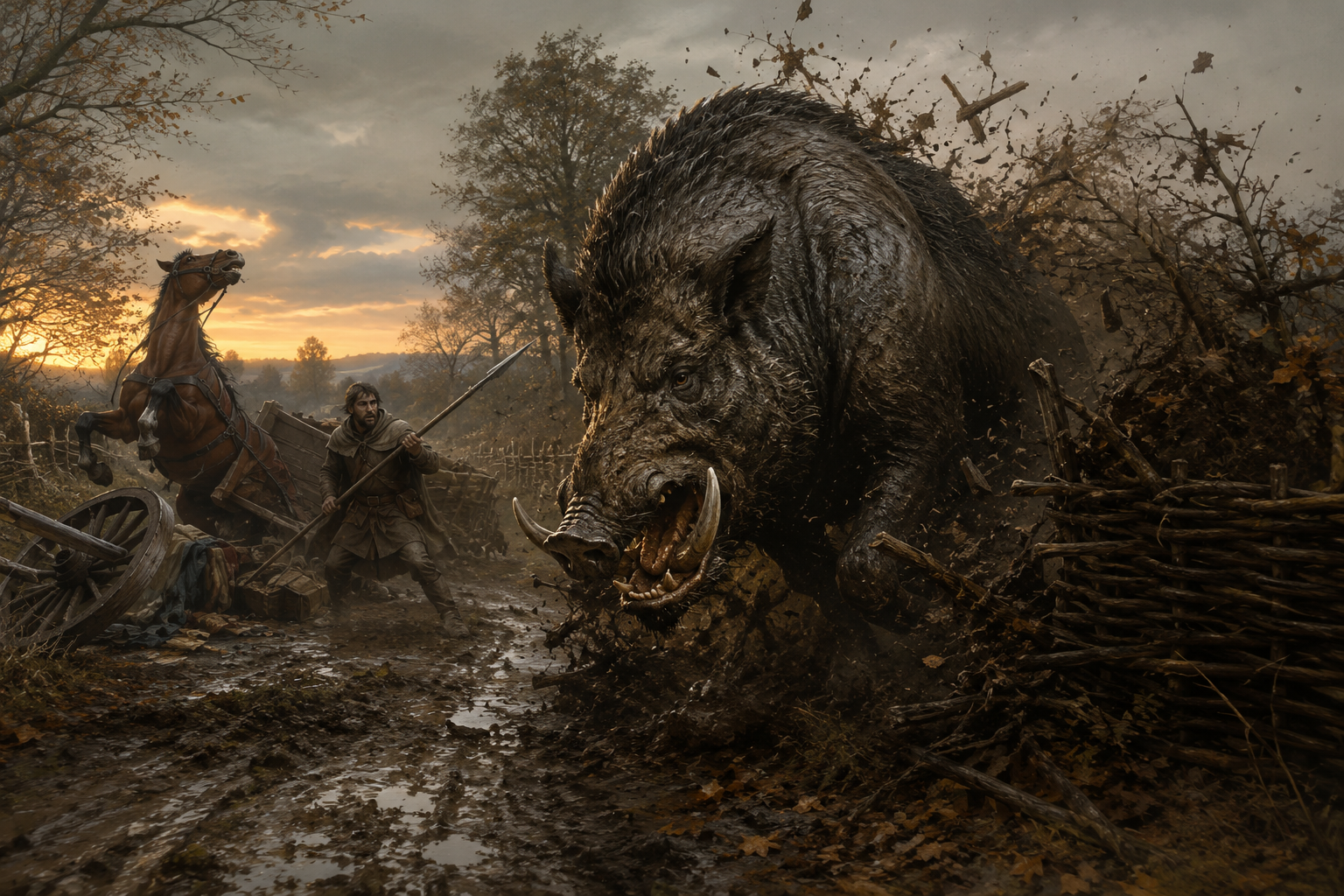
Large Beast, Unaligned
| STR | DEX | CON | INT | WIS | CHA |
|---|---|---|---|---|---|
| 19 (+4) | 11 (+0) | 17 (+3) | 2 (-4) | 12 (+1) | 7 (-2) |
Armor Class: 13 (natural armor)
Hit Points: 52 (7d10 + 14)
Speed: 40 ft.
Proficiency Bonus: +2
Skills: Perception +3, Survival +3
Senses: passive Perception 13
Languages: —
Challenge: 2 (450 XP)
Traits
Boar Charge. If the dire boar moves at least 20 feet straight toward a creature and then hits it with a Gore attack on the same turn, the target takes an extra 7 (2d6) piercing damage. If the target is Large or smaller, it must succeed on a DC 14 Strength saving throw or have the Prone condition.
Relentless Ferocity. If damage would reduce the dire boar to 0 Hit Points, it drops to 1 Hit Point instead, unless the damage is from a critical hit or the dire boar has already used this trait since its last rest.
Keen Smell. The dire boar has Advantage on Wisdom (Perception) checks that rely on smell.
Actions
Gore. Melee Attack Roll: +6, reach 5 ft. Hit: 13 (2d8 + 4) piercing damage.
Running the Dire Boar in 5.5e / 2024
The dire boar should not be run as a stationary sack of hit points. Its strength is the opening collision. Give it a line, a reason to charge, and terrain that matters.
Use it to punish careless movement, frighten mounts, scatter retainers, break cover, or turn a safe-looking road into a dangerous lane. If the party sees the signs early, they should be able to prepare. If they ignore the signs, the first charge should feel earned.
One dire boar is a strong low-level wilderness threat. A mated pair, a sow with young, a mounted orc rider, or a boar in bad terrain may be more dangerous than its challenge rating suggests.
Mounted Dire Boar Use
A mounted dire boar uses the same basic statistics unless the rider, tack, armour, or training justifies a stronger version. As a mount, it should still feel difficult to control. If the rider is knocked prone, killed, frightened, or thrown, the boar may continue its charge, attack the nearest creature, or flee toward cover at the DM’s discretion.
Dire Boar (Daeodon) Pathfinder 1e
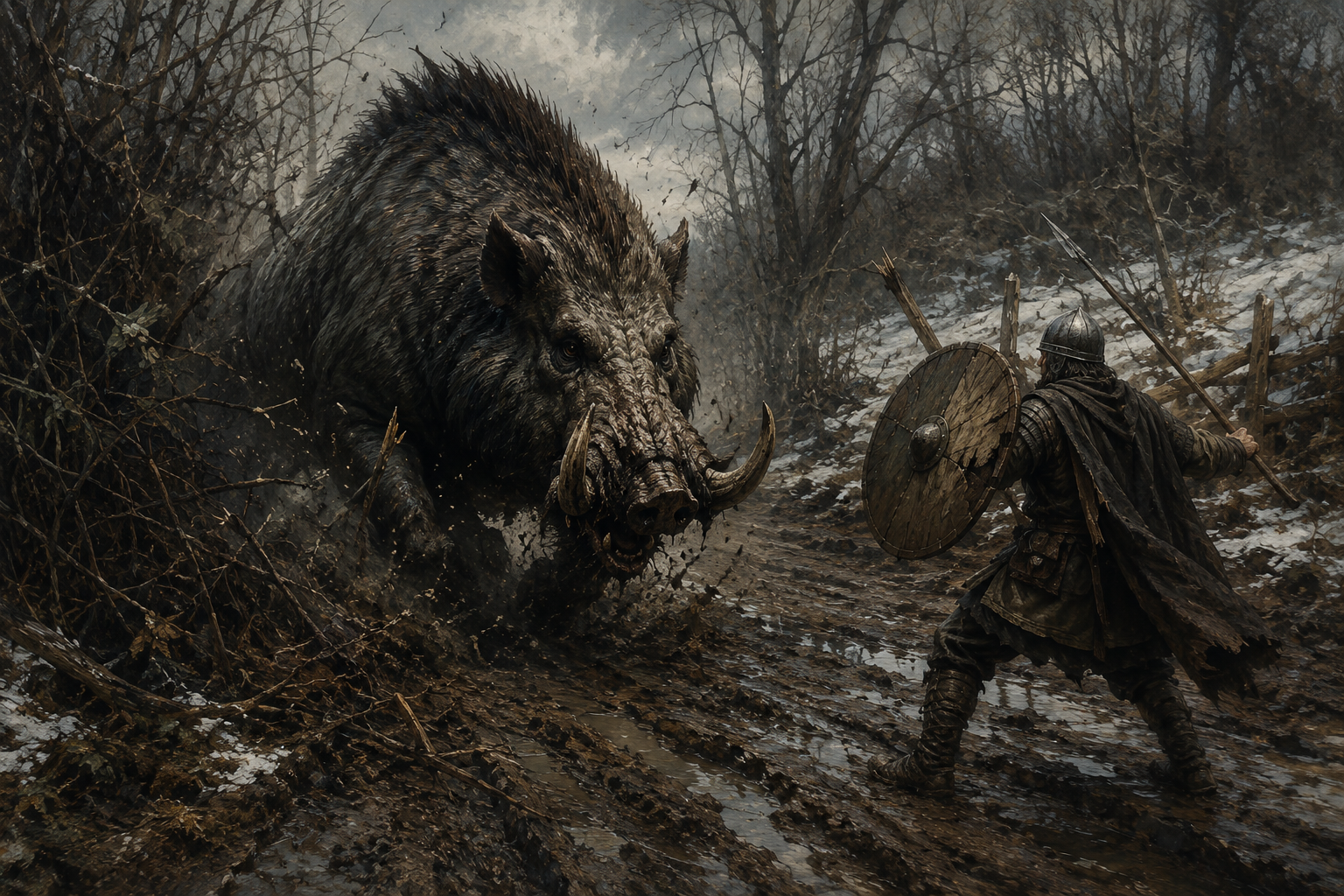
Dire Boar (Daeodon) CR 4
XP 1,200
N Large animal
Init +4; Senses low-light vision, scent; Perception +12
Defense
AC 15, touch 9, flat-footed 15 (+6 natural, –1 size)
hp 42 (5d8+20)
Fort +7, Ref +4, Will +2
Defensive Abilities ferocity
Offense
Speed 40 ft.
Melee gore +8 (2d6+9)
Space 10 ft.; Reach 5 ft.
Statistics
Str 23, Dex 10, Con 19, Int 2, Wis 13, Cha 8
Base Atk +3; CMB +10; CMD 20
Feats Improved Initiative, Skill Focus (Perception), Toughness
Skills Perception +12
Ecology
Environment temperate forests, hunting preserves, ruined farmland, battlefield edges, badlands, broken hills, and primal valleys
Organization solitary or herd; rarely encountered as orc shock cavalry or hobgoblin assault beasts
Treasure none by default, though tusks, hide, bristles, stomach contents, and war tack may have modest practical value
Special Abilities
Ferocity (Ex) A dire boar remains conscious and can continue fighting even if its hit point total is below 0. It is still staggered and loses 1 hit point each round. It dies when its hit point total reaches a negative amount equal to its Constitution score.
Mounted Dire Boar Use
When used as a mount, the dire boar remains more volatile than a horse or trained war-beast. Orc riders treat it as a shock animal, not precision cavalry. A failed Ride check, a panicked rider, a blocked charge lane, or sudden fire can make the boar surge, wheel, or attack unpredictably.
Daeodon 5e
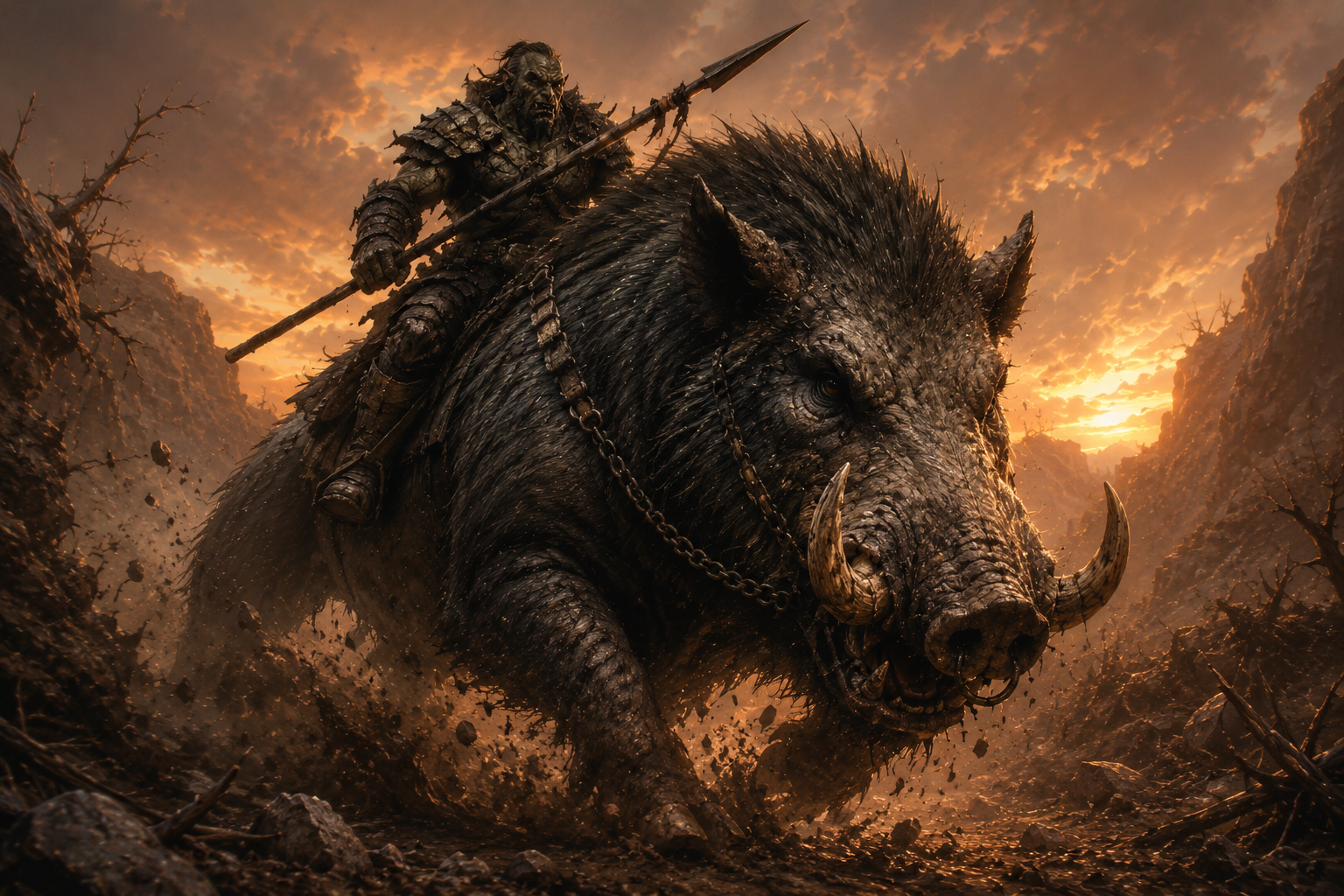
Large beast, unaligned
Armor Class 13 (natural armor)
Hit Points 76 (9d10 + 27)
Speed 40 ft.
| STR | DEX | CON | INT | WIS | CHA |
|---|---|---|---|---|---|
| 21 (+5) | 8 (–1) | 16 (+3) | 2 (–4) | 12 (+1) | 6 (–2) |
Senses passive Perception 11
Languages —
Challenge 3 (700 XP)
Proficiency Bonus +2
SPECIAL TRAITS
- Keen Smell. The daeodon has advantage on Wisdom (Perception) checks that rely on smell.
- Relentless (Recharges after a Short or Long Rest). If the daeodon takes 15 damage or less that would reduce it to 0 hp, it is reduced to 1 hp instead.
- Trampling Charge. If the daeodon moves at least 20 feet straight toward a creature and then hits it with a Bite attack on the same turn, that target must succeed on a DC 13 Strength saving throw or be forced prone. If the target is prone, the daeodon can make one Slam attack against it as a bonus action.
ACTIONS
- Multiattack. The daeodon makes one Bite attack and one Slam attack.
- Bite. Melee Weapon Attack: +7 to hit, reach 5 ft., one target. Hit: 14 (2d8 + 5) piercing damage, and the target is grappled (escape DC 13). Until this grapple ends, the target is restrained, and the daeodon can’t Bite another target.
- Slam. Melee Weapon Attack: +7 to hit, reach 5 ft., one target. Hit: 10 (2d4 + 5) bludgeoning damage.
- Fierce Call (Recharges after a Short or Long Rest). The daeodon lets out a loud, fearsome call. Each hostile creature within 60 feet of the daeodon must succeed on a DC 13 Wisdom saving throw or drop whatever it is holding and become frightened for 1 minute. While frightened, a creature must take the Dash action and move away from the daeodon by the safest available route on each of its turns, unless there is nowhere to move. A frightened creature can repeat the saving throw at the end of each of its turns, ending the effect on itself on a success.
ABOUT
The massive warthog has a disturbingly large maw lined with enormous teeth. It snorts and charges. Daeodons are scavengers that range freely in forests and grasslands. Locals refer to them as hell pigs, but they are more closely related to hippopotamuses and possess massive maws.
Unfussy Eaters. Daeodons will eat most anything. While they may be content to graze for fruit and leaves or dig for tubers and grubs, they have the power to crush bone and devour flesh. Most of that is from scavenging kills from others—coming in only after something else has done all the hard work and is too tired to stand up to a hungry daeodon—but they’ve been known to hunt prey themselves.
Temporary Herds. Daeodons live largely solitary lives. They can tolerate one another enough to briefly form small squads and bring down tougher prey. However, they rarely come together unless food is plentiful. They fight among themselves, and the winners garner respect until another can best them.
Rude Neighbors. Isolated towns often face the challenge of keeping daeodons away from their food stores and livestock, for these massive beasts can trample fencing and destroy other obstacles to reach food. Some towns and villages create massive refuse piles well outside of the settlement; by keeping them well stocked, the villages satisfy local daeodons and keep them from the more vital stores.
This has the added benefit of using the daeodons as deterrents from bandits and dangerous predators, though it means the daeodons adopt the area as their territory.
Section 15: Copyright Notice
Tome of Beasts 3 © 2022 Open Design LLC; Authors: Eytan Bernstein, Celeste Conowitch, Benjamin L. Eastman, Robert Fairbanks, Scott Gable, Basheer Ghouse, Richard Green, Jeremy Hochhalter, Jeff Lee, Christopher Lockey, Sarah Madsen, Ben Mcfarland, Jonathan Miley, Kelly Pawlik, Sebastian Rombach, Chelsea Steverson, Brian Suskind, Mike Welham
Tactics
Before combat, show the damage. Churned mud, broken roots, tusk-scored bark, crushed shields, blood-smeared stones, and panicked animals all tell players what sort of force is nearby.
In the opening round, the boar should charge from cover if possible. The charge should not be decorative. It should knock a creature down, break a line, scatter animals, or force the party to move.
In the middle of the fight, the boar keeps using the ground. It wheels through mud, crashes through brush, turns on the nearest serious threat, and uses its size to make positioning awkward.
At the end of the fight, it either dies hard or crashes back into cover. A fleeing dire boar should leave a trail: blood, snapped reeds, torn bark, and the possibility that following it reveals a lair, carcass, lost victim, or hidden ruin.
When mounted, start with the rider’s intent and the boar’s momentum. The rider may want to strike a target, but the beast wants to move, break, gore, and survive. The best mounted boar encounters feel one bad turn away from becoming dangerous to everyone.
Treasure and Remains
- Tusks: A matched pair of full tusks is worth 5–20 gp to hunters, armourers, trophy buyers, or craftsmen. Broken tusks are worth 1–5 gp each. Fine tusks may be carved into knife handles, drinking-horn mounts, ritual hooks, or oath-tokens.
- Hide: A usable hide is worth 5–15 gp if removed cleanly and cured quickly. It is thick, difficult to work, and useful for shield facing, saddle panels, reinforced leather, crude armour patches, or orcish mount barding.
- Bristles: Bundles of coarse bristles are worth 5 sp–2 gp, depending on cleanliness and quantity. They can be used for brushes, coarse stitching, fletching tools, charms, and village craftwork.
- Jawbone: An intact jawbone is worth 2–8 gp as a tavern trophy, shrine warning, oath-object, or grim marker above a forest gate. A particularly large or scarred specimen may fetch more from the right buyer.
- Meat: Fresh meat from an uncontaminated dire boar is worth 3–10 gp if butchered quickly, though many people refuse it because of the beast’s scavenging habits. Meat from a diseased or plague-ground boar is worthless and dangerous.
- War Tack: A ridden dire boar may carry crude saddle frames, chain harness, hooked goads, iron nose-rings, or battered armour plates worth 5–25 gp in salvage, depending on condition. Orcish tack is usually ugly, practical, and hard-used rather than finely made.
- Stomach Contents: The stomach is not treasure by default, but it may contain valuables or clues: rings, buttons, buckles, coins, strange roots, bone splinters, or pieces of a missing victim. Value varies from nothing to 25 gp or more, depending on what the beast has swallowed.
Adventure Hooks
The Hunt Was Not an Accident
A noble heir is dead after a boar hunt. The family calls it misfortune. The beaters say the animal was driven toward him deliberately, and the hounds refused the trail before the charge.
The Badlands Boar-Riders
An orc raiding band has abandoned horses and now rides chained dire boars through gullies, thorn scrub, and dry riverbeds. Their raids are louder, faster, and harder to stop than before. The party must reach the next village before its palisade learns the difference between stopping men and stopping tusks.
The Boar Beneath the Boundary Thorn
Two villages argue over a hedge-line that marks their old boundary. A dire boar has started breaking through the same stretch night after night, revealing buried stones and older markers beneath the roots.
Rumours and False Beliefs
- “It only attacks if hungry.” False. Territory, young, pain, blood-smell, and blocked escape can all trigger a charge.
- “Fire always drives it off.” Half true. Fire can break its line, but a wounded boar may charge through smoke if the path is clear.
- “The tusks are the valuable part.” Too simple. Tusks sell, but hide, bristles, jawbone, stomach contents, and war tack may matter more.
- “It is just a boar.” Dangerous falsehood. A dire boar is heavier, harsher, and built for a different kind of violence.
- “A boar with a rider is trained.” False. A ridden dire boar may be broken to harness, but it is never safe.
Source, Natural History, and Mythic Context
The classic fantasy dire boar is a practical monster: a huge, ill-tempered animal that charges, gores, and keeps fighting through terrible wounds. The older open rules present the dire boar as a Large omnivorous animal of temperate forests, dangerous because it attacks anything that comes too close and relies on tusks, charge, and ferocity.
Pathfinder’s Dire Boar (Daeodon) gives the creature a strong game identity, while the natural-history grounding comes from Daeodon and related entelodonts: pig-like mammals with heavy skulls, harsh jaws, powerful frames, and brutal prehistoric weight. For real-world background, see Encyclopaedia Britannica on entelodonts and Dinohyus.
Mythically, the dire boar belongs with dangerous hunts, ravaged fields, warrior deaths, forest boundaries, and beasts that make human confidence look foolish. As a war-beast, it also belongs to raider country: a creature whose natural charge can be bent into battle, but never made truly obedient.
Keep this reference growing
If this page helped with your reading or game, you can support its upkeep or explore the curated books.
Explore the Bookshop — epics, classics and stories behind imagined worlds.