
Traveler’s Outfit | Road Clothing
Traveler’s Outfit | Road Clothing
Road Clothing for Weather, Dust, Inns, Gates, and Long Miles Between Settlements
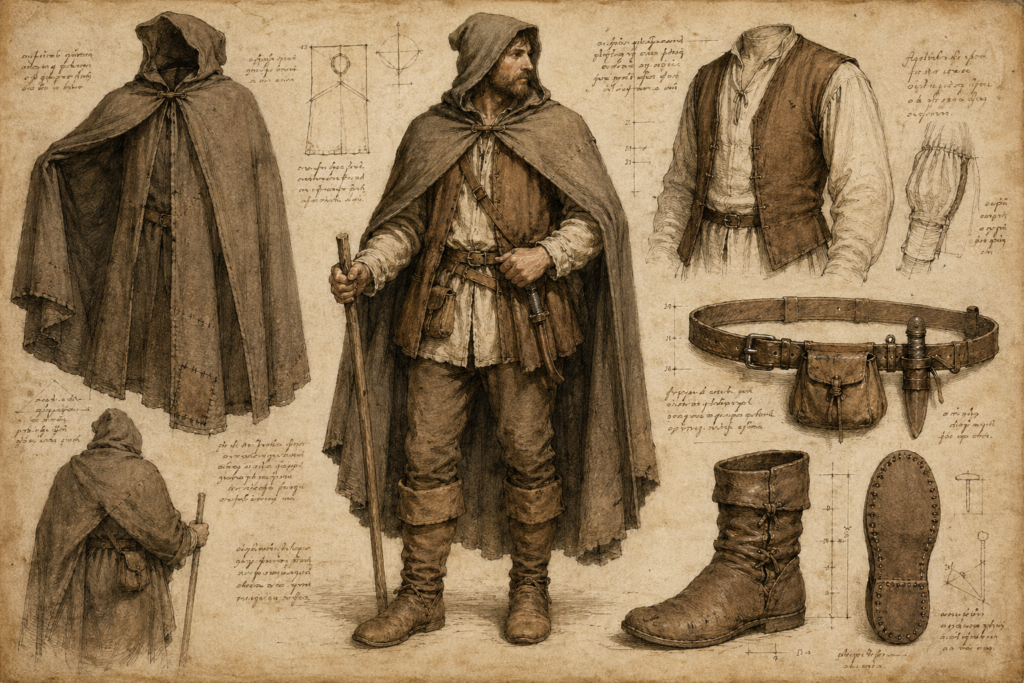
A Traveler’s Outfit is the clothing of the road: boots, belt, shirt, wool skirt or breeches, and a hooded cloak sturdy enough for bad weather, rough lodging, guarded gates, and long miles between settlements.
Overview
A Traveler’s Outfit is not armour, finery, or a disguise by itself. It is practical clothing for someone who expects to arrive as a stranger and be judged before speaking.
For adventurers, that matters. A character in a Traveler’s Outfit can pass more naturally as a courier, pilgrim, drover, messenger, merchant’s hireling, guard, refugee, or ordinary wayfarer than someone dressed for court, war, ritual, or beggary. The outfit does not make the wearer invisible, but it gives them a believable place in the world.
Its value lies less in protection than presentation. A Traveler’s Outfit tells gate guards, innkeepers, ferrymen, patrols, and villagers that the wearer belongs on the road. It gives the character a plausible reason to carry a pack, wear a cloak, bear travel stains, ask for lodging, or appear at a settlement gate after dark.
Its strength is its anonymity.
Physical Description
A typical Traveler’s Outfit includes sturdy boots, a wool skirt or breeches, a shirt, a strong belt, and an ample cloak with a hood. A vest, jacket, head covering, gloves, leg wraps, or spare outer layer may be included depending on region, season, and local custom.
The cloak is usually the most visible part of the outfit. It may be plain wool, weathered cloth, wax-treated fabric, or a local travelling mantle. A poor cloak is patched and smoke-stained. A prosperous one may be better dyed or lined, but it should still look useful rather than ornamental.
The details matter: worn soles, road dust, careful repairs, regional stitching, cloak badges, belt fittings, and stains all say something about where the traveler has been and how they expect to be received.
Why This Item Matters
Clothing determines how a stranger is read before they speak.
A Traveler’s Outfit gives guards, innkeepers, merchants, villagers, and patrols a familiar category for the wearer. That does not guarantee trust or welcome, but it can reduce the immediate suspicion caused by court dress, visible armour, ceremonial robes, foreign finery, or obvious poverty.
This makes the outfit useful in social play. It can support a cover identity, soften the presence of weapons or road grime, and explain why a stranger has arrived with tired boots, a pack, a cloak, and business elsewhere.
The outfit also gives the DM a simple tool for grounding the world. In a suspicious town, fine clothes may attract thieves. In a noble hall, road clothes may seem crude. In a war zone, a plain cloak may be safer than a uniform. The Traveler’s Outfit sits in the useful middle: practical, common, and believable.
Edition Tabs
Traveler’s Outfit 5.5e / 2024
Traveler’s Outfit, Pathfinder 1e / 3.5e
Traveler’s Outfit 3.0
Adventuring Gear
Cost: 2 gp
Weight: 5 lb.
Includes: Boots, shirt, belt, wool skirt or breeches, vest or jacket, and hooded cloak
A Traveler’s Outfit is practical road clothing suitable for ordinary travel, settlement life, inns, markets, mild weather, and long journeys between communities.
While wearing a Traveler’s Outfit, you are dressed appropriately for common travel in most settled regions. At the DM’s discretion, this may help you avoid suspicion or penalties caused by unsuitable clothing when passing as an ordinary traveler, courier, pilgrim, messenger, drover, refugee, or hired guard.
A Traveler’s Outfit provides no fixed bonus by default. It does not replace cold-weather gear, desert clothing, rainproof gear, armour, formal clothing, or a true disguise.
Practical Benefit
When clothing reasonably matters, a Traveler’s Outfit may prevent penalties that would apply to inappropriate dress.
Examples include entering a roadside inn, passing a village gate, joining a caravan, walking through a market, speaking with toll collectors, or concealing small mundane objects beneath a cloak.
The outfit does not grant automatic advantage. Its value is contextual: it makes the character look properly equipped for the road.
Quality Variants
- Poor Traveler’s Outfit: patched, stained, and worn; suitable for refugees, prisoners, beggars, desperate road folk, or labourers.
Common Traveler’s Outfit: the standard outfit described here.
Fine Traveler’s Outfit: better cloth, cleaner stitching, stronger boots, and local fashion; suitable for merchants, successful couriers, envoys, educated pilgrims, or minor retainers. - A fine Traveler’s Outfit usually costs 5 gp or more, depending on region and quality.
Traveler’s Outfit, Pathfinder 1e / 3.5e
Adventuring Gear
Cost: 1 gp
Weight: 5 lb.
This set of clothes consists of boots, a wool skirt or breeches, a sturdy belt, a shirt, perhaps with a vest or jacket, and an ample cloak with a hood.
A Traveler’s Outfit is suitable clothing for ordinary travel, roadside inns, markets, mild weather, and general use outside formal, noble, ceremonial, or military settings.
Game Use
A Traveler’s Outfit normally provides no direct skill bonus. It establishes that the character is dressed appropriately for the road and should not suffer penalties the GM might apply for unsuitable clothing in ordinary travel conditions.
At the GM’s discretion, a Traveler’s Outfit may matter when clothing affects a Disguise, Diplomacy, Gather Information, Survival, Sleight of Hand, or Stealth check.
The outfit is not a disguise by itself. It does not count as cold-weather gear, desert clothing, noble clothing, artisan’s clothing, clerical vestments, or armour.
Traveler’s Outfit 3.0
Source Core Rulebook
This set of clothes consists of boots, a wool skirt or breeches, a sturdy belt, a shirt (perhaps with a vest or jacket), and an ample cloak with a hood.
How a Traveler’s Outfit Is Used
A Traveler’s Outfit helps a character move through settled lands as someone who belongs on the road.
It is useful at inns, toll houses, ferry crossings, stable yards, markets, roadside shrines, caravan camps, and guarded settlements. It supports simple cover identities such as courier, pilgrim, drover, messenger, hireling, guard, refugee, or ordinary wayfarer. It can make road stains less remarkable, soften the appearance of weapons or travel gear, and keep a character from looking too wealthy, too martial, or too desperate in the wrong place.
The cloak, belt, boots, and outer layers also give the wearer practical room for the small business of travel: a sealed letter, purse, belt knife, holy token, folded map, spare tie, or hidden injury. None of this makes the outfit exceptional. It simply makes it believable.
Failure, Risk, and Misuse
A Traveler’s Outfit can still betray the wearer.
Blood on the cuff, boots too clean for a muddy road, noble cloth on a supposed beggar, a foreign cloak in hostile territory, or a soldier’s belt worn under civilian clothing may all invite questions. In some places, the wrong colour, badge, stitch pattern, or regional cut matters more than the wearer expects.
The outfit also has limits. It will not protect against severe weather, conceal heavy armour, pass for formal wear, or make an armed adventurer look harmless under close inspection.
Value in the World
Traveler’s Outfits are common wherever roads, rivers, markets, shrines, patrol routes, and caravan tracks connect communities.
They are rarely generic in practice. A merchant’s road clothes differ from a pilgrim’s. A courier’s boots differ from a refugee’s. A border scout’s cloak differs from a city messenger’s mantle. A good cloak may be patched for years, boots may be resoled again and again, and belts, buckles, knife loops, purse ties, hidden stitching, and local repairs often reveal the wearer’s trade, wealth, and habits.
A Traveler’s Outfit always belongs to a place, profession, road, or season.
Trade, Craft, and Common Variants
A Traveler’s Outfit is a baseline, not a uniform. Its price and appearance change quickly with profession, region, weather, and wealth.
The standard version costs 1–2 gp, but many road outfits are cheaper, dearer, or assembled over time from repaired garments.
Poor Road Outfit: 2–5 sp
A patched, mismatched set of usable clothes: worn boots or sandals, plain shirt, rough belt, and salvaged cloak. Common among refugees, labourers, prisoners, beggars, and the very poor. It may help the wearer pass unnoticed, but it can just as easily mark them as vulnerable.
Pilgrim’s Outfit: 5 sp–1 gp
Plain, durable clothing with a walking cloak, staff loop, simple belt, and space for badges, tokens, or shrine marks. It is humble by design, though not necessarily ragged.
Common Traveler’s Outfit: 1 gp
The standard road outfit: boots, shirt, belt, wool skirt or breeches, and hooded cloak. It suits wayfarers, minor hirelings, drovers, messengers, and people who travel without luxury.
Courier’s Outfit: 2–5 gp
Built around speed and documents: better boots, spare ties, a weatherproofed pouch or case, and a cloak cut to keep clear of mud, wheels, and stirrups. A good courier’s outfit looks practical, not rich.
Drover’s Outfit: 2–4 gp
Heavy road clothing for people moving animals through mud, weather, and open country. It may include gloves, thicker cloak cloth, reinforced boots, and darker outer layers that tolerate filth and rain.
Scout’s Outfit: 3–8 gp
Close-fitting travel clothing in muted local colours, with durable soles, quiet ties, fewer loose edges, and a cloak or mantle suited to the terrain. It is not camouflage by itself, but it avoids obvious colour and movement mistakes.
Merchant’s Road Outfit: 5–20 gp
Respectable travel clothing for someone who must look solvent without appearing foolishly rich. Better stitching, lined cloak, hidden purse space, cleaner fabric, and locally fashionable details are common.
Climate alters the outfit quickly. Wet regions favour treated wool and waxed cloth. Cold roads demand heavier layers. Hot regions favour loose linen, head coverings, and lighter footwear. Mountain tracks require stronger soles and shorter hems.
Using a Traveler’s Outfit in Your Game
Use the Traveler’s Outfit as a quiet social signal, not a rules burden.
It helps establish how the party appears when they arrive, who is stopped at the gate, who looks like a noble or soldier, who passes as a pilgrim or courier, and who is dressed for the road they claim to have travelled.
The item works best when it rewards players for thinking about place, weather, class, custom, and first impressions. It should support grounded play without turning clothing into a constant penalty trap.
Adventure and Worldbuilding Hooks
- A dead courier’s Traveler’s Outfit hides a sealed message inside the belt lining.
- A second-hand cloak still bears the stitch mark of a disgraced noble household.
- A border town arrests anyone wearing the colours of a neighbouring realm.
- A noble heir vanishes in plain road clothes, leaving only court finery behind.
- A village in flood season distrusts strangers with clean boots.
- A pilgrim’s cloak badge grants safe passage in one province and marks the wearer for death in another.
- A merchant’s “ordinary” road outfit contains hidden purse slits, false seams, and a coded pattern of repairs.
For historical context on medieval shirts, tunics, mantles, hose, and status-marking clothing, see Britannica’s overview of dress in Medieval Europe.
Keep this reference growing
If this page helped with your reading or game, you can support its upkeep or explore the curated books.
Explore the Bookshop — epics, classics and stories behind imagined worlds.