
Riding Kit — Mount Tack, Saddlebags, and Feed for Travel
Riding Kit — Mount Tack, Saddlebags, and Feed for Travel
A Riding Kit is a practical bundle of tack, saddlebags, and feed used to keep a mount controllable, supplied, and ready for road travel.
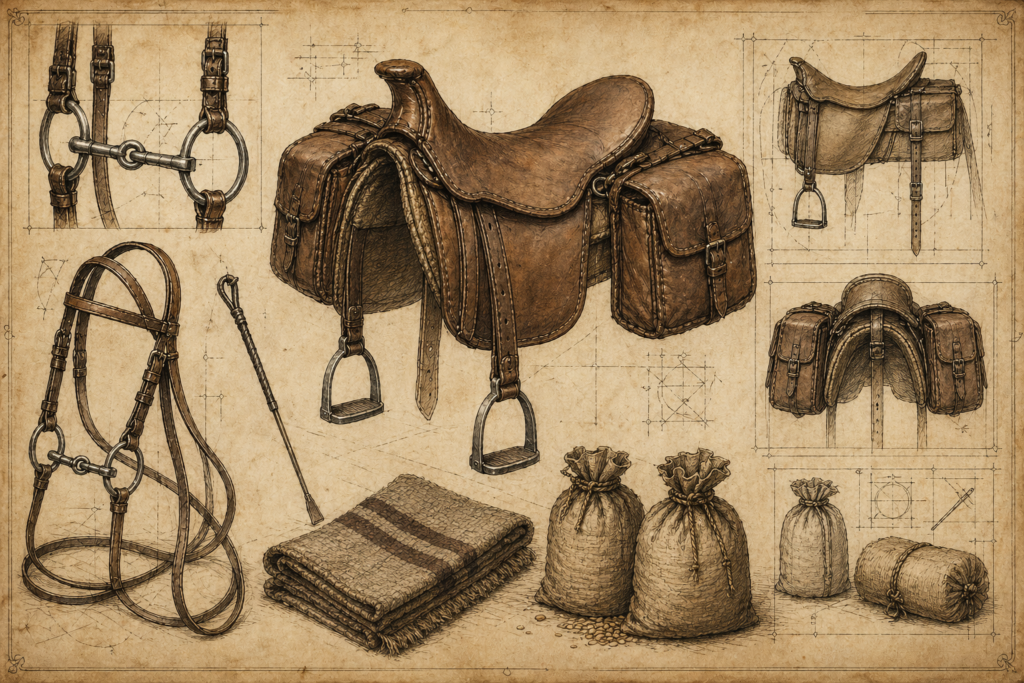
A Riding Kit gathers the basic equipment needed to manage a mount on the road. It includes the tack that lets a rider guide the animal, the saddle and blanket that make long travel possible, the saddlebags that carry small goods, and enough feed to keep the mount supplied for two days when grazing is poor or unavailable.
This is not a luxury kit. It is the practical riding bundle bought by travellers, messengers, scouts, caravan guards, pilgrims, hunters, and adventurers who need their mount to be more than an animal tied outside an inn. Without proper tack, a mount is harder to guide, harder to load, and more likely to injure itself or its rider over distance.
A riding kit is especially important where roads are long, settlements are far apart, and animals are part of travel rather than scenery.
Description
A riding kit normally contains a bit and bridle, a saddle, a saddle blanket, saddlebags, and two days of feed. The common version is sized for ordinary mounts such as horses, ponies, mules, camels, donkeys, or riding dogs where such animals are locally used.
An exotic-mount riding kit is made for stranger bodies: great cats, giant lizards, axe beaks, griffons, riding birds, huge insects, or other creatures that require altered straps, broader cinches, reinforced fittings, special harnessing, or a saddle shaped for an unusual back.
The saddle blanket matters more than inexperienced riders think. It protects the animal from rubbing, sweat sores, and pressure marks. The saddlebags keep gear balanced. The feed prevents a journey from depending entirely on pasture, roadside grass, or whatever the mount can find at the end of a hard day.
Why the Item Matters
A riding kit makes mounted travel believable. It explains how a rider controls the animal, how the saddle stays in place, where small gear goes, and how the mount is fed when the road offers nothing.
For adventurers, the kit turns a mount into a travelling asset. Saddlebags can carry food, spare clothing, tools, maps, messages, small loot, or emergency supplies. Feed allows the party to cross bad ground, winter roads, city streets, deserts, mountains, or dungeon approaches where grazing is not available.
It also gives the GM a clear way to make travel matter without overcomplicating the game. Lost feed, damaged tack, cut straps, stolen saddlebags, or saddle sores can become real problems on the road.
Failure, Risk, and Limitations
A riding kit does not include the mount itself. It also does not include barding, a pack saddle, wagon harness, horseshoes, veterinary tools, or long-term fodder beyond two days of feed.
The weight is significant. A common riding kit weighs 54 lb. with feed, or 44 lb. if the feed is discarded. An exotic-mount riding kit weighs 59 lb. with feed, or 49 lb. without feed. Dropping the feed lightens the load, but it also removes the animal’s emergency food supply.
Poorly fitted tack can injure a mount, slow travel, or make a difficult ride dangerous. A saddle made for one animal may not suit another, and exotic mounts require gear shaped for their anatomy.
Value in the World
Riding kits are found wherever mounted travel is common: stables, caravanserais, military depots, roadside markets, noble estates, courier houses, border forts, and horse fairs. A common kit is ordinary trade stock in settlements that support travellers. Exotic kits are rarer, more expensive, and usually require a specialist saddler, beast-handler, or stable attached to a noble, military, or monstrous-rider tradition.
A good riding kit is not glamorous, but experienced riders respect it. They notice worn stitching, cracked leather, cheap buckles, damp feed, and badly balanced bags. A poor rider may boast of their horse; an experienced one checks the tack first.
Trade, Craft, and Common Variants
- Common Riding Kit, 16 gp: The standard version for ordinary mounts. It includes a bit and bridle, saddle, saddle blanket, saddlebags, and two days of feed. Weight: 54 lb., or 44 lb. without the feed.
- Exotic-Mount Riding Kit, 36 gp: A fitted version for unusual riding animals. It includes equivalent tack, saddle support, saddlebags or harnessed storage, and two days of suitable feed. Weight: 59 lb., or 49 lb. without the feed.
- Poor Riding Kit, 10 gp: Worn, mismatched, or second-hand tack. It functions, but a long journey may cause discomfort, rubbing, loose straps, or minor complications at the GM’s discretion.
- Courier Riding Kit, 25 gp: A light, well-balanced common kit with better saddlebags and secure straps for letters, documents, and small parcels. It has the same basic function as a common riding kit, but is better suited to fast road travel.
- Military Riding Kit, 30 gp: A sturdy common kit with reinforced straps, plain hard-wearing leather, and saddlebags suitable for campaign roads. It does not include barding.
- Fine Riding Kit, 75 gp: A high-quality riding kit with better leather, careful fitting, decorated stitching, and more durable hardware. It provides no automatic combat bonus, but may help in social situations where good tack signals wealth, discipline, or rank.
Using a Riding Kit in Your Game
Use a riding kit when travel should feel practical. It is the item that separates “we bought horses” from “we are equipped to ride them for days.”
A lost or damaged riding kit can delay a journey, force a rider to walk, reduce how much the mount can carry, or make a long trip risky. In wilderness play, the feed matters. In urban play, the saddlebags matter. In military or noble play, the quality and appearance of the tack can affect how the rider is judged.
Riding Kit 5.5e / 2024
Riding Kit Pathfinder 1e
Riding Kit
Adventuring Gear / Mount Gear
Cost: 16 gp common; 36 gp exotic mount
Weight: 54 lb. common; 59 lb. exotic mount
Weight Without Feed: 44 lb. common; 49 lb. exotic mount
A riding kit includes a bit and bridle, saddle, saddle blanket, saddlebags, and two days of feed for a mount. The common version suits ordinary riding animals. The exotic version is fitted for mounts with unusual anatomy or special handling needs.
Discarding the feed reduces the kit’s weight by 10 lb., but leaves the mount without its emergency supply of food.
A mount without suitable riding tack may be harder to control, ride, or load over long distances. The DM may call for an Animal Handling check when a rider uses poor, missing, or badly fitted tack in difficult conditions.
Riding Kit
Source: Pathfinder Society Field Guide / Ultimate Equipment
Price: 16 gp common; 36 gp exotic mount
Weight: 54 lb. common; 59 lb. exotic mount
Weight Without Feed: 44 lb. common; 49 lb. exotic mount
Category: Kit
This kit includes a bit and bridle, saddle, saddle blanket, saddlebags, and two days’ worth of feed for a mount. The weight can be lightened 10 pounds by discarding the feed.
The kit is also useful as treasure. A good saddle, full saddlebags, or well-made exotic tack can tell the party what kind of rider came before them and what kind of creature they rode.
Adventure and Worldbuilding Hooks
- The Cut Cinch: A courier’s saddle strap snaps on a mountain road, revealing that someone tampered with the riding kit before departure.
- The Wrong Feed: An exotic mount refuses the feed packed with its kit. Either the supplier made a dangerous mistake, or someone wanted the animal weak before the next stage of travel.
- The Saddlebags’ Secret: A second set of hidden pockets is stitched beneath the lining of an old riding kit, containing letters, coins, or a map from a rider who never reached the next inn.
- The Noble Saddle: A fine riding kit found beside a dead mount bears the stamped mark of a noble house that denies ever sending anyone through the region.
For the official game reference and historical saddle examples, see Archives of Nethys riding kit rules and The Metropolitan Museum of Art’s Central European saddle, ca. 1400–1420.