
Folding Ladder | Portable Adventuring Gear
Folding Ladder | Portable Adventuring Gear
A compact hinged ladder for explorers, roof-runners, tomb-breakers, siege scouts, and adventurers who need ten feet of reach without carrying ten feet of awkward timber.
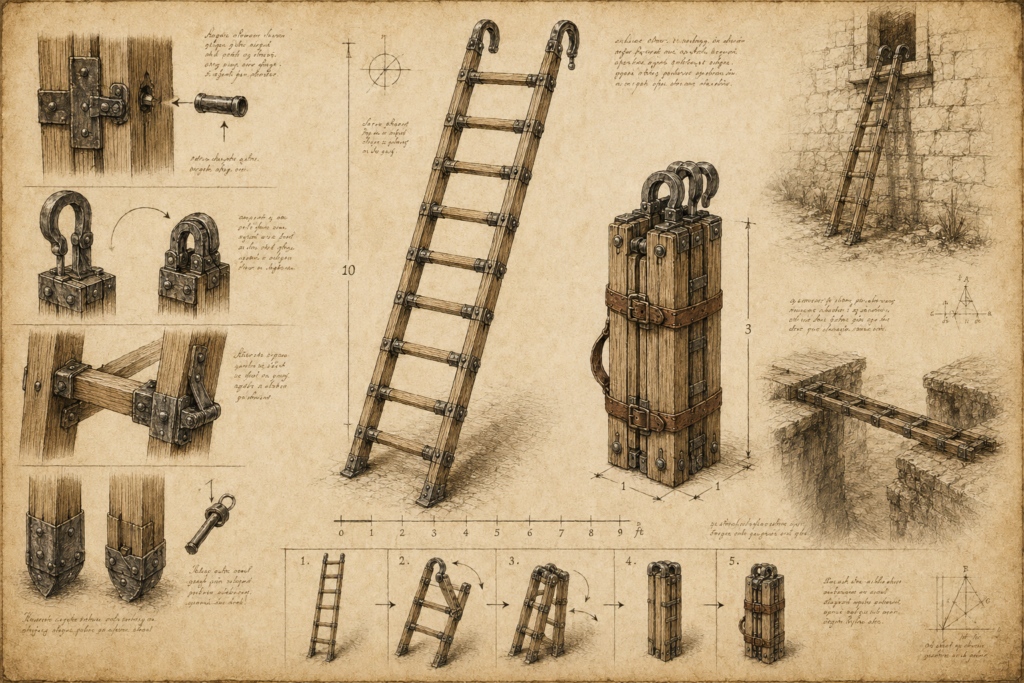
Overview
A Folding Ladder is a portable 10-foot ladder built with hinged rungs, a folding pole, and a collapsible hook, allowing it to be packed down into a compact bundle. Unlike an ordinary ladder, it is designed for travel through dungeons, alleys, ship holds, mountain paths, ruined towers, and cramped underground passages.
When unfolded, it functions like a normal 10-foot ladder. When folded, it forms a 3-foot-by-1-foot-by-1-foot bundle that can be strapped to a pack frame, mule, cart, saddle, or expedition pole.
The Folding Ladder is not magical, but it often solves the kind of practical problem that adventurers otherwise waste spells, ropes, noise, or time trying to overcome. It is most useful when the party needs to reach a ledge, climb to a window, cross a narrow gap, descend into a pit, bridge a collapsed floor, scale a low wall, or create a quick route for heavily armored companions.
Physical Description
A Folding Ladder is usually made from seasoned hardwood, iron hinges, locking pins, reinforced rung joints, and a hooked upper section. Better examples include leather-wrapped grip points, quiet hinge collars, and iron-shod feet that help the ladder hold its position on stone or packed earth.
Folded, the ladder looks like a dense wooden-and-iron frame bound with straps. Its rungs tuck inward, the pole sections collapse against one another, and the hook folds flat against the body of the frame. Unfolded, the locking joints stiffen the structure into a usable 10-foot ladder.
A good Folding Ladder should look practical rather than elegant: a tool for rooftops, ravines, crypt shafts, siege walls, orchard work, ship repair, and ruin exploration.
Why This Item Matters
The Folding Ladder matters because it gives adventurers a mundane answer to vertical problems.
A rope can be cut, a climb can be failed, and a spell slot can be too precious to spend on a ten-foot obstacle. A Folding Ladder lets a careful party reach places that are just out of reach without turning every ledge, balcony, or pit into a major encounter.
It is especially valuable for groups that include heavily armored characters, injured allies, pack animals, hirelings, prisoners, children, or rescued captives. Not everyone can climb a rope under pressure. A ladder turns a risky climb into a manageable route.
Practical Limits
A Folding Ladder follows the ordinary limits of a 10-foot ladder. It must be unfolded, placed, braced, hooked, or otherwise supported before it can be climbed, and it cannot stand freely in open space.
It cannot reach higher than its length, bridge a gap wider than its length, or safely support unreasonable weight. If it is used as a bridge, ramp, stretcher, barricade, or other improvised tool, the DM or GM decides whether the use is practical and whether a check is required.
The Folding Ladder helps adventurers climb, cross, reach, and descend. It does not remove all risk from climbing.
Folding Ladder 5.5e / 2024
Folding Ladder Pathfinder 1e / 3.5e
Folding Ladder 3.0
Folding Ladder 5.5e / 2024
Adventuring Gear
Cost: 5 gp
Weight: 20 lb.
Length: 10 feet unfolded
Folded Size: 3 feet by 1 foot by 1 foot
A Folding Ladder is a hinged 10-foot ladder that can be collapsed into a compact bundle. Its hook, pole, and rungs fold inward, allowing it to be carried more easily than a rigid ladder.
As an Action, a creature can fold or unfold the ladder, provided it has both hands free and enough room to handle it. Once unfolded, the ladder functions as a normal 10-foot ladder.
It follows the ordinary limits of a ladder: it must be placed, hooked, braced, or supported before it can be climbed, and it cannot stand freely in open space.
The ladder can be used to reach a ledge, climb to a window, cross a narrow gap, descend into a pit, bridge a broken floor, or provide a climbing aid where a ladder would reasonably help.
At the DM’s discretion, using the ladder in poor conditions may require a DC 10 Strength or Dexterity check. Examples include placing it on mud, ice, loose rubble, wet stone, a moving ship, or during combat. On a failed check, the ladder slips, shifts, clatters, or must be repositioned. It does not normally break unless it is overloaded, sabotaged, badly damaged, or used in a clearly unsafe way.
Folding Ladder Pathfinder 1e / 3.5e
Adventuring Gear
Cost: 5 gp
Weight: 20 lb.
Length: 10 ft. unfolded
Folded Size: 3 ft. by 1 ft. by 1 ft.
The hook, pole, and rungs of this 10-foot ladder are hinged, allowing it to fold into a compact 3-foot-by-1-foot-by-1-foot bundle.
Folding or unfolding a Folding Ladder is a standard action. Once unfolded, it functions as a normal 10-foot ladder.
It follows the ordinary limits of a ladder: it must be placed, hooked, braced, or supported before it can be climbed, and it cannot stand freely in open space.
The ladder may be used to climb short walls, reach trapdoors, descend pits, access windows, bridge narrow gaps, brace against ledges, or provide a practical climbing aid in ruins, dungeons, alleys, mines, ships, and siege works.
If it is used on unstable ground, slick stone, loose rubble, a moving surface, or under combat pressure, the GM may call for an appropriate Climb, Balance, Strength, or Dexterity-based check to avoid slipping, noise, delay, or mishap.
Folding Ladder 3.0
The hook, pole, and rungs of this 10-foot ladder are hinged, allowing you to fold it into a 3-foot-by-1-foot-by-1-foot bundle. Folding or unfolding it is a standard action.
Adventuring Use
A Folding Ladder earns its place in a pack when its compact form matters. A normal ladder is awkward to carry through a dungeon, forest, alley, mine, sewer, ship, or mountain pass; this one can be folded, strapped down, and brought out only when the route demands it.
In play, it suits short, visible access problems: reaching a window, climbing to a ledge, descending into a shallow pit, or helping an armored companion manage a climb that would otherwise be noisy or difficult. It can also bridge a narrow break in a floor, trench, or passage if the span is short enough and the ladder can be properly supported.
It is not a universal climbing solution. It is a practical tool for obstacles that are close, clear, and within ten feet.
Risks and Limits
A Folding Ladder has hinges, pins, straps, and locking joints, making it more complex than a plain wooden ladder. Mud, rust, grit, slime, or bent metalwork can make it stiff, noisy, or unsafe. On slick stone, loose rubble, wet planks, ice, or a moving surface, it may slip unless braced, hooked, wedged, or held.
Its weakest points are its moving parts. A broken pin, cracked rung, cut strap, or bent hinge can make the ladder unreliable. In stealth scenes, its main drawback is noise: unfolding it, setting it against stone, or dragging it into place may alert nearby creatures.
Value in the World
A Folding Ladder costs more than a plain ladder because it requires careful carpentry and metal fittings. It is the work of wagonwrights, shipwrights, siege carpenters, miners’ suppliers, roofers’ guilds, and military engineers.
It is common enough to be practical, but unusual enough to attract attention in the wrong place. A roofer, builder, or shipwright carrying one is unremarkable. A cloaked figure carrying one through a noble district after dark is not.
Common Variants
- Hooked Folding Ladder: A reinforced hook helps the ladder catch on ledges, windowsills, battlements, branches, ship rails, or pit rims.
- Silent Folding Ladder: Leather-wrapped joints and padded pins reduce rattling. This version is favored by scouts, burglars, spies, and night watchmen.
- Reinforced Folding Ladder: Heavier hinges and thicker rungs make the ladder better suited to armored climbers, repeated use, and rough expedition work.
- Shipboard Folding Ladder: Treated against damp and salt, with stronger hooks or wider feet for docks, decks, rigging, and harbor walls.
- Siege Folding Ladder: A rough military version built for speed rather than elegance, usually carried with other assault tools.
Adventure Hooks
- The Upper Window: A locked room has no stair, but scrape marks below the second-floor window show where a ladder has been used more than once.
- The Missing Ladders: Several Folding Ladders vanish from a city watch storehouse shortly before a string of upper-floor burglaries.
- The Broken Descent: A damaged Folding Ladder lies beside a dungeon pit, its lowest hinge twisted as if something pulled it down from below.
- The Rooftop Route: A messenger network, thieves’ guild, or rebel cell uses Folding Ladders to move between upper stories without touching the streets.
Keep this reference growing
If this page helped with your reading or game, you can support its upkeep or explore the curated books.
Explore the Bookshop — epics, classics and stories behind imagined worlds.