
 Buy me a coffee
Bloodblock – Alchemical Wound-Sealant
Bloodblock is a sticky alchemical wound-sealant used when a cut must stop bleeding now, not after the battle is over.
Overview
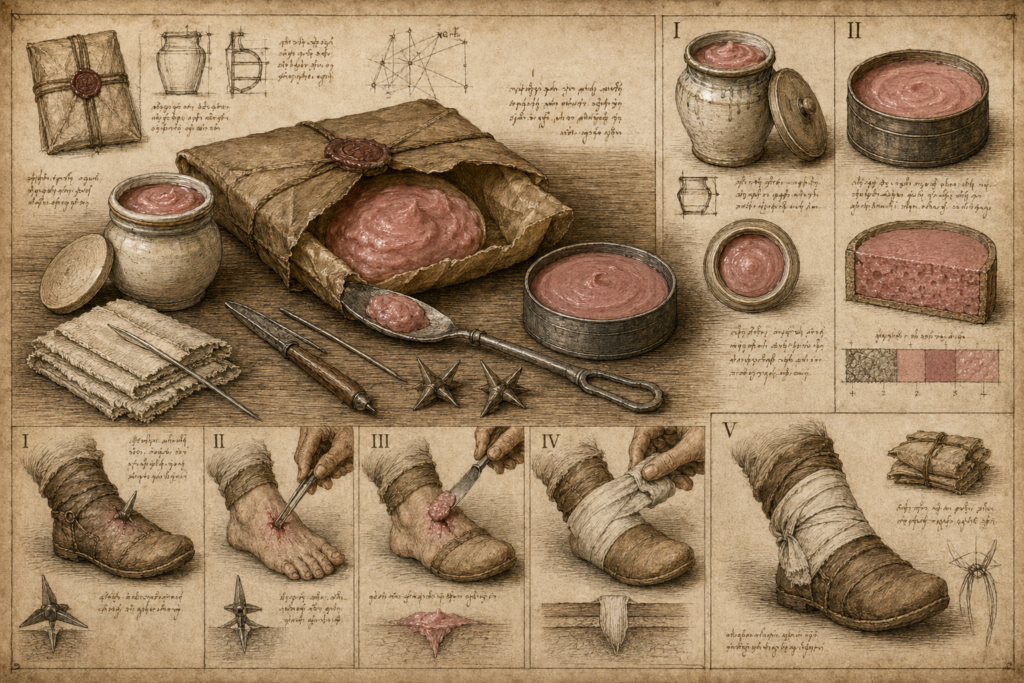
Bloodblock is battlefield alchemy for open wounds, torn flesh, and injuries that refuse to clot. This gooey pinkish substance is pressed into cuts, punctures, and jagged wounds to help staunch bleeding and make emergency treatment more reliable.
Adventurers carry Bloodblock because it solves a specific problem: someone is bleeding, the healer has only moments, and ordinary pressure may not be enough. It is especially useful after caltrops, barbed traps, broken glass, blades, hooks, animal bites, or battlefield debris.
Bloodblock is not a healing potion. It does not close wounds by magic, restore lost strength, cure disease, neutralise poison, or replace proper medical care. It buys time, improves treatment, and helps a wounded creature survive long enough for better help to matter.
Physical Description
Bloodblock is a thick pink paste stored in a waxed packet, stoppered ceramic vial, sealed bladder, or small tin. Fresh Bloodblock is tacky, pliable, and faintly medicinal, with a sharp mineral smell. When pressed into a wound, it darkens as it absorbs blood and binds against torn flesh, cloth fibres, grit, and broken skin.
A good dose spreads under pressure but stays where it is placed. Old or poorly made Bloodblock becomes grainy, rubbery, or dry around the edges. Counterfeit versions may look convincing until they crack, slide loose, or seal dirt inside the wound.
Why Bloodblock Matters
Bloodblock makes mundane healing matter in play.
It gives prepared characters a reason to carry medical supplies beyond a generic healer’s kit. It also makes traps, caltrops, battlefield injuries, and bleeding wounds feel more concrete without turning every injury into a magical problem.
Bloodblock is strongest in campaigns where healing magic is scarce, expensive, delayed, or socially restricted. It belongs in surgeon’s bags, military stores, dungeon packs, caravan medicine chests, and the emergency kits of people who expect blades and spikes to be part of the road.
Bloodblock 5.5e / 2024
Bloodblock Pathfinder 1e / 3.5e
Bloodblock 5.5e / 2024
Adventuring Gear, Alchemical Remedy
Cost: 25 gp per dose
Weight: Negligible
Use: One dose is expended when applied
Application Time: Usually 1 action, or as part of a longer treatment
Bloodblock is a sticky alchemical wound-sealant used to help staunch bleeding and support emergency wound care.
When you use a dose of Bloodblock as part of a Wisdom (Medicine) check to stabilize a creature, treat a bleeding wound, dress a caltrop-like injury, or provide urgent first aid, you gain a +5 bonus to that check.
A dose of Bloodblock can also end one ongoing nonmagical bleeding effect, provided the bleeding could reasonably be treated by pressure, packing, binding, or clotting. Applying Bloodblock in this way requires direct access to the wound and expends the dose.
When Bloodblock is used during a longer treatment of serious wounds, it counts as one use of a healer’s kit and grants the +5 bonus above to the relevant Medicine check.
Bloodblock does not restore hit points unless the rule being used for treatment already allows a Medicine check, healer’s kit use, rest activity, or similar procedure to restore hit points.
5.5e Balance Note
Bloodblock should apply to bleeding, first aid, wound dressing, caltrop injuries, and similar physical trauma. It should not help with disease, poison, curses, exhaustion, burns, broken bones, lost limbs, or magical corruption unless the DM deliberately expands its use.
Bloodblock Pathfinder 1e / 3.5e
Alchemical Tool
Price: 25 gp
Weight: —
Craft: Craft (alchemy) DC 25
This gooey, pinkish alchemical substance helps treat wounds. Using a dose of Bloodblock grants a +5 alchemical bonus on Heal checks made to provide first aid, treat wounds made by caltrops or similar objects, or treat deadly wounds.
A dose of Bloodblock ends a bleed effect as if the user had succeeded at a DC 15 Heal check.
When Bloodblock is used to treat deadly wounds, one dose counts as one use of a healer’s kit and grants the +5 alchemical bonus above.
Rules Clarification
Bloodblock improves wound treatment. It does not create magical healing, remove disease, neutralise poison, or replace the normal requirements for treating deadly wounds unless the rules specifically say otherwise.
Original Source : Advanced Player’s Guide
How Bloodblock Is Used
Bloodblock belongs in scenes where injury is immediate, messy, and practical.
A scout tears open a calf on hidden caltrops and needs the wound packed before pursuit continues. A spearman is dragged behind a shield wall while a field surgeon presses Bloodblock into the cut. A thief keeps a dose hidden in a sleeve because rooftop escapes often end with torn hands, slashed palms, and broken glass.
The item is most interesting when time matters. In a calm room with clean tools, it is useful medicine. In a collapsing tunnel, moonless battlefield, trap-filled corridor, or burning street, it becomes a decision.
Failure, Risk, and Misuse
Bloodblock can stop bleeding, but it does not make a wound clean.
If applied carelessly, it may seal dirt, cloth fibres, rust, venom residue, or splinters inside the injury. A hurried application may save a life now and create a worse wound later. This makes Bloodblock useful in gritty campaigns where field medicine has consequences.
Poor-quality Bloodblock may dry out, crack under movement, fail to adhere, or burn badly enough that the patient struggles during treatment. Counterfeit Bloodblock is not a standard trade variant; it is a fraud. It may be thinned, spoiled, badly sealed, or bulked out with cheap binding agents, then sold into military stores, caravan supplies, or desperate adventuring markets.
Value in the World
Bloodblock is valuable because it is small, portable, and useful before magic enters the conversation.
Armies buy it for scouts, sappers, shield-bearers, and battlefield surgeons. City watches keep it near caltrop stores and gatehouses. Caravan masters issue it to guards before crossing dangerous country. Alchemists sell it to hunters, duelists, delvers, gladiatorial handlers, and anyone who works near hooks, blades, spikes, traps, or dangerous animals.
At 25 gp per dose, Bloodblock is not common village medicine. Most ordinary people encounter it only through armies, noble households, wealthy guilds, temples, or professional adventurers.
Trade, Craft, and Common Forms
Bloodblock requires trained alchemical preparation. A proper dose must clot, bind, and adhere without turning hard in storage or losing strength when exposed to cold, damp, or rough travel.
| Form | Cost | Description |
|---|---|---|
| Field Packet | 25 gp | A standard single dose sealed in waxed cloth, leather, or a small tin. Soldiers, scouts, caravan guards, and adventurers carry this form because it survives travel and can be opened quickly. |
| Chirurgeon’s Pot | 100 gp | A glazed container holding 4 doses. This is the cleaner professional form used with linen, washing, stitching needles, and formal wound care in infirmaries, temples, noble households, and military medical tents. |
| Caltrop Salve | 30 gp | A thicker specialist dose used for puncture wounds caused by caltrops, boot-spikes, broken glass, street traps, and similar hazards. It uses the same rules as Bloodblock unless the GM decides otherwise. |
These forms do not need separate rules. They show how Bloodblock is stored, who buys it, and where it appears in the world.
Counterfeit Bloodblock
Because Bloodblock is expensive and often purchased in bulk, counterfeit versions appear wherever corrupt suppliers can profit from fear, war, or scarcity.
Fake Bloodblock may look convincing in the packet but fail under pressure. It may crack as the patient moves, slide loose in rain or sweat, sting badly, or fail to bind the wound at all. Counterfeit Bloodblock is best used as a discovery, scandal, or consequence rather than as a normal item for sale.
Using Bloodblock in Your Game
Use Bloodblock when you want injury care to have texture without slowing the game.
It works well as loot in surgeon’s bags, military stores, thieves’ caches, monster-hunter packs, abandoned battlefield wagons, trap-makers’ workshops, and caravan medicine chests. It also gives nonmagical healers and prepared adventurers a useful answer to bleeding injuries.
Bloodblock is especially useful in low-magic campaigns, military expeditions, dungeon crawls with traps, urban knife-fights, survival games, and campaigns where healer’s kits matter.
Adventure and Worldbuilding Hooks
The Surgeon’s Counterfeit:
A city watch has been issued fake Bloodblock that fails during riots and street fighting. Someone made money replacing real medical stores with spoiled paste and cheap binding agents.
The Red Cart:
A battlefield surgeon’s cart vanished after a massacre. It contains Bloodblock, clean tools, patient records, and proof that some of the dead were mutilated after the fighting ended.
Caltrops in the Pilgrim Road:
Travellers arrive lame and bleeding after crossing a road seeded with hidden spikes. The local alchemist is suddenly selling Caltrop Salve at triple price.
Historical Context
Bloodblock fits the practical high-medieval history of wound dressing: pressure, packing, binding, salves, lint, linen, stitching, cautery, and field treatment. In a campaign set around armies, roads, castles, cities, and battlefield surgery, it should feel like an alchemical refinement of practical wound care rather than modern medicine.
It belongs beside bandages, vinegar-washed cloth, cautery irons, stitching needles, poultices, surgeon’s tools, and the hard-learned craft of treating wounds before infection, shock, or blood loss finishes what the weapon began.
For historical context on medieval wound treatment, including the work of doctors and barber-surgeons in treating wounds and using substances such as egg whites or wine to seal or clean injuries, see Medieval Medicine from the University of Aberdeen.