
Spiked Barding – Mount Equipment for Warhorses and Shock Cavalry
Spiked Barding – Mount Equipment for Warhorses and Shock Cavalry
Spiked barding makes the war mount part of the weapon.
Overview
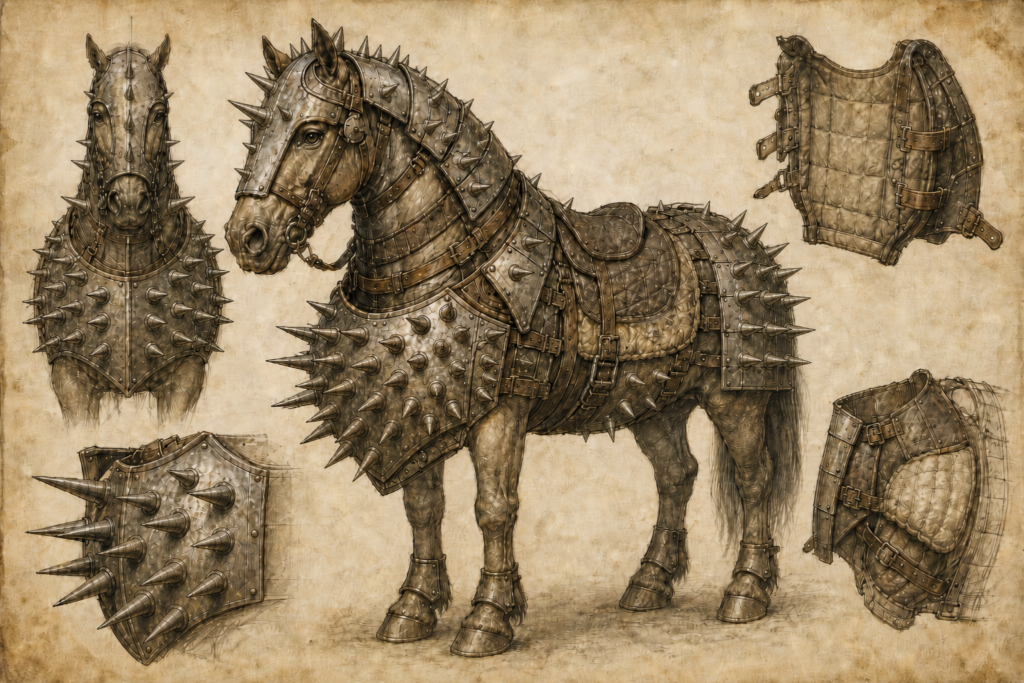
Spiked barding is armoured mount gear fitted with forward-facing iron or steel spikes. They are fixed across the chest, shoulders, or reinforced breastpiece, where the animal’s weight strikes hardest during a charge.
This is not decoration. Spiked barding belongs to shock cavalry, brutal mercenary companies, goblin wolf-riders, boar-riding clans, infernal cavalry, and lords who want fear to arrive before their banners. It is made for the ugly work of riding enemies down.
A horse in ordinary barding is protected. A horse in spiked barding is a threat. The armour no longer says merely, “This mount may survive the battle.” It says, “This mount is part of the killing.”
Physical Description
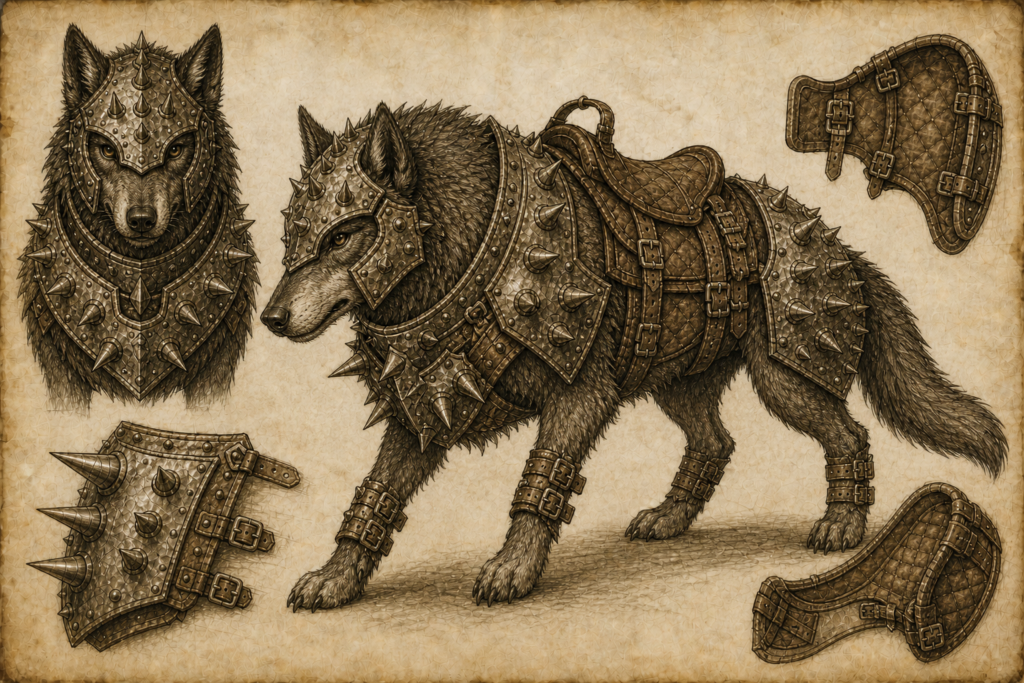
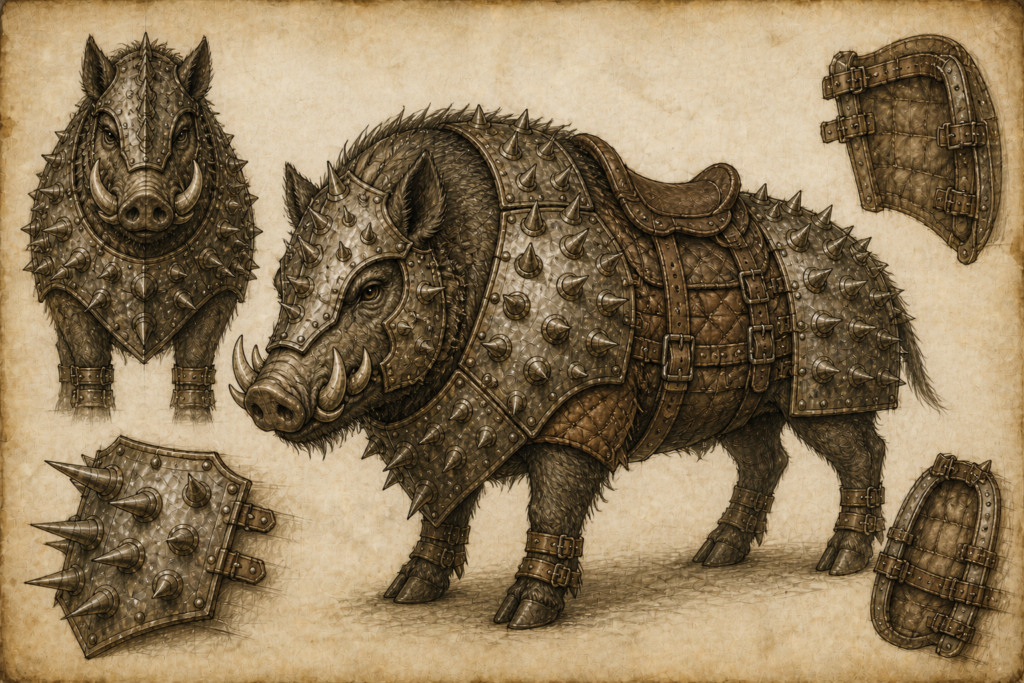
Spiked barding is usually added to existing barding rather than replacing it. The spikes are mounted on the peytral, chest plate, reinforced breastband, or heavy leather fronting. On horses, they often form a hard row or brutal fan across the chest. On boars, bulls, worgs, or stranger mounts, they follow the shoulders, neck, or forward harness, where impact is most likely.
The spikes must be broad-based and securely riveted. Cheap work bends, tears loose, bruises the mount, or catches where it should slide clear. Proper spiked barding has padded backing, reinforced straps, and enough clearance that the animal can turn, lower its head, kneel, or rise without cutting itself.
After battle, the spikes may hold mud, blood, torn cloth, broken shield-rims, and strips of harness leather. Many commanders consider that part of the point.
Why This Item Matters
Spiked barding changes the meaning of mounted armour. It turns protection into warning.
On the battlefield, it rewards riders who already use trained war mounts for charges, tramples, overruns, and intimidation. Off the battlefield, it creates trouble by existing. A spike-covered warhorse at a town gate, ferry, market, shrine, or noble court is not merely armed. It is fitted to maim people by collision.
Used well, spiked barding gives mounted combat more weight. It makes the mount visible as a combatant, not a platform. It tells players, guards, grooms, enemies, and bystanders what kind of violence is being prepared.
Spiked Barding 5.5e / 2024
Spiked Barding, Pathfinder / 3.5e
Spiked Barding 3.0
Spiked Barding 5.5e / 2024
Adventuring Gear, Mount Equipment
Cost: Cost of the base barding + 75 gp
Weight: Base barding + 20 lb.
Requirement: A war-trained mount of Large size or larger
Spiked barding can be added to barding worn by a war-trained mount. The spikes are fixed to the forward body of the armour so the mount can drive them into a creature during a forceful charge, trample, or overrun.
When the mount moves at least 20 feet straight toward a creature and hits that creature with a charge, trample, gore, hoof, tusk, or similar bodily impact attack, the target takes an extra 2d4 piercing damage.
A creature can take this extra damage only once per turn from the same mount.
Spiked barding does not grant the mount a new attack, a trample, or the ability to knock creatures prone. It only adds damage when the mount already has a suitable charge or impact attack.
Critical Hits
If the attack that triggers the spiked barding is a critical hit, the extra 2d4 piercing damage is also doubled.
Handling Drawback
Spiked barding is awkward outside battle. The rider has disadvantage on checks made to guide the mount safely through dense crowds, narrow interiors, packed stables, ceremonial spaces, or other places where the spikes could catch, injure bystanders, or frighten animals.
Social Consequences
A mount wearing spiked barding is visibly prepared for violence. Town gates, inns, temples, markets, ferries, and noble courts may refuse entry unless the rider has military authority, removes the barding, or pays for special handling.
Spiked Barding, Pathfinder / 3.5e
Cost: Cost of base barding + 75 gp
Weight: Base barding + 20 lb.
Type: Mount equipment
Spiked barding adds long spikes to the chest and forward body of a mount’s barding. The rider must have the Trample feat to take full advantage of the spikes.
When the mount successfully tramples an enemy, the barding spikes deal an additional 2d4 points of piercing damage to the target. This spike damage has a ×2 critical multiplier if the table is using the original item’s critical rule.
The mount may still make a single hoof attack as allowed by the original rules.
If the rider has the Spirited Charge feat and the mounted attack qualifies for that feat, the damage from the barding spikes is doubled as part of the mounted charge.
Spiked barding does not grant a mount the ability to trample. It only improves a trample or qualifying mounted charge the rider can already execute.
Spiked Barding 3.0
Ultimate Equipment Guide II
Author Greg Lynch, J. C. Alvarez
Publisher Mongoose Publishing
Publish date 2005
Spiked barding boasts a collection of long spikes on the chest of the mount, enabling it to do extra damage on any successful Trample. Upon trampling an enemy, the mount does an additional 2d4 (x2 critical) damage to the target. The mount may still make a single hoof attack. If the rider has the Spirited charge feat, he may double the damage of the barding spikes. The rider must have the Trample feat to take advantage of the barding spikes.
Barding, Spiked: Cost of barding +75 gp; +20 lb.
How It Is Used
Spiked barding is used at the moment of impact. The rider drives the mount into a vulnerable enemy, broken shield wall, fleeing line, exposed infantryman, kneeling foe, or creature already unable to get clear.
The equipment is poor for scouting, polite travel, street patrols, narrow woodland paths, crowded roads, and ceremonial riding. It shines when the battlefield gives the mount room to build speed and the rider has the nerve to commit.
Common users include shock cavalry, raiding clans, goblin and hobgoblin outriders, boar-riders, infernal cavalry, arena stables, and rulers who want fear to arrive before their banner does.
Failure, Risk, and Misuse
Spiked barding is dangerous even when no one is fighting.
A mount wearing it can injure grooms, prisoners, servants, bystanders, other animals, or the rider’s allies in a crush. In a crowded stable, market, or narrow gatehouse, the spikes become a liability.
Badly fitted spikes may twist under impact, tearing the barding, bruising the mount, or wrenching straps loose. A serious failure during a charge can leave the mount panicked, wounded, or tangled with a shield, corpse, wagon frame, barricade, or gate.
A DM does not need to track every minor inconvenience. The drawback matters when space is tight, tempers are high, or the rider tries to bring battlefield equipment somewhere it does not belong.
Value in the World
Spiked barding is not especially expensive compared to full barding, but it carries a heavy social cost. It marks the rider as someone who expects to ride people down.
In noble courts, it may be treated as vulgar, threatening, or unlawful. Among raiders, it may be admired. In cities, it may be regulated. In mercenary companies, it can become a badge of the first charge, reserved for riders trusted to break the enemy line.
A captured set can also serve as evidence. If a village claims it was attacked by ordinary riders, but the dead show deep forward-driving puncture wounds, someone used spiked barding.
Trade, Craft, and Common Variants
Spiked barding is usually made as a modification to existing barding rather than as a separate full suit. The armourer reinforces the chest, breastband, or forward plates, then rivets the spikes where the mount’s weight will strike during a charge.
Most versions differ by mount rather than by rules. A destrier needs broad chest spikes fixed to heavy barding. A boar, bull, or worg needs shorter spikes placed around the shoulders and forward harness, where they will not injure the animal as it lowers its head or turns.
Poor spiked barding is dangerous. Badly placed spikes can tear free, catch on reins or harness, bruise the mount, or make the animal difficult to stable. Good work is less dramatic-looking than cheap work: fewer spikes, stronger rivets, better padding, and enough clearance for the mount to move naturally.
Spiked barding normally uses the same rules regardless of appearance. Its differences are practical: what creature wears it, how well it is fitted, and whether it was made for battlefield use, arena spectacle, or intimidation.
Using Spiked Barding in Your Game
Spiked barding works best when it remains tied to mounted impact. It should improve a charge, trample, overrun, or similar bodily collision. It should not become automatic extra damage on every mounted attack.
The item is useful when the mount has room to build speed and the rider can force enemies to hold ground or scatter. It becomes awkward in forests, alleys, markets, narrow gates, ship decks, crowded stables, and any place where the mount cannot safely drive forward.
The simplest table rule is this: if the mount is not using its body weight to smash into the target, the spikes do not matter.
Outside combat, spiked barding should draw attention. Guards may refuse it at a gate. Stablehands may demand extra pay. Inns may not want the animal in their yard. Nobles may read it as a threat. That is enough. The item does not need constant penalties, but it should feel like visible battlefield cruelty, not ordinary travel gear.
Adventure and Worldbuilding Hooks
The False Trample:
A village elder is found crushed in a lane after a noble’s warhorse breaks loose from its stable. The hoofmarks are real, but the killing wounds came from chest-spikes fitted after the animal was supposedly locked away. Someone wanted the death to look like an accident caused by an unruly mount.
The Armourer’s Pattern:
Three raids in different valleys leave the same deep forward-driving wounds in shieldmen, gates, and livestock. No banner is seen, and the riders change horses after every attack, but the spike pattern is identical. The armourer who made the barding may know the raiders better than any survivor does.
No Spikes at the Gate:
A city bans spiked barding after a groom is torn open in a crowded stable yard. The order looks like a safety law, but it also prevents cavalry houses from bringing their war mounts inside the walls. One noble house calls it an insult. Another quietly supports it because they know a coup was planned around mounted force in the streets.
Historical Context
Spiked barding is a fantasy exaggeration, but barding itself has a strong historical basis. Medieval and early Renaissance horse armour protected war mounts with pieces such as the peytral for the chest, the crinet for the neck, and the chanfron or shaffron for the head.
For historical background on horse armour, see the Metropolitan Museum of Art’s essay Horse Armor in Europe, which discusses surviving bards and the different forms of protection used for armoured horses.